
Key takeaways
- Compare the best toy pianos for toddlers with sturdy key picks, demo songs, and volume controls that keep first music play fun for small hands at home.
A toy piano is usually the first real instrument a toddler meets, and the five picks in this guide cover the three shapes the shelf actually takes. Two are touch-surface pianos: flat wooden keyboards with no moving keys at all, where a fingertip tap on the printed keys makes the note, which is exactly right for babies who can pat but cannot yet press. Two are acoustic pianos with real keys and hammers, the kind that make their sound with no batteries and no speaker, sized down from the upright and baby grand shapes a child sees in books. The last is an electronic grand with a stool, for the preschooler who wants the full sit-down performance. One boundary is worth stating up front: this guide is about standalone pianos a child plays at a table or on the floor. It is not about the kick piano built into an activity gym, the piano station inside an activity center, or the key panel on a push walker — those are fine toys, but the piano is a guest in them, not the product itself. Every pick below is the piano first and everything else second.
Sound level deserves a paragraph of its own, because a toddler piano is played inches from a small pair of ears, often with the player’s face right over the keys. Prefer a pick with a volume control or a modest fixed output, and be wary of any electronic toy that only plays loud. The two touch pianos here both carry a low/high volume setting an adult can choose before handing the toy over. The two acoustic pianos sidestep the question entirely: their volume is set by how hard small fingers strike, and neither can blast. The electronic grand has no published volume control, which is part of why it sits last and suits an older preschooler playing across a stool rather than a baby holding a speaker to one ear. On the battery-powered picks, check that the battery door is held shut with a screw before the first session, and treat battery changes as an adult job, since loose cells are a swallowing hazard.
Disclosure: As an Amazon Associate, I earn from qualifying purchases. Product details were verified at the time of writing.
How to Choose a Toy Piano
Start with the maker age line, because it tracks hand strength. A baby of 6 to 12 months pats, slaps, and leans on a keyboard; she cannot aim one finger at one narrow key. Touch-surface pianos answer any flat-handed pat with a clean note, so the youngest players get music instead of silence or a stuck key. Real keys ask for a deliberate press, which is why the acoustic and grand picks here all start at 3 years. Buying a keyed piano for a young toddler usually means an adult pressing the keys while the toddler watches, and the toy gets shelved until hands catch up.
Decide whether you want electronics in the instrument at all. An acoustic toy piano makes sound the way a real one does in miniature: a key moves a hammer, the hammer strikes, and the note rings at the volume of the strike. There is nothing to charge, nothing to replace, and nothing to switch off. An electronic piano trades that simplicity for help: demo songs to copy, color-coded cards that turn notes into a follow-the-dots game, extra voices, and a volume switch. Neither family is better in the abstract; the question is whether your household wants a quiet, self-contained instrument or a guided music toy with batteries to feed.
Count keys, then check what the keys teach. Twenty-five keys span two full octaves, enough for the simple songs in a beginner songbook and for a child to hear high and low as real places on the keyboard. The touch pianos print fewer, larger note areas, which suits babies. Whichever size you choose, look for a learning aid that connects the keyboard to a song: a color-coded key chart, printed music cards, or a songbook whose notes match colors or letters on the keys. That bridge from random banging to a first recognizable tune is the moment the toy starts teaching.
Check the sound controls before the song list. A long list of demo songs matters less than a low volume setting you can reach in one move. On electronic picks, look for a volume switch or buttons, an off switch that truly silences the toy, and ideally an automatic sleep mode so a forgotten piano does not chirp from the toy box at midnight. On acoustic picks, the control is placement: a rug under the piano softens the ring for nap-adjacent play.
Match the footprint to the room. The touch pianos are flat boards that slide onto a shelf and travel in a tote. The acoustic upright is a solid piece of wooden furniture that weighs over eleven pounds and will live where you put it. The grand needs floor space for the piano, the stool, and the small performer, plus clearance for a lid that opens. Measure the corner before you fall for the silhouette.
The 5 Best Toy Pianos
1. Baby Einstein Cal’s First Melodies Magic Touch Piano

This is the baby end of the list: a compact wooden piano from Kids2’s Baby Einstein line, fronted by Cal the Caterpillar and built around the same Magic Touch idea as its bigger sibling below. There are no keys to press down. The printed keyboard on the wooden surface answers the lightest tap, so a 6-month-old who can only pat still gets a clean note every time, and the cause-and-effect lesson lands in the first session. Four sound voices — piano, vibraphone, dog, and cat — keep the game fresh, and the silly animal voices do real work: they give a baby a reason to tap again and again long after a single piano tone would fade into the background. Three double-sided, color-coded music cards teach six familiar melodies as a follow-the-dots game, and pressing the blue Baby Einstein button plays the tunes straight through for listening. A low/high volume switch sits where an adult can set it before handing the piano over, which is exactly where this guide wants it. Honest note on the family: this piano and the next pick are relatives, both Baby Einstein Magic Touch models from Kids2. This one is the smaller, simpler first piano; the next is the fuller keyboard for a child a few months further along.
Specs
- Brand: Baby Einstein (Kids2)
- Model: 12577
- Type: Touch-surface wooden piano, no moving keys
- Sound voices: 4 (piano, vibraphone, dog, cat)
- Music cards: 3 double-sided, color-coded, covering 6 melodies
- Volume: Low/high switch
- Batteries: 3 AA (not included)
- Age range: 6 months and up
- Cleaning: Wipe clean
2. Baby Einstein and Hape Magic Touch Piano
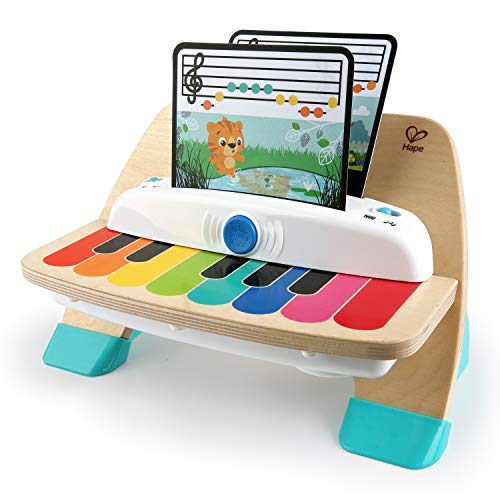
The full-size Magic Touch piano, made with Hape, stretches the touch idea across a 25-key printed keyboard on a wooden body, and it is the strongest pick here for the 6-month-to-3-year span. Because the surface responds to touch rather than pressure, a baby can crawl over it, pat it with a whole hand, or drum it with a soft toy and still make music, while an older toddler can aim at single notes and follow the three included sheet music cards, matching the color on the card to the color on the key. Six built-in songs give the follow-along game its material. Volume buttons let an adult set the output to low for morning play or high for a living-room concert, and the speaker stays clear at both settings. Two honest limits belong in the open. The black keys on the printed keyboard are decorative rather than playable, so this is a white-key instrument for first songs, not a true miniature of a full keyboard. And like its smaller sibling, it runs on batteries an adult must load and replace. Within those limits, it is the rare baby instrument that still has something to teach a 3-year-old.
Specs
- Brand: Baby Einstein with Hape
- Model: 11649
- Type: Touch-surface wooden piano, no moving keys
- Keys: 25 touch keys (printed keyboard)
- Songs: 6 built-in songs, 3 sheet music cards included
- Volume: Low/high control buttons
- Batteries: 3 AA (not included)
- Age range: 6 to 36 months
- Weight: About 1.7 lb
3. Schoenhut My First Piano II, 25 Keys

Schoenhut has made toy pianos since the 1800s, and the My First Piano II is its classic first instrument: a wooden baby grand shape with 25 real keys, each one driving a small hammer that strikes a tuned steel rod, which is where the bright, chime-like tone comes from. Nothing is amplified and nothing needs batteries; the note is as loud as the press, and a gentle player gets a gentle sound, a useful governor at toddler ear height. The key width is deliberately proportioned for small fingers learning proper placement, so habits formed here carry onto a full-size keyboard later. Schoenhut’s Learn-to-Play system comes in the box as a songbook with a color-coded key chart, turning the keyboard into a first reading exercise. The legs attach at setup, and the whole piano is light and shallow enough — about eleven and a half inches deep — to live on a low table as easily as on the floor. This is the pick for a household that wants an instrument rather than a music toy, and can accept that an acoustic piano offers no demo songs and no volume switch, because it needs neither.
Specs
- Brand: Schoenhut
- Model: 2522P
- Type: Acoustic baby grand, hammer-and-rod action
- Keys: 25 real keys
- Learning aid: Songbook with Schoenhut’s color-coded Learn-to-Play key chart
- Batteries: None, fully acoustic
- Age range: 36 months and up
- Dimensions: 15.75 x 9.5 x 11.5 in
- Assembly: Legs attach at setup
4. Melissa & Doug Learn-to-Play Piano

Melissa & Doug’s upright takes the same acoustic idea and stands it up: 25 keys across two full octaves in a solid wood cabinet, painted in bright colors, with a color-coded key chart running along the keys themselves. The illustrated songbook teaches nine favorite tunes by matching the color on the page to the color on the key, so a preschooler can play a recognizable song in the first sitting without reading a note of standard notation. At eleven and a half pounds, this is furniture as much as toy — it stays where it is placed, shrugs off daily pounding, and asks for nothing: no batteries, no charging, no settings. That weight cuts both ways, and the honest framing is that a toddler cannot carry this piano from room to room the way she can the touch boards above. What she gets instead is the most piano-like object on this list, an upright with a music desk and a key cover shape she will recognize from every picture book. For a playroom with a fixed music corner, it is the anchor pick.
Specs
- Brand: Melissa & Doug
- Model: 1314
- Type: Acoustic upright piano
- Keys: 25, spanning two full octaves
- Learning aid: Illustrated songbook with 9 tunes, color-coded key chart
- Batteries: None, fully acoustic
- Age range: 3 years and up
- Weight: 11.5 lb
- Construction: Solid wood
5. Hape Happy Grand Piano, Pink

The finale pick is the full performance: a wooden grand piano shape with 30 electronic keys, a matching stool, a music rest, and a lid that opens and holds its position on a safety support designed to stop at any angle rather than slam. The tone was developed with musicians and piano teachers to sit close to a real piano’s voice, and a musical scale printed at the keys plus the included music book give a preschooler the same follow-the-guide path as the acoustic picks. An automatic power-saving mode switches the piano off after two idle minutes, which saves both batteries and parental sanity. Two honest cautions come with the grandeur. Hape publishes no volume control for this model, so output is what it is — one more reason it suits a 3-to-6-year-old playing seated at the stool, across the room, rather than a baby at close range. And at nearly two feet in each direction, piano plus stool plus performer is a real footprint that needs a chosen corner. For the child who stages concerts, it is the only pick here that looks the part.
Specs
- Brand: Hape
- Model: E0319
- Type: Electronic grand piano with stool
- Keys: 30 (18 white, 12 black)
- Included: Stool and music rest, music book
- Lid: Opens, with a safety support that holds any position
- Power saving: Automatic shutoff after 2 minutes idle
- Batteries: 4 AA (not included)
- Age range: 36 months to 6 years
- Dimensions: 19.69 x 23.62 x 20.47 in
Quick Comparison
| Product | Type | Keys | Power | Maker age line | Standout feature |
|---|---|---|---|---|---|
| Baby Einstein Cal’s First Melodies | Touch surface | Printed touch keyboard | 3 AA | 6 months and up | 4 sound voices, music cards |
| Baby Einstein and Hape Magic Touch Piano | Touch surface | 25 touch keys | 3 AA | 6 to 36 months | Volume buttons, sheet music cards |
| Schoenhut My First Piano II | Acoustic baby grand | 25 real keys | None | 36 months and up | Hammer-and-rod chime tone |
| Melissa & Doug Learn-to-Play Piano | Acoustic upright | 25 real keys | None | 3 years and up | Songbook with 9 tunes, key chart |
| Hape Happy Grand Piano | Electronic grand | 30 keys | 4 AA | 36 months to 6 years | Stool, opening lid, auto shutoff |
Care and Handling Tips
Wipe wooden piano bodies and touch surfaces with a damp cloth and mild soap, and never soak them; water finds seams, swells wood, and silences touch sensors. Keep drinks off the music desk, because a single spilled cup across a keyboard is the end of most toy pianos. On the battery-powered picks, take the cells out before any long stretch in storage, since a forgotten battery can leak and ruin the contacts, and keep spare AA cells in an adult drawer rather than the toy box. Check the battery door screw for tightness whenever you change cells. Acoustic pianos need no tuning in the toy sense, but they do need a stable spot: a piano parked against a heating vent or in a damp basement corner will age faster than one on an inside wall. Songbooks and music cards are the parts that wander off, so give them a home in the piano bench, a basket on the music corner shelf, or the same drawer as the spare batteries, or the follow-along game ends early.
FAQ
When can a baby start with a toy piano?
From about 6 months, with a touch-surface model. A baby that young cannot press a real key with one finger, but she can pat a flat surface, and both touch pianos on this list answer a pat with a full note. Move to real keys around the maker’s 3-year line, when finger strength and aim catch up.
Are the acoustic pianos loud enough to bother the house?
They are as loud as the player. A hammer-and-rod toy piano has no amplifier, so a gentle press gives a soft chime and only determined pounding gets bright. A rug underneath and a room with soft furnishings keep even enthusiastic sessions at a level most households accept.
Do the electronic picks protect young ears?
The two touch pianos carry low/high volume settings, so an adult chooses the output before play starts; keep them on low for babies and for any play where the toy sits close to the child’s face. The Hape grand has no published volume control, which is why this guide places it with older preschoolers playing seated at a distance from the speaker.
What should I check on the battery compartment?
That the door is held shut with a screw, that the screw is tight after every battery change, and that cells go in and out of the toy only in adult hands. If a door ever cracks or a screw strips, retire the toy until the compartment closes securely again, because loose button and cylinder cells are a swallowing hazard.
Can a toy piano prepare a child for real lessons?
It can prepare the hands and the ear. Real keys in proper proportion build finger placement, color-coded songbooks teach that marks on a page map to keys, and two full octaves let a child hear high and low as real territory. What a toy piano cannot do is replace a teacher or a full keyboard once a child is ready for formal lessons, usually a few years past the ages on this list.
Verdict
For a baby under 1 year, start with the Baby Einstein Cal’s First Melodies: it answers a pat with music, keeps its volume on a switch an adult controls, and teaches six melodies through its cards. For the widest span from babyhood into the toddler years, the Baby Einstein and Hape Magic Touch Piano is the center of this list, a 25-key touch keyboard with volume buttons and sheet music that grows from first pats to first songs. Households that want no batteries and no speaker should choose between the two acoustics by shape: the Schoenhut My First Piano II for a light baby grand that can sit on a table, the Melissa & Doug Learn-to-Play Piano for a solid upright that anchors a music corner. And for the preschooler who performs, the Hape Happy Grand Piano supplies the stool, the opening lid, and the stage presence. Whichever you choose, set the volume before the first note, screw the battery door down tight, and let the banging begin — that noise is the sound of the first music lesson going well.
More from Amazon
Programs that pair well with the guide above. Offers and eligibility are set by Amazon and may change.
A free business account with business pricing and bulk-buying tools for work, shop or home office.
Create a business accountFree shipping on eligible items, Prime Video and more. Eligible new members can start with a free trial.
Start a Prime free trialAudiobooks and podcasts to listen to on the go. Eligible new members can start with a free trial.
Try Audible freeAd-free music streaming. Eligible new subscribers can start with a free trial.
Try Music Unlimited freeAs an Amazon Associate we earn from qualifying purchases.

Write Your Review
No reviews yet. Be the first to share your experience!