
Key takeaways
- Compare calf raise blocks by platform size, angle and grip surface, with the full-foot-on-the-edge rule and slow-lowering habit for steady calf work.
A calf raise block is a low, rigid platform you stand on with the balls of your feet so your heels can drop below floor level and rise through a full range — the stretch at the bottom is the whole point of the tool, and it is what a flat floor cannot give you. Three habits decide whether a block helps or hurts. First: the whole ball of your foot sits on the platform edge, with the heel free to drop — a foot placed too far back shortens the range, and toes gripping the edge is a balance problem waiting for a loaded rep. Second: lower slowly, under control, on every rep — the lowering half is where the calf works hardest, and bouncing out of the stretch throws that work away while jerking the Achilles. Third: the block goes on a flat floor and gets checked before any load is added — stand on it with body weight alone, shift side to side, and only then pick up weight. A note on boundaries: this guide covers blocks and platforms built for standing calf raises. It is not about squat wedges, which are angled ramps for heel-elevated squats, nor about slant boards, which are incline boards sold for calf stretching and rehab work, nor about calf machines with frames and weight posts — a different purchase entirely. The five picks below are all flat-topped steel blocks and platforms, judged on platform size, the ankle angle their height creates, and the grip of the surface your shoes stand on.
Disclosure: As an Amazon Associate, I earn from qualifying purchases. Product details were verified at the time of writing.
Our top picks
How to Choose a Calf Raise Block
Platform size decides whose feet fit and which stances work. Length is the first number: a block around 24 inches long takes a two-foot stance with room to adjust, while compact blocks near 19 inches suit single-leg work and smaller gyms. Width — the depth of the surface your foot rests on — matters just as much. A wider platform near 5.5 inches holds the whole ball of the foot with margin; a narrow bar asks for precise placement on every set. If part of your forefoot hangs off the front edge, the block is too small, full stop.
Height sets the ankle angle at the bottom of the rep. Taller blocks, around 5 to 6.5 inches, let the heel drop further and deepen the stretch. Lower blocks near 3.3 to 3.9 inches give a shallower, gentler range that newer lifters and stiff ankles usually handle better. Height is a progression, not a contest: begin on the lower end, and move up only when the full range stays smooth and controlled at the current depth.
Grip surface is a two-sided question. The top face has to hold your shoe under load — diamond-plate texture, raised anti-slip patterns, and padded non-slip surfaces all do this in different ways — and the base has to hold the floor. Rubber feet or end caps are what keep a light steel block from skating on smooth concrete or tile. Test both faces with body weight before the first loaded set, on the actual floor you train on.
Edge profile changes how the block feels under the arch. A square edge concentrates pressure on a narrow line of the foot, which some lifters never notice and others feel within a set. Rounded edges spread that pressure and are kinder during high-rep work. Neither is wrong; it is a comfort choice worth making deliberately, especially if you train calves several times a week.
Load figures are maker figures. The numbers in this guide are the figures the makers publish for each block, given so you can compare builds. A higher figure points to heavier steel and stronger welds. It is not a target to test, and it never outranks the floor check: flat surface, no rocking, no sliding, before the first loaded rep.
1. Body-Solid SCB26 Calf Raise Block and Squat Platform

The SCB26 is the heavy-duty build of this guide: a solid steel unit that pairs an 18-inch calf block with a wider 26-inch squat platform, so one piece of equipment covers standing raises and heel-elevated squat work. At 6.5 inches, the calf block is the tallest pick here, which means the deepest heel drop and the strongest stretch at the bottom of the rep — a genuine training effect, and the reason shorter lifters and stiff ankles should build up to it rather than begin on it. The diamond-textured steel surface grips training shoes well, the maker’s published load figure is 2000 lb, the highest in this guide, and a welded handle makes the unit easier to move around a garage gym than its build suggests. Assembly is a simple 2-bolt job. The honest trades are size and permanence: this is a fixture for a dedicated training space, not a block that disappears into a closet. Choose it if your calf work is loaded, your gym is permanent, and you want the platform to outlast everything around it.
Specs
- Format: Steel calf block with attached squat platform
- Calf block: 18 in long, 6.5 in high
- Squat platform: 26 in long
- Material: Solid steel, diamond-textured surface
- Maker load figure: 2000 lb
- Assembly: 2-bolt
2. TDS Calf Block Platform
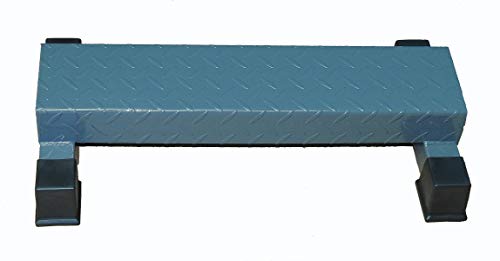
The TDS block is the straightforward mid-range pick: a one-piece steel platform, 24 inches long, 5.5 inches wide, and 5 inches high, with a diamond-plate surface and reinforced end caps. The length takes a comfortable two-foot stance, the width holds the whole ball of the foot, and the 5-inch height sits between the deep SCB26 and the low bars below — enough drop for a full stretch, without the steep ankle angle of the tallest block. The reinforced end caps address the wobble that cheaper bars are known for, and the block ships ready to use with no assembly at all. The maker’s published load figure is 1000 lb, half the Body-Solid figure and still far beyond what home calf training will ever ask of it. One honest note: diamond plate can feel less grippy than a raised-texture finish with some shoe soles, so the body-weight floor check matters with this pick. Choose it if you want a ready-to-train block with balanced dimensions and no setup.
Specs
- Format: One-piece steel calf block
- Block size: 24 × 5.5 × 5 in
- Surface: Diamond-plate steel
- End caps: Reinforced for stability
- Maker load figure: 1000 lb
- Assembly: None required
3. EVERYMATE Steel Calf Raise Block

The EVERYMATE is the compact, low-profile end of this guide. This listing is the small size of a two-size line: a 19.7 by 9.4 inch alloy steel platform standing 3.9 inches high, with raised anti-slip texture across the top and four rubber foot pads underneath. That low height is a feature for the right lifter — the ankle angle at the bottom is gentle, the stretch is manageable, and the block suits beginners, stiff ankles, and single-leg work where balance is still developing. The maker’s published load figure is 1000 lb despite the light build, and the small footprint tucks under a bench when the session ends. The honest trade is the mirror of the SCB26: lifters with flexible ankles who want a deep stretch will outgrow the shallow drop, and light blocks can shift on smooth floors, so a rubber mat underneath is a sensible habit with this pick. Choose it if you want a low, portable block for controlled work rather than maximum depth.
Specs
- Format: Steel calf raise block, small size
- Platform: 19.7 × 9.4 in, 3.9 in high
- Material: Alloy steel
- Surface: Raised anti-slip texture, four rubber foot pads
- Maker load figure: 1000 lb
4. BLUSLM Steel Calf Raise Bar

The BLUSLM bar adds one feature none of the other picks offer: four welded rings at the base that take resistance band carabiners, so the same block that anchors barbell and dumbbell raises also anchors banded calf work for warm-ups and lighter accessory days. The bar itself is reinforced carbon steel with four anti-slip rubber feet, a rust-proof and waterproof paint finish that holds up in unheated garages, and no assembly — set it down and train. The maker’s published load figure is about 880 lb, the lowest in this guide, which still covers body weight plus any load a home lifter can hold in a standing raise. The footprint is narrower than the SCB26 or TDS platforms, so wide two-foot stances feel tighter; most lifters will work at a natural stance or one foot at a time. Choose it if banded work is part of your calf training, or if the block will live in a damp garage where the finish earns its keep.
Specs
- Format: Steel calf raise bar
- Material: Reinforced carbon steel
- Feet: 4 anti-slip rubber feet
- Extras: Welded rings for resistance band carabiners
- Finish: Rust-proof, waterproof paint
- Maker load figure: About 880 lb
5. Kipika Versatile Calf Raise Bar

The Kipika bar is the simple, sturdy generalist of the guide: a heavy duty steel standing block with an anti-slip surface, sold for calf raises and also for squats, foot stretches, and dip exercises. The maker’s published load figure is 800 lb — the lowest headline number here alongside the BLUSLM, and like that bar, still well beyond the loads standing calf work involves at home. What the Kipika offers is an uncomplicated one-piece steel platform with no setup and no moving parts, from a maker whose line focuses on exactly this kind of compact home-gym steel. As with every light steel bar, the floor check is the routine: rubber-floored gyms will hold it happily, while smooth tile deserves a mat underneath. Choose it if you want a basic steel block that also covers dip and stretch work without taking up a machine’s footprint.
Specs
- Format: Steel standing calf raise block
- Material: Heavy duty steel
- Surface: Anti-slip design
- Maker load figure: 800 lb
- Use: Calf raises, squats, foot stretches and dips
Safety Checks That Come Before the Workout
Set the whole ball of the foot on the edge. Heel free to drop, forefoot fully supported. A foot placed too far forward shortens the stretch; a foot placed too far back turns the set into a balance exercise. Set the position with body weight before adding any load.
Lower slowly, every rep. The lowering half of the raise is where the calf lengthens under load, and it is the half that builds the muscle. Count the descent, pause briefly in the stretch, and rise without bouncing. If the load forces a bounce, the load is too heavy for this tool.
Check the block on the floor before loading. Flat surface, body weight on the block, a deliberate shift side to side and front to back. Any rocking or sliding gets fixed — a mat underneath, a different patch of floor — or the session stays on flat ground.
Pain is information, not a target. A deep calf stretch feels like work; a sharp pull in the Achilles, pain that lingers after the session, or pain that grows across weeks is a stop signal. Calf and Achilles problems belong in front of a clinician, not under a taller block.
Frequently Asked Questions
How high should a calf raise block be?
High enough that your heels can drop below the level of your forefoot through a full, controlled range. For most lifters that is somewhere between about 4 and 6.5 inches. Begin at the lower end if your ankles are stiff, and treat extra height as a progression to earn over weeks, not a setting to jump to.
Can I do calf raises on a weight plate or a step instead?
A plate edge or a stair can work in a pinch, and lifters did exactly that for decades. A purpose-built block earns its place on grip and stability: a textured steel surface and rubber feet hold both your shoe and the floor in a way a smooth plate edge does not, and the width is made for the job.
Should my knees be straight or bent?
Both, across the week. Straight knees put more of the work on the upper calf, while a soft knee bend shifts work to the deeper calf muscle underneath. The block does not care which you choose — keep the foot placement and the slow lowering the same either way.
How often should calves be trained on a block?
Calves recover quickly and tolerate frequency well; two or three focused sessions a week is a common pattern. What matters more than the count is the quality of the reps — full range, slow lowering, no bouncing — and rest days when the Achilles feels irritated rather than merely worked.
Do I need a rack or machine to load calf raises on a block?
No. Body weight is the honest beginning, dumbbells in hand add load for most lifters, and a barbell across the shoulders or a Smith machine bar is the heavy end. The block only provides the platform; the load can come from whatever you already own.
Verdict
For most home lifters, the TDS block is the sensible default: balanced dimensions, a ready-to-use one-piece build, and a published figure with headroom to spare. Heavy lifters with a permanent gym should look at the Body-Solid SCB26, whose tall block gives the deepest stretch in this guide and whose platform doubles for squat work. The EVERYMATE is the low, compact pick for beginners, stiff ankles, and single-leg work. The BLUSLM suits lifters who want banded calf work from the same block, and the Kipika is the plain steel generalist that also covers dips and stretching. Whichever block you choose, the routine is the same: whole forefoot on the edge, heel free, a floor check before the load, and a slow lowering on every single rep.
More from Amazon
Programs that pair well with the guide above. Offers and eligibility are set by Amazon and may change.
A free business account with business pricing and bulk-buying tools for work, shop or home office.
Create a business accountFree shipping on eligible items, Prime Video and more. Eligible new members can start with a free trial.
Start a Prime free trialAudiobooks and podcasts to listen to on the go. Eligible new members can start with a free trial.
Try Audible freeAd-free music streaming. Eligible new subscribers can start with a free trial.
Try Music Unlimited freeAs an Amazon Associate we earn from qualifying purchases.

Write Your Review
No reviews yet. Be the first to share your experience!