
Key takeaways
- Compare the best ball pits with foam and inflatable picks, sturdy walls, and ball counts sized for safe toddler jumping, hiding, and indoor play.
A ball pit turns a corner of the living room into the one place a toddler is allowed to fall down on purpose. Wading, digging, hiding, and flopping into a sea of soft balls gives deep-pressure sensory input, endless chances to grab, toss, and sort by color, and a contained space where a new walker can tumble without meeting a hard edge. The five picks in this guide cover the shapes that play takes at home. There is a velvet-covered foam pit that arrives with its balls in the box, a big 47-inch foam pit built for two toddlers at once, a padded turtle pit made for babies who are just sitting up, a pop-up pit that folds away into a zippered bag, and a pop-up hybrid that works as a shaded paddling pool in summer and a ball pit the rest of the year.
One boundary is worth stating up front. Balls sold on their own are an accessory, not a pit, and they are not what this guide is about — every pick below is a pit structure, with balls included on two of them and sold separately for the other three. Play tents are a different class again: a tent is a fabric shelter to sit inside, while a ball pit is a shallow, open-topped pool built to hold balls and bodies at floor level. However you set one up, a ball pit is supervised play equipment. Stay within arm’s reach of babies and young toddlers, because a small child can sink down under the balls and struggle to right themselves, and keep the ball layer shallow for the youngest players.
Disclosure: As an Amazon Associate, I earn from qualifying purchases. Product details were verified at the time of writing.
How to Choose a Ball Pit
Start with the structure, because the structure decides the daily reality. Foam pits hold their shape, look like furniture, and give a climbing toddler a soft wall to lean and pull on, but they claim a permanent circle of floor. Pop-up pits spring open in seconds and fold flat into a bag, which suits small homes and travel, though their flexible walls bow outward under a determined climber. Padded fabric pits sit between the two: soft and portable, sized for babies rather than roughhousing preschoolers.
Size the pit to the child and the room. A pit around 35 inches across suits one baby or young toddler and fits a nursery corner. Stepping up to 47 inches lets two toddlers play together and gives a preschooler room to stretch out, but it needs a clear four-foot circle of floor full time. Wall height matters as much as width: walls around 12 to 14 inches are tall enough to hold balls in and short enough for a toddler to climb over safely, while the low padded rim of a baby pit is designed for a seated player, not a standing one.
Count the balls before you fall for a pit. Most pits ship with few or no balls, and an underfilled pit is a sad sight — a single layer that scatters instead of swallowing a jump. As a working guide, a 35-inch pit feels properly full with about 200 balls, a 39-inch pop-up can hold more than 400, and the big 47-inch foam pits want several hundred more on top of that. If a pit includes balls, check the count and the ball size in the box rather than assuming a full fill.
Ball size is a safety line, not a preference. For children under three, choose balls too big to fit the small-parts test cylinder regulators use, which in practice means balls of about 2.2 inches across or larger; the common 2.75-inch and 3-inch pit balls clear it comfortably. Inspect balls now and then and throw out any that crack or crush flat, since a split ball leaves sharp edges and a flattened one changes how the pit supports a fall.
Plan the cleaning before the first snack goes in. Foam pits earn their keep with zip-off covers that go in the washing machine. Pop-up shells wipe clean with a damp cloth. The balls themselves need an occasional wash in a mesh bag or a soapy tub rinse, and a pit used outdoors should come back inside rather than live in the weather. A pit that is hard to clean becomes a pit nobody wants to touch.
Match the pit to the age on the label. Baby pits start around 9 to 10 months, once a child sits unsupported, and work as enclosed sensory stations. Foam and pop-up pits labeled from 12 months suit the climbing, dumping, and jumping stage. Whatever the label says, stop using a pit a child can flatten, climb out of and tip, or overwhelm — and never let a baby sleep in one.
1. Nuby Velvet Ball Pit

The Nuby is the ready-to-play pick: a round foam pit in a soft velvet-feel cover, and the box already holds 200 balls in a calm aqua, white, and grey mix, so there is no second order to place before the first jump. The walls and the base are cut from the same supportive foam, which is why the pit keeps its round shape when a toddler leans, climbs, or belly-flops against the side, and the whole cover unzips in sections — base first, then the walls — and goes in the wash on a cold gentle cycle. At 35.4 inches across it fits one baby or young toddler comfortably and tucks into a nursery corner. Nuby labels it from 10 months, right for a steady sitter, and the pit is certified through the Baby Safety Alliance program, the successor to the JPMA certification parents may know from other nursery gear. Like every foam pit here, it ships compressed and can take days, sometimes up to two weeks, to expand to its full round shape.
Specs
- Type: round foam ball pit with balls included
- Size: 35.4 in diameter
- Balls included: 200, aqua, white, and grey
- Cover: velvet-feel, zips off in sections, machine wash cold on gentle cycle
- Construction: foam walls and foam base in the same material
- Certification: Baby Safety Alliance certified
- Age: 10 months and up
- Model: 5010
2. SHJADE Large Foam Ball Pit

The SHJADE is the big-room pick, a 47.2-inch round pit with 13.8-inch walls that gives two toddlers space to sit, dig, and climb without crowding each other out. The walls are two inches of memory foam wrapped in a soft fabric cover, so a child who trips into the side lands against cushion rather than a frame rib, and the foam gives the pit enough body that it does not fold flat when a toddler hauls themselves over the edge. The cover unzips and goes in the washing machine, which matters once sticky hands and snack dust get involved. Two things to plan for: the balls are sold separately, and a pit this wide swallows several hundred of them before it feels full, and the vacuum-packed foam needs time — days, occasionally longer — to settle into a true round shape after unpacking. SHJADE labels it from 12 months, and for a playroom that can give a four-foot circle a permanent home, it is the pit toddlers are least likely to outgrow quickly.
Specs
- Type: large round foam ball pit
- Size: 47.2 in diameter, 13.8 in wall height
- Walls: memory foam, 2 in thick
- Cover: removable, zips off, machine washable
- Balls included: none, sold separately
- Age: 12 months and up
- Model: SHJ-2004
3. Melissa & Doug Turtle Ball Pit
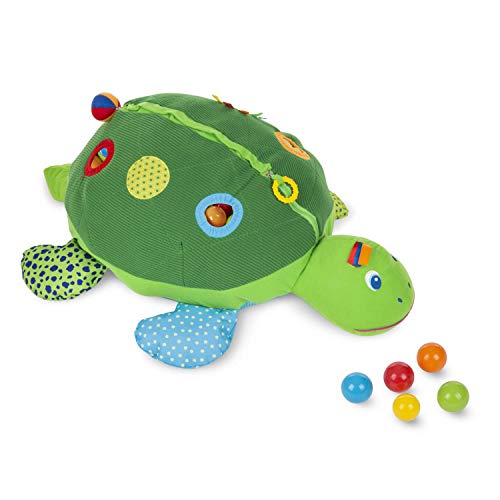
The Turtle Ball Pit is the baby pick, and it works less like a playroom pit than like an enclosed sensory station. The giant padded turtle comes filled with 60 soft plastic balls in two sizes and six colors, sized for small hands to grasp, toss, and roll, and the turtle itself joins in: crinkle flippers, a squeaker, a mirror, silky tags, and a teething ring on the zipper pull give a seated baby plenty to explore between the balls. The underside is non-slip, the whole body is machine washable, and when playtime ends the turtle zips shut with the balls stored inside — which also makes it the easiest pit here to carry to a grandparent’s house. Melissa & Doug labels it from 9 months to 2 years, and that window is honest: it is a first pit for a baby who sits and reaches, and an active two-year-old will treat it as a pillow to wrestle rather than a pit to sit in.
Specs
- Type: padded fabric baby ball pit
- Assembled size: about 39 x 29 x 8.5 in
- Balls included: 60 soft plastic balls, two sizes, six colors
- Bottom: non-slip underside
- Cleaning: machine washable
- Storage: zips shut with the balls inside
- Extras: crinkle flippers, squeaker, mirror, teething ring
- Age: 9 months to 2 years
- Weight: about 2 lb
4. EocuSun Pop-Up Ball Pit
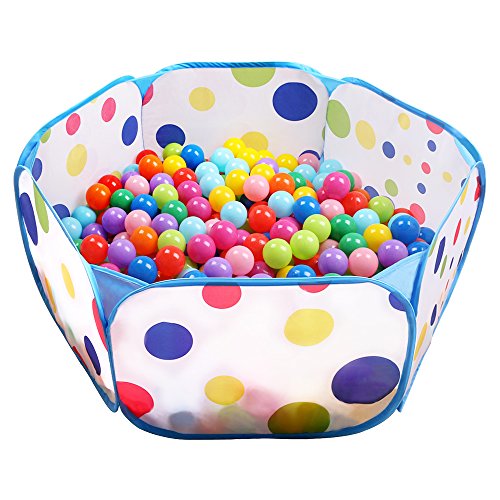
The EocuSun is the pit for homes where floor space has to be earned back every evening. It springs open in a second or two — 39.4 inches square with 14.5-inch walls — and when playtime ends it twists back down into an 11.8-inch disc that slides into the included zippered storage bag and onto a closet shelf. The frame is memory steel sleeved in waterproof polyester, light enough to carry from room to room or out to the yard, and the shell wipes clean rather than needing a wash cycle. It holds well over 400 balls if you want a deep pit, though it plays happily with fewer, and the balls are sold separately. The honest trade-off is the walls: a pop-up flexes where a foam pit stands firm, so this is a pit for sitting, wading, and tossing rather than for a toddler who climbs everything. EocuSun has sold this design for years, and its staying power in a fast-copying category says plenty.
Specs
- Type: pop-up ball pit
- Open size: 39.4 x 39.4 x 14.5 in
- Folded size: 11.8 in diameter disc
- Frame: memory steel in waterproof polyester
- Storage: zippered storage bag included
- Balls included: none, sold separately; holds 400 or more
- Cleaning: wipe clean
- Model: ECWJ001
5. Peradix 3-in-1 Ball Pit Tent and Paddling Pool

The Peradix earns its place by changing jobs with the seasons. Indoors it is a pop-up ball pit about 37 inches across; in summer the same waterproof shell works as a shaded paddling pool, with a detachable canopy that gives UV protection overhead and a basketball hoop that adds a throw-and-aim game for older toddlers. Nothing needs inflating and there is no pump to store — it pops up on its steel-wire frame and folds flat into its storage bag when the day is done, which makes it a natural for beach trips and small yards as well as the living room. Balls are sold separately, and as a pool it holds water for splashing rather than swimming, so the same arm’s-reach rule applies in both modes. For a family that wants one purchase to cover the rainy-day pit and the sunny-day pool, this is the pick that does both.
Specs
- Type: pop-up 3-in-1 ball pit, paddling pool, and play tent
- Size: about 37 in across
- Canopy: detachable sunshade with UV protection
- Extras: basketball hoop, storage bag included
- Setup: pop-up frame, no pump or inflation needed
- Balls included: none, sold separately
- Cleaning: wipe clean
- Model: PBP-462169
Ball Pits Compared
| Pick | Type | Size | Balls included | Cleaning | Storage |
|---|---|---|---|---|---|
| Nuby Velvet Ball Pit | Foam | 35.4 in round | 200 | Zip-off cover, machine wash | Stays assembled |
| SHJADE Large Foam Ball Pit | Foam | 47.2 in round, 13.8 in walls | None | Zip-off cover, machine wash | Stays assembled |
| Melissa & Doug Turtle Ball Pit | Padded fabric | About 39 x 29 x 8.5 in | 60 | Machine washable | Zips shut with balls inside |
| EocuSun Pop-Up Ball Pit | Pop-up | 39.4 x 39.4 x 14.5 in | None | Wipe clean | Folds to a disc in a zippered bag |
| Peradix 3-in-1 | Pop-up hybrid | About 37 in across | None | Wipe clean | Folds flat in a storage bag |
Frequently Asked Questions
What age is a ball pit right for?
Most home ball pits start once a baby can sit unsupported, around 9 to 10 months for the padded baby pits in this guide, and foam and pop-up pits labeled from 12 months suit the climbing toddler stage. The upper end depends on size rather than birthday: a 35-inch pit is a one-toddler space, while the 47-inch foam pit keeps two toddlers or a preschooler happy. Whatever the label, stay within arm’s reach of babies and young toddlers while they play.
How many balls do I need to fill a ball pit?
More than the box art suggests. A 35-inch round pit feels full at around 200 balls, a 39-inch pop-up can hold more than 400, and a 47-inch pit wants several hundred beyond that for real depth. If the pit you like ships without balls, order the fill at the same time, and choose balls of about 2.2 inches across or larger for children under three.
Are ball pits safe for babies?
They are, with the rules that apply to any contained play space: an adult within arm’s reach, a shallow layer of balls for the youngest babies so they never sink below the surface, balls large enough to stay out of the small-parts range, and no sleeping in the pit. Soft foam or padded walls remove the hard edges, and damaged or crushed balls should be thrown out as soon as you spot them.
How do I clean a ball pit and the balls?
Foam pits are the easiest to live with: unzip the cover and machine wash it cold on a gentle cycle. Pop-up shells wipe down with a damp cloth. For the balls, a mesh laundry bag in the machine or a soak in a tub of warm soapy water followed by air drying handles a full set in one go. Let everything dry completely before the pit goes back into service or into storage.
Foam or pop-up — which should I choose?
Choose foam if the pit will live in one room and your toddler climbs: the walls hold their shape, support a child pulling up, and look tidy between sessions, at the expense of a permanent circle of floor. Choose a pop-up if the pit needs to travel or disappear daily: it opens in seconds and stores in a bag, but its flexible walls suit sitting and wading better than climbing.
The Verdict
Start with the Nuby Velvet Ball Pit if you want the pit that is ready the day it arrives: supportive foam, a washable velvet cover, and 200 balls already in the box. Choose the SHJADE when you have the floor for it — its 47-inch span and thick foam walls are the toddler-proof option for siblings and playdates. The Melissa & Doug Turtle is the first pit to buy for a baby, a padded sensory station that zips shut into its own storage. For small homes and travel, the EocuSun pop-up folds into a bag and gives the floor back every night. And if one purchase has to cover winter indoors and summer in the yard, the Peradix hybrid swaps between ball pit and shaded paddling pool without missing a beat.
More from Amazon
Programs that pair well with the guide above. Offers and eligibility are set by Amazon and may change.
A free business account with business pricing and bulk-buying tools for work, shop or home office.
Create a business accountFree shipping on eligible items, Prime Video and more. Eligible new members can start with a free trial.
Start a Prime free trialAudiobooks and podcasts to listen to on the go. Eligible new members can start with a free trial.
Try Audible freeAd-free music streaming. Eligible new subscribers can start with a free trial.
Try Music Unlimited freeAs an Amazon Associate we earn from qualifying purchases.



Write Your Review
No reviews yet. Be the first to share your experience!