
Key takeaways
- Compare the best toddler snow boots with cozy lining picks, easy strap designs, and grippy soles that keep little feet warm on winter play days.
A toddler snow boot has a different job from every other shoe in the hall closet. It has to trap warmth around a small foot that generates very little heat of its own, shed snow and slush before either soaks through, open wide enough for a thick sock and a wiggly heel, and still flex enough for a new walker to stomp, climb a snowbank, and fall down in it. The five picks in this guide are all insulated winter boots sized for toddlers, built around a waterproof shell or seam-sealed upper, a warm lining, and a strap or pull-on opening a mittened adult can work in seconds.

One boundary is worth stating plainly: these are snow boots, not rain boots. The toddler rain boots in our earlier guide are uninsulated or lightly lined rubber built for puddles and wet pavement; they flex beautifully and keep rain out, but they do not hold warmth in deep snow. A snow boot trades some of that puddle flexibility for insulation, a taller shaft, and a cuff that seals snow out from the top. If your winter is mostly cold rain, the rain boot guide is the right shelf. If your winter is real snow, start here.
Disclosure: As an Amazon Associate, I earn from qualifying purchases. Product details were verified at the time of writing.
How to Choose Toddler Snow Boots
Fit with thick socks is the headline test. Always size a snow boot with the sock your child will actually wear in it — a midweight wool or wool-blend winter sock, not the thin cotton pair from the drawer. Put the boot on over that sock and look for about a thumb’s width of room past the toes: enough space for warm air to circulate and for toes to wiggle, which is how small feet stay warm. A boot fitted to a bare or thin-socked foot in the store becomes a tight boot in January, and a tight boot is a cold boot, because squeezed insulation cannot trap air and snug toes cannot move. Going a full size too big is its own failure — the heel lifts, the boot slops around, and new walkers trip on the extra length. Thumb’s width over the winter sock, no more.
Insulation comes in two honest forms. Fixed insulation — a measured weight of synthetic fill or foam sewn into the boot, often paired with a fleece or faux-fur lining — is simple, nothing to lose, and the norm in toddler sizes. A removable felt liner pulls out for drying and lets you check fit with a thumb press on the toes, at the expense of one more piece to keep track of. Makers publish comfort figures for their boots, and those figures appear in this guide as plain maker figures only: they are measured under maker conditions with active movement, so treat any figure as a rough guide to the boot’s class, not a promise for a toddler standing still in a sled queue. A still toddler gets cold faster than the figure assumes; plan shorter outings and check toes on schedule.
Waterproofing lives in the shell and the seams. The most reliable toddler snow boots pair a waterproof rubber or molded shell around the foot — the part that actually stands in slush — with a water-shedding textile shaft above it. Fully seam-sealed uppers push protection higher up the leg. What no snow boot survives is snow over the top: a shaft that gaps at the calf pours snow straight onto the sock, which is why cuffs, drawcords, and gaiter-style snow pants pulled over the boot top matter as much as the boot itself.
Closures decide whether the boot gets worn. One wide hook-and-loop strap is the toddler benchmark: it opens the boot wide for the heel, cinches the ankle so the boot stays on in deep snow, and works with gloves on. Drawcord cuffs add a seal at the top. Laces have no place on a toddler boot — they loosen, drag in slush, and need dry adult hands. Whatever the closure, practice the full routine once indoors: sock on, heel down, strap snug, snow pants over the top.
Check the boot dry inside before every wear. This is the habit that separates warm days from miserable ones. Before each outing, reach a hand inside each boot. Yesterday’s slush melts into linings, and a boot that feels even slightly damp inside will chill small feet within minutes, no matter how good its insulation figure looks on paper. A damp boot needs a day off: pull the insole or liner out, stand the pair open near — not on — a heat source, and send the dry backup pair out instead. Two pairs in rotation, or one pair plus the discipline to dry them the moment you come in, is the real system behind every warm-foot winter.
Grip is lugs plus flex. Deep, multi-directional lugs bite on packed snow and icy patches; a sole that still bends at the ball of the foot lets a toddler feel the ground and catch a stumble. Rock-hard soles skate. Press the toe of the boot down on a hard floor before the first outing — it should flex, not feel like a plank.
The 5 Best Toddler Snow Boots
1. Sorel Toddler Snow Commander — the deep-snow classic
The Snow Commander is the boot most parents picture when they picture a toddler snow boot: a calf-high shaft, a waterproof rubber shell wrapping the whole foot, and a wide hook-and-loop strap that does the fastening in one pull. Inside, 200 grams of insulation and a soft fleece lining do the warming, and the listing for this line describes a felt inner layer underfoot for insulation against cold ground. The multi-directional lug sole is built for slick sled hills and packed-snow sidewalks alike. It is the heaviest style in this guide, which is the honest trade for the tallest, warmest build here — a confident walker heading into deep snow is exactly its child.
Specs
- Brand/model: Sorel Toddler Snow Commander (model 2114102)
- Insulation: 200 g synthetic insulation with fleece lining
- Upper: PU-backed synthetic textile with waterproof rubber shell
- Closure: wide hook-and-loop strap
- Outsole: rubber, multi-directional lugs
- Shaft: calf high
- ASIN: B0CRSHKTJS
2. Kamik Snowbug 7 — the easy one-strap everyday boot
Kamik builds the Snowbug line specifically for the youngest snow players, and the Snowbug 7 keeps the formula simple: a waterproof nylon upper over a waterproof rubber bottom, foam and faux-fur insulation inside, and one wide strap that opens the boot almost flat. That wide opening is the whole point — a toddler foot in a thick sock drops straight in, the strap cinches the ankle, and you are done. The listing carries a maker comfort figure of -10°F for this boot, stated here as the plain maker figure it is; for everyday snow days, daycare recess, and short sled runs, that class of warmth paired with a genuinely easy on-and-off is the combination most families actually use all winter.
Specs
- Brand/model: Kamik Snowbug 7 (Toddler/Little Kid), style NF9564N-LIL
- Insulation: foam with faux-fur lining; maker comfort figure -10°F
- Upper: waterproof nylon with rubber shell bottom
- Closure: single wide hook-and-loop strap
- Fit note: wide opening sized for thick winter socks
- ASIN: B0F2WBBFSQ
3. Columbia Powderbug Snowlite — the light molded-shell pick
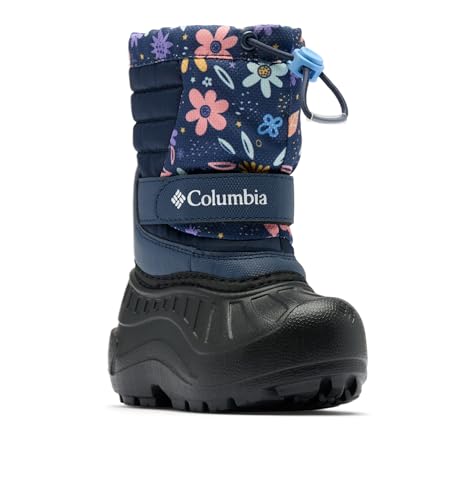
Columbia’s Powderbug family is the long-running alternative to the Sorel pattern, and the Snowlite is its lighter toddler branch: a waterproof woven upper, an insulated lining, and a strap closure, all sitting on a one-piece molded shell and outsole that shrugs off slush and salt. The molded shell means there is no seam at ground level to wick meltwater in, and the whole boot wipes clean at the door. Families whose winters run more to slushy sidewalks and wet playground snow than to deep drifts will find this lighter build easier for a small walker to lift with every step, while the strap still gives the snug ankle fit that keeps a boot on when a foot pulls out of a snowbank.
Specs
- Brand/model: Columbia Toddler Powderbug Snowlite (style 207892)
- Construction: waterproof woven upper on a one-piece molded shell and outsole
- Lining: insulated lining
- Closure: adjustable hook-and-loop strap
- Outsole: molded traction pattern for packed snow and slush
- ASIN: B0DK7PSFFR
4. Northside Frosty — the tall-shaft value workhorse
The Frosty has been the budget-shelf staple of this class for years, and its formula explains why: 200 grams of Thinsulate insulation, a waterproof nylon upper over a rubber shell, a removable EVA insole that adds a layer of insulation underfoot and lifts out for drying, and a tall shaft — around 8 inches — that stands up well under snow pants. It fastens with an adjustable strap plus a bungee cord and cinch toggle at the top, the only pick here that seals the cuff as well as the ankle. Northside publishes a comfort figure of -25°F for the Frosty, given here as the plain maker figure; even read conservatively, this is a genuinely warm boot for its shelf, and the removable insole makes the check-it-dry-inside routine faster than any fixed-lining boot in this guide.
Specs
- Brand/model: Northside Frosty Snow Boot (Toddler)
- Insulation: 200 g Thinsulate; maker comfort figure -25°F
- Insole: removable EVA insole
- Upper: waterproof nylon with rubber shell
- Closure: adjustable strap plus bungee cord with cinch toggle
- Shaft height: about 8 inches
- ASIN: B01IC21D8A
5. The North Face Toddler Alpenglow II — the flexible lightweight

The Alpenglow II is built like a tiny hiker rather than a pac boot, and that is its appeal for new walkers: a ballistic mesh upper with waterproof leather overlays, seam-sealed waterproof construction, and 200 grams of Heatseeker insulation inside a noticeably lighter, more flexible package than the shell-boot pattern. A single strap handles fastening. The North Face does not publish a temperature figure for this boot, and the listing is honest about that — you compare it on its insulation weight and seam-sealed build instead, which are both squarely in the serious-winter class. For a toddler who walks more than they are carried, and whose snow days are active rather than standing-around, the lighter flex underfoot is worth real comfort.
Specs
- Brand/model: The North Face Toddler Alpenglow II
- Insulation: 200 g Heatseeker synthetic insulation
- Upper: ballistic mesh with waterproof leather overlays, seam-sealed
- Bottom: TPR shell bottom and outsole
- Closure: single hook-and-loop strap
- Maker temperature figure: none published
- ASIN: B0CMJ1C55M
Keeping Small Feet Warm All Winter
Match the boot to the day, not the season label. Deep snow and a long sledding morning call for the tallest, warmest build — the Sorel or the Northside. Everyday daycare snow, where boots go on and off four times a day, rewards the Kamik’s wide one-strap opening. Slush and wet sidewalks favor the Columbia’s molded shell; a new walker covering real distance favors the lighter flex of The North Face.
Whatever pair you choose, the system around the boot does half the work: winter socks fitted first and boots sized over them, snow pants pulled down over the shaft so snow cannot pour in at the top, a hand inside each boot before every wear to confirm it is dry all the way to the toe, and liners or insoles pulled out to air the moment you come home. Do those four things and any of these five boots will do the job it was built for — warm, dry feet from the first snow day to the last.
More from Amazon
Programs that pair well with the guide above. Offers and eligibility are set by Amazon and may change.
A free business account with business pricing and bulk-buying tools for work, shop or home office.
Create a business accountFree shipping on eligible items, Prime Video and more. Eligible new members can start with a free trial.
Start a Prime free trialAudiobooks and podcasts to listen to on the go. Eligible new members can start with a free trial.
Try Audible freeAd-free music streaming. Eligible new subscribers can start with a free trial.
Try Music Unlimited freeAs an Amazon Associate we earn from qualifying purchases.
Write Your Review
No reviews yet. Be the first to share your experience!