
Key takeaways
- Compare medicine balls by surfaces, bounce behavior and weight steps, with the catch-with-soft-hands rule and wall-clearance habit trainers use.
A medicine ball earns its place in a workout by being caught, not just lifted. It comes back at your chest off a wall, arrives from a partner at arm’s length, and turns a plain sit-up into loaded rotation — and every one of those jobs depends on how the ball behaves in the air and in your hands. The five balls below are the catching kind: three classic rubber medicine balls with a live, predictable bounce, one traditional stitched leather ball for floor work and passing, and one soft wall ball built for high-rep throws at a target. One format is deliberately absent. A slam ball is a different tool — a dead-bounce ball made to be thrown at the floor and stay there — and it is not interchangeable with anything in this guide, so no slam ball appears among the picks.

Disclosure: As an Amazon Associate, I earn from qualifying purchases. Product details were verified at the time of writing.
How to Choose a Medicine Ball
Start with the format, because the formats do different jobs. A classic rubber medicine ball is firm, compact for its weight, and bounces off hard floors and solid walls — that rebound is the point, because it keeps partner passes and rebound drills moving. A stitched leather ball is the traditional gym and rehab form: softer in the hands, with a modest, controlled bounce, built for passing, carries, and floor work rather than impact. A wall ball is a medicine ball in a bigger, softer body — a full 14 inches across at every weight — made to be thrown up at a wall target and caught on the way down, absorbing the catch instead of springing away. Pick the format that matches the drill you actually do most; a ball that is wrong for the drill is wrong at any weight.
Bounce behavior is a safety spec, not a preference. A firm rubber ball comes off a wall fast and true, which is exactly right for rebound work with room to move — and exactly wrong in a tight space or aimed anywhere near face height without a ready catcher. A soft wall ball comes off the wall slow and close, which is why it can be caught hundreds of times in a session. Know which behavior you are buying before the first throw, and never let a partner find out by catching the wrong ball cold.
Choose the weight for speed of movement, not for the heaviest load you can move once. Medicine ball work is power work: the throw, the twist, and the catch should all stay quick and crisp. If the ball slows your hands down, bends your elbows into a shove, or makes you brace and heave, it is too heavy for the drill, whatever the number printed on it says. Most adults do their best core and conditioning work between 6 and 15 pounds, and a lighter ball thrown fast teaches better mechanics than a heavy ball muscled through slowly. When in doubt, start one step lighter than your instinct says.
Surface and size decide whether you can hold on. A textured rubber or treaded surface stays put in sweaty hands through rotational work; a smooth ball starts to wander by the second set. Diameter matters just as much: classic balls grow only slightly as they get heavier, so an 8 or 10 pound ball still fits smaller hands, while a wall ball is a two-handed catch at any weight because of its 14-inch body. If your hands cannot wrap the ball with fingers spread and wrists neutral, the grip will fail before the muscles do.
The catch rule outranks every spec in this guide. Every catch is taken with soft hands and bent elbows — hands giving with the ball, elbows flexing to absorb it, the ball finishing at the chest and never at the face. A stiff-armed catch, arms locked and ball arriving high, is how fingers get jammed and faces get hit; it is not a technique, it is an accident in progress. Wall work follows the same logic: throw only at a wall that can take it — concrete block, brick, or a built gym wall, never drywall or a stud wall with give — and check the clearance first: floor space behind you for the return, nobody crossing the throw line, and a partner who knows the weight and the count before the first rep. Those two habits, soft hands and a checked space, are what make a medicine ball a training tool instead of a hazard.
The 5 Best Medicine Balls
1. Amazon Basics Medicine Ball, 10 lb
The straightforward classic, and the ball most home gyms should start from. The Amazon Basics medicine ball is a firm rubber ball with a lightly textured surface and its weight printed on both sides, so the right ball is identifiable at a glance in a rack or a bin. Its defining behavior is a genuine bounce: it rebounds off hard floors and solid walls with enough life to keep partner passes, chest passes, and rebound drills flowing without a pause to fetch it. The 10 pound listing verified here sits in the middle of the line, which runs in steps from light core-work weights up to 20 pounds, so a household can add a second ball later and keep the same feel. The honest limits are the format’s own: the firm shell is unforgiving on a bad catch, the bounce demands the clearance habit described above, and it is a throwing and catching ball — not a ball to be slammed into the floor, which will shorten its life and send it back at you besides.
Specs
- Format: classic medicine ball
- Weight on verified listing: 10 lb
- Shell: textured rubber
- Bounce: live rebound off hard floors and walls
- Markings: weight printed on both sides
- Line: weight steps from 4 to 20 lb
- ASIN: B00R3N0BDS
2. CAP Barbell Medicine Ball, 8 lb
The compact classic for smaller hands and faster work. CAP’s medicine ball is a rubber ball in the traditional form — firm, textured, and sized so that an 8 pound weight still wraps comfortably in the hands, which is what rotational drills ask for: Russian twists, woodchoppers, and standing side throws all fail at the grip before they fail anywhere else. Its bounce is the classic ball’s live rebound, suited to partner work and wall passes where the return keeps the tempo up. The 8 pound weight is a deliberate choice rather than a compromise — it is the step where throws stay quick and catches stay soft-handed for most people, and it is the weight a beginner should learn the catch rule on before touching anything heavier. The trade-off is headroom: a strong trainee will outgrow 8 pounds for squat throws and loaded carries, and this ball will become the light, fast option in the rack rather than the only one.
Specs
- Format: classic medicine ball
- Weight on verified listing: 8 lb
- Shell: rubber with textured grip surface
- Bounce: live rebound for partner and wall work
- Size: compact diameter for the weight, suited to smaller hands
- Best use: rotational core work, overhead throws, partner drills
- ASIN: B001Q3LDJO
3. SPRI Xerball Medicine Ball, 15 lb
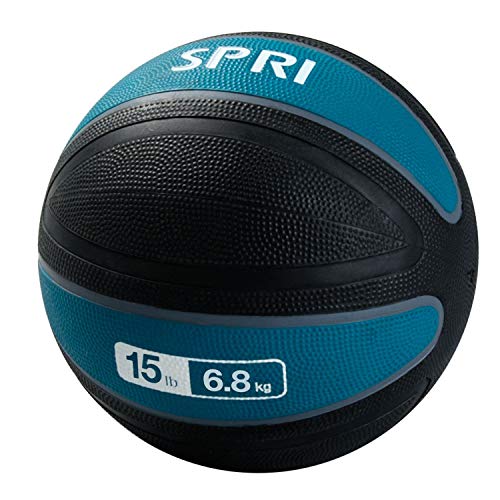
The heavy classic, built for trainees who have already earned the weight. The Xerball is a thick-walled rubber medicine ball with a textured, basketball-style surface — the tread pattern is the functional detail, because at 15 pounds a smooth ball starts to slip in sweaty hands during exactly the explosive work this weight is for. SPRI builds the Xerball for a steady, consistent bounce, and that predictability is its real virtue: a ball that rebounds the same way every time can be caught with soft hands on rhythm, while an erratic bounce turns every return into a reaction test. Fifteen pounds is a serious medicine ball weight — right for squat throws, loaded carries, and conditioning circuits for someone whose 10 pound ball has started to feel like a warm-up, and too much for a first ball or for fast rotational work. Buy it as the step up, not the starting point, and keep the lighter ball for speed days.
Specs
- Format: classic medicine ball
- Weight on verified listing: 15 lb
- Shell: thick-walled rubber
- Surface: textured, basketball-style tread for grip
- Bounce: steady, consistent rebound for partner drills
- Best use: squat throws, loaded carries, conditioning circuits
- ASIN: B006SEQYOS
4. Champion Sports Leather Medicine Ball, 6 lb

The traditional ball, in the form gyms and rehab rooms have used for decades. Champion Sports builds this medicine ball with a synthetic leather exterior over reinforced stitching — a surface that feels supple rather than grippy-tacky, and that treats the hands kindly through long sets of floor work: sit-up throws to a partner, seated twists, and slow controlled passing where the ball is received as much as caught. Its bounce is modest and controlled, the leather-ball behavior — it comes back low and honest, never springing. At 6 pounds it is the lightest pick in this guide, and that is its role: movement quality, coordination, and high-rep core work, including the rehab-style training where a heavy or lively ball has no place. The limits are real and worth stating plainly. Stitched leather is not an impact shell: never slam this ball, keep it dry, and keep it for the floor and partner work it was built for.
Specs
- Format: classic medicine ball, traditional stitched form
- Weight on verified listing: 6 lb
- Shell: synthetic leather
- Seams: reinforced stitching
- Bounce: modest, controlled rebound
- Best use: floor core work, partner passing, rehab-style movement
- ASIN: B000KYQ70I
5. RitFit Soft Medicine Ball (Wall Ball)

The wall ball, and the one pick here built around the catch itself. RitFit’s soft medicine ball holds a uniform 14-inch diameter across its whole line, wrapped in a PU leather shell with reinforced seams, with the internal weights balanced so the ball flies true and lands in the hands the same way at the hundredth throw as at the first. That size and softness change the bounce behavior completely: thrown at a solid wall, the ball comes off slow and close, absorbing into the hands instead of rebounding away, which is what makes high-rep wall ball work — squat, throw, catch, repeat — sustainable at all. The line runs in color-coded steps of 10, 15, 20, and 25 pounds, so the weight is identifiable by sight across a gym floor. Two honest boundaries: a 14-inch ball is a two-handed tool that will feel bulky for one-handed rotational work, and a soft wall ball is not a floor ball — it is built to hit a wall and be caught, not to be slammed down, and its seams will thank you for keeping that distinction.
Specs
- Format: wall ball (soft medicine ball)
- Diameter: 14 in across all weights in the line
- Shell: PU leather with reinforced seams
- Fill: balanced internal weights for a true flight and even catch
- Bounce: low — comes off the wall soft and close
- Line: color-coded steps of 10, 15, 20, and 25 lb
- ASIN: B0991XCNPH
Frequently Asked Questions
What weight should a first medicine ball be? For most adults, 8 to 10 pounds is the honest starting point for core work and partner drills — heavy enough to load a twist or a throw, light enough that the catch can still be taken with soft hands and bent elbows. Go lighter, 6 pounds, for rehab-style movement or high-rep floor work, and treat 15 pounds and up as a step for trainees who already own the mechanics at lighter weights. The test is speed: if the ball slows your hands, it is too heavy for the drill.
Can a medicine ball be used for slams? No — and the distinction matters. Slamming is the slam ball’s job: that format is built with a dead bounce to be thrown at the floor and stay there. A classic medicine ball bounces, so a hard floor throw sends it back toward your shins or face, and repeated slamming splits shells and seams that were built for catching. A wall ball’s stitched shell fails the same way from the other direction. If slams are the workout you want, buy the format built for them and keep the balls in this guide for throwing and catching.
What wall can a medicine ball be thrown against? A wall that can take repeated impact without flexing or denting: concrete block, poured concrete, brick, or a purpose-built gym wall. Drywall and hollow stud walls will dent and eventually break through, and the ball’s return off a giving wall is unpredictable besides. Stand far enough back that the return reaches your chest with your arms able to give, keep the floor behind you clear, and agree the weight and the rep count with a partner before the set starts.
How should the ball be caught? With soft hands and bent elbows, every time, at the chest. Hands meet the ball with fingers spread, the elbows flex as the ball arrives so the arms absorb it, and the ball finishes against the chest — never taken stiff-armed, and never allowed to arrive at face height. A partner who throws a ball you are not ready for, or a weight you did not agree on, is the most common way this simple tool hurts someone; the catch rule and a called count prevent both.
Verdict
Buy by format first and weight second. The Amazon Basics 10 lb is the all-around classic for a first home gym ball, the CAP 8 lb is the fast, compact option for rotational work and smaller hands, and the SPRI Xerball 15 lb is the step up for trainees who have outgrown both. The Champion Sports leather ball owns the floor-work and rehab-style corner at 6 lb, and the RitFit is the pick when the workout is wall throws by the hundred. Whichever one comes home, the rules travel with it: soft hands and bent elbows on every catch, a wall that can take the throw, clearance checked before the first rep, and a weight chosen for speed — because a medicine ball trains power only while it is moving fast and being caught well.
More from Amazon
Programs that pair well with the guide above. Offers and eligibility are set by Amazon and may change.
A free business account with business pricing and bulk-buying tools for work, shop or home office.
Create a business accountFree shipping on eligible items, Prime Video and more. Eligible new members can start with a free trial.
Start a Prime free trialAudiobooks and podcasts to listen to on the go. Eligible new members can start with a free trial.
Try Audible freeAd-free music streaming. Eligible new subscribers can start with a free trial.
Try Music Unlimited freeAs an Amazon Associate we earn from qualifying purchases.


Write Your Review
No reviews yet. Be the first to share your experience!