
Key takeaways
- Compare snow boots for kids by insulation types, closure styles and sole grip, with the two-pair rotation and full-dry habit families use nightly.
A school-age snow boot works a longer day than a toddler boot ever does. It goes on at breakfast, crosses a slushy parking lot, stands through a bus wait, spends recess in drifted snow, walks home, and then gets asked to do it all again tomorrow. The five picks in this guide are insulated winter boots in little-kid and big-kid sizes, roughly ages five to twelve: pac boots with pull-out liners, a lace-up insulated hiker style, a pull-on neoprene boot, and a teen-line boot for the oldest kids in that range. Every one is a true winter build with real insulation, not a rain boot with a lining added.
Two boundaries are worth stating plainly. Our earlier toddler snow boots guide covers the first-snow shelf — toddler sizes for new walkers, roughly ages one to four — and none of its picks appear here. And these are snow boots, not rain boots: an uninsulated rubber boot keeps water out but holds no warmth, so it belongs to the puddle season, not to January.
Disclosure: As an Amazon Associate, I earn from qualifying purchases. Product details were verified at the time of writing.
How to Choose Snow Boots for Kids
Size by the measured foot, in the socks the boot will wear. Put the winter sock on first — a midweight wool or wool-blend sock, not a thin cotton one — then measure the foot and match it to the maker’s size chart. Look for one thumb’s width of room past the toes and no more. That space traps warm air and lets toes move, which is how feet stay warm; a full size of extra growing room makes the heel lift, the foot slide, and the boot feel colder than a snugger pair. Sizing by age alone is how families end up with the wrong size in the wrong brand, because a size 2 in one line is not a size 2 in another.
Liners out, boots dry, every single night. This is the habit the whole guide hangs on. Snow works over the cuff, feet sweat inside insulation, and a liner that goes to bed damp is a cold liner at breakfast. Boots with removable liners win the school week for exactly this reason: the liner pulls out, stands open by the door, and is dry by morning. Fixed-lining boots need the same discipline — insoles up, shafts open, air moving through them overnight, near a heat source but never on one. A boot that feels even slightly damp inside at 7 a.m. will chill feet by the bus stop.
Run two pairs in rotation on multi-day snow weeks. When snow stays on the ground for a week, one pair of boots rarely gets a full dry day. Two pairs alternating — today’s pair drying while yesterday’s goes out — is the system that keeps feet warm through a long cold snap. The second pair does not need to match the first: a pac boot for deep-snow days and a lighter insulated boot for slush days cover more weather than two identical pairs.
Closures a child can work with mittens on. A school-age boot gets fastened by its owner, often in a hurry, often with cold hands. One wide strap, a drawcord collar with a toggle, or handles on a pull-on shaft all pass the mitten test. Laces pass it only for older kids who tie them fast and double-knot them; loose lace ends drag in slush and freeze stiff. Whatever the closure, the test is simple: your child puts both boots on, fastens them fully, and takes them off again without help, gloves on, before the first snow day.
Warmth figures are maker figures. Makers publish comfort figures for their boots, measured under maker conditions with an active, moving child. Those figures appear in this guide as plain maker figures only — a guide to the boot’s class, not a promise. A child standing still at a bus stop gets cold faster than any figure assumes, so match the boot to the coldest still-air morning your winter actually produces, and check toes on schedule during long sledding sessions.
Grip is lugs plus flex. Deep, multi-directional lugs bite on packed snow and the icy patch at the end of the driveway. The sole should still bend at the ball of the foot — a plank-stiff sole skates on ice and tires legs on the walk to school. Press the toe down on a hard floor before the first outing: it should flex, not feel like a board.
The 5 Best Snow Boots for Kids
1. Kamik Snobuster 1 — the removable-liner pac boot

The Snobuster 1 is the classic Canadian pac boot scaled for school kids, and its argument is the liner: a removable 6 mm Thermal Guard liner that pulls out at the door, dries overnight, and goes back in warm at breakfast. Below the ankle, a waterproof rubber shell wraps the whole foot, so the seam that fails on lesser boots does not exist here. A nylon upper, an adjustable snow collar that cinches against drifted snow, and a hook-and-loop midfoot strap finish the build — the strap is the mitten-friendly fastening this guide asks for. Kamik publishes a comfort figure of -25°F for this boot, stated here as the plain maker figure it is. For a family that wants one proven pattern for the whole school winter, this is the boot the rest of the list gets compared against.
Specs
- Brand/model: Kamik Snobuster 1 (Kids)
- Liner: removable 6 mm Thermal Guard liner
- Insulation: liner-based; maker comfort figure -25°F
- Upper: waterproof rubber shell bottom with nylon upper
- Closure: hook-and-loop midfoot strap, adjustable snow collar
- ASIN: B00SJGJ9RM
2. Sorel Youth Flurry — the deep-cold cinch-top boot

The Flurry is Sorel’s youth pac boot for genuinely cold places: a waterproof synthetic textile upper over a rubber shell, a built-in gaiter collar with a barrel-lock drawcord that seals the top against snow, an elastic instep strap a mittened hand can set, and a removable felt inner boot that lifts out for the nightly dry. Sorel publishes a comfort figure of -25°F for the Flurry, given here as the plain maker figure. It is the pick for the kid whose winter is measured in weeks below freezing — the one who builds the fort, stays for the whole sledding session, and comes in last. True to the pac-boot pattern, it runs sturdy rather than light, which is the honest trade for this much warmth.
Specs
- Brand/model: Sorel Youth Flurry (model 1855251)
- Liner: removable felt inner boot
- Insulation: felt liner system; maker comfort figure -25°F
- Upper: waterproof synthetic textile with rubber shell and outsole
- Closure: elastic instep strap, drawcord collar with barrel lock
- ASIN: B07KJTHNMD
3. Columbia Youth Bugaboot Celsius — the lace-up school boot

The Bugaboot Celsius is the kid-size version of Columbia’s adult winter boot line, and it reads like it: a waterproof leather and textile upper, 400 grams of insulation, and Columbia’s Omni-Heat reflective lining, which bounces body heat back toward the foot instead of letting it soak into the boot. The lace-up closure is the grown-up fastening in this guide — best for the older half of the range, kids who tie quickly and want the closest fit for walking real distances. A molded rubber outsole with deep lugs handles the packed-snow sidewalk and the icy patch by the school door. This is the pick for the kid who walks to school all winter and has outgrown pac-boot styling.
Specs
- Brand/model: Columbia Youth Bugaboot Celsius
- Insulation: 400 g insulation with Omni-Heat reflective lining
- Upper: waterproof leather and textile, Omni-Tech waterproof build
- Closure: lace-up
- Outsole: molded rubber, deep-lug tread
- ASIN: B0CLWKJ9DV
4. MUCK Rugged II — the pull-on neoprene workhorse

The Rugged II skips liners and laces entirely: a 5 mm neoprene shaft over a rubber foot, a soft fleece lining, and an EVA footbed, pulled on by its handles in one motion. The whole boot is waterproof to the top of the shaft, which makes it the slush, mud, and wet-snow specialist in this guide — the pair for farm chores, soaked fields, and the thaw weeks at both ends of winter. MUCK publishes a comfort range of -40°F to 40°F for this boot, stated here as the plain maker figure it is. The trade is fit: a tall pull-on shaft is looser at the ankle than a strapped pac boot, so it suits steady outdoor work better than running games. As the second pair in a two-pair rotation, it covers the wet days the pac boots handle worst.
Specs
- Brand/model: MUCK Rugged II (Kids)
- Insulation: 5 mm neoprene with fleece lining; maker comfort range -40°F to 40°F
- Construction: waterproof rubber foot with neoprene shaft
- Footbed: EVA
- Closure: pull-on with handles
- ASIN: B00TT2Z96U
5. The North Face Alpenglow V — the light teen-line boot
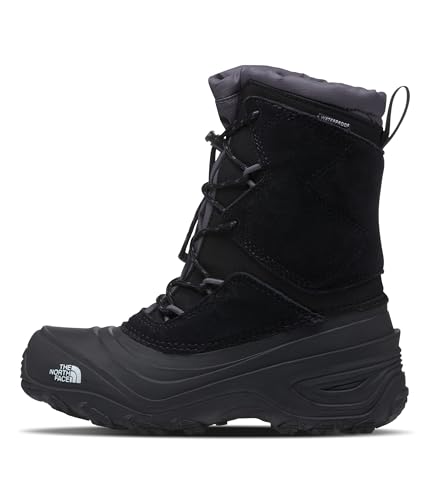
The Alpenglow V is The North Face’s youth and teen winter boot, built lighter and more flexible than the pac-boot pattern: a waterproof upper, a TPR shell bottom, and a removable Thermafelt Plus liner, with a maker comfort figure of -25°F stated here as the plain maker figure. Laces give the closest fit in this guide, and the whole boot flexes like a hiker rather than a pac boot, which matters for the oldest kids in the range — the ones walking a mile to a friend’s house or spending the day on a ski-hill sled run. The liner still pulls out for the nightly dry, so it plays by the same rotation rules as the Kamik and the Sorel. For a big kid who has started refusing anything that looks like a little kid’s boot, this is the one that ends the argument.
Specs
- Brand/model: The North Face Alpenglow V (Youth/Teen)
- Liner: removable Thermafelt Plus liner; maker comfort figure -25°F
- Upper: waterproof textile and synthetic build
- Bottom: TPR shell bottom and outsole
- Closure: lace-up
- ASIN: B09TRXP9BR
Keeping School Feet Warm All Winter
Match the boot to the day, not the season label. Deep snow and a long sledding morning call for a pac boot — the Kamik or the Sorel, liners pulled and drying the night before. The walk to school rewards the Columbia’s close lace-up fit; wet, muddy, thawing ground is the MUCK’s whole reason to exist; and the oldest kids cover real distance best in the lighter flex of The North Face.
Whatever pair goes out the door, the system around it does half the work: feet measured in winter socks with one thumb of toe room, liners or insoles pulled out the moment the boots come off, a hand inside each boot at breakfast to confirm it is dry to the toe, and two pairs rotating whenever the snow stays for a week. Do those four things and any of these five boots will do the job it was built for — warm, dry feet from the first snow day to the last.
More from Amazon
Programs that pair well with the guide above. Offers and eligibility are set by Amazon and may change.
A free business account with business pricing and bulk-buying tools for work, shop or home office.
Create a business accountFree shipping on eligible items, Prime Video and more. Eligible new members can start with a free trial.
Start a Prime free trialAudiobooks and podcasts to listen to on the go. Eligible new members can start with a free trial.
Try Audible freeAd-free music streaming. Eligible new subscribers can start with a free trial.
Try Music Unlimited freeAs an Amazon Associate we earn from qualifying purchases.




Write Your Review
No reviews yet. Be the first to share your experience!