
Key takeaways
- A monopod steadies long lenses and cuts fatigue without the bulk of a tripod. Compare five proven supports for sports, wildlife, travel and video work.
- Top Pick: SIRUI P-326 Carbon Fiber Monopod
- Runner-up: LEOFOTO MP-284C Carbon Fiber Monopod
- Also consider: Amazon Basics 67-Inch Monopod
A monopod is the simplest way to steady a heavy camera setup without carrying a full tripod. One leg takes the weight of a long lens, steadies the frame at slow shutter speeds, and lets you pan smoothly to follow action. It sets up in seconds, works in crowds and tight sidelines, and folds small enough to strap to a bag.
The best monopod for most photographers balances four things: enough load capacity for the heaviest lens you own, a folded length that fits your bag, a lock system you can operate with one hand, and a foot that grips the ground you shoot on. Carbon fiber saves weight for travel, aluminum saves money, and a folding base adds hands-free standing for video.
As an Amazon Associate, we earn from qualifying purchases.
Table of Contents
- Quick Answer
- Manfrotto XPRO Carbon Fiber 4-Section Monopod
- SIRUI P-326 Carbon Fiber Monopod
- Neewer Extendable Camera Monopod
- LEOFOTO MP-284C Carbon Fiber Monopod
- Amazon Basics 67-Inch Monopod
- How to choose
- Who should skip
- Frequently Asked Questions
- Final verdict
- Product and ASIN Reference
Quick Answer
For most photographers, the Manfrotto XPRO Carbon Fiber Monopod is the strongest all-round pick, with a high load capacity, quick lever locks, and retractable feet. Travelers who count every gram should look at the SIRUI P-326, while the Neewer model with its folding stand base is the most versatile choice for video. Budget buyers get solid basics from the Amazon Basics model.
Manfrotto XPRO Carbon Fiber 4-Section Monopod
The Manfrotto XPRO is the professional benchmark in this roundup, and it earns that position with a combination of stiffness, reach, and speed. Its carbon fiber legs keep vibration low, which matters when a long telephoto magnifies every tremor, and the four-section design extends to nearly 65 inches, high enough to shoot over a crowd. Quick Power Lock levers snap each section open or closed with one hand, so you can adjust height while keeping your eye on the action.
Three retractable feet fold out of the base for extra stability on flat ground and tuck away when you want a plain pole for walking. The dual thread mount accepts both common head sizes, and the monopod pairs with Manfrotto fluid bases for video work. A leg warmer grip keeps hands comfortable in cold weather and stops the pole slipping in a sweaty palm.
Specs
- Material: carbon fiber
- Sections: 4
- Maximum height: 64.76 inches
- Minimum height: 20.47 inches
- Folded size: 20.47 inches
- Weight: 1.3 pounds
- Weight limit: 20 kilograms
- Mount: dual 1/4-inch and 3/8-inch screw
- Lock type: Quick Power Lock levers
- Base: three retractable feet
SIRUI P-326 Carbon Fiber Monopod
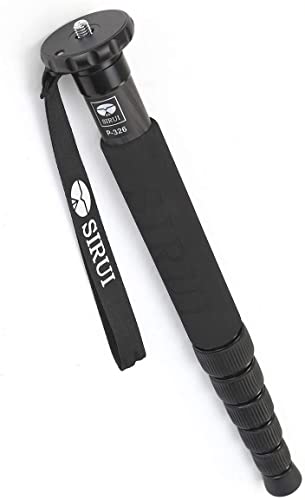
The SIRUI P-326 is the travel pick, and its numbers explain why. Six carbon fiber sections collapse to just 15 inches and weigh only 400 grams, so the pole disappears into a carry-on or daypack. Extended, it reaches 60.6 inches, enough for comfortable eye-level shooting for most adults, and it carries up to 22 pounds, which covers a mirrorless body with a mid-size telephoto.
Twist locks keep the slim profile clean, and the reversible screw fits any head you already own. A wrist strap is included, which is a small detail that matters when you are hiking with the pole in one hand and a camera in the other. The P-326 has no head and no folding base, so it is a pure support pole rather than a complete system, but for photographers who already own a ball head or tilt head, that simplicity is a strength.
Specs
- Material: carbon fiber
- Sections: 6
- Maximum height: 60.6 inches
- Minimum height: 15.5 inches
- Folded size: 15 inches
- Weight: 400 grams
- Weight limit: 22 pounds
- Mount: reversible 1/4-inch and 3/8-inch screw
- Lock type: twist locks
- Included: wrist strap
Neewer Extendable Camera Monopod
The Neewer monopod is the most versatile pick for hybrid shooters who move between stills and video. Its detachable folding stand base turns the pole into a self-standing support, so you can step away from the camera during a livestream or a locked-off video shot, then remove the base in seconds for a plain walking monopod. The aluminum alloy body extends from 52 to 168 centimeters and handles loads up to 5 kilograms, which suits mirrorless bodies, DSLRs with standard zooms, and camcorders.
A foam handle gives a secure grip during long sessions, and replacement spikes are included for soft ground. The 3/8-inch thread mounts directly to a camera or to a head of your choice. Aluminum is heavier than carbon fiber, but it keeps the cost down and shrugs off knocks that would worry a carbon tube.
Specs
- Material: aluminum alloy
- Sections: 4
- Height range: 52 to 168 centimeters
- Folded size: 20.5 inches
- Weight: 1.3 pounds
- Maximum load: 5 kilograms
- Mount: 3/8-inch thread
- Base: detachable and foldable stand base
- Grip: foam handle
- Included: replacement spikes
LEOFOTO MP-284C Carbon Fiber Monopod

The LEOFOTO MP-284C is the heavy lifter of this roundup. Its carbon fiber tube supports up to 18 kilograms, far more than any other monopod here, which makes it the right choice for full-frame bodies paired with super-telephoto lenses for wildlife and sports. Four sections with flip locks extend from about 20.6 inches to 65 inches, and the whole pole weighs just over a pound, so the strength-to-weight ratio is outstanding.
A detachable screw locking sleeve adjusts the height smoothly, and the design doubles as a trekking pole or a low-angle support when the situation calls for it. A wrist strap, an accessories bag, and a carry bag are included. The load rating is the headline, but the real appeal is confidence: when a heavy lens is mounted, this pole does not flex or creep.
Specs
- Material: carbon fiber
- Sections: 4
- Height range: 20.59 to 64.96 inches
- Weight: 1.1 pounds
- Maximum load: 18 kilograms
- Mount: 1/4-inch and 3/8-inch compatible
- Lock type: flip locks
- Included: wrist strap, accessories bag, carry bag
Amazon Basics 67-Inch Monopod
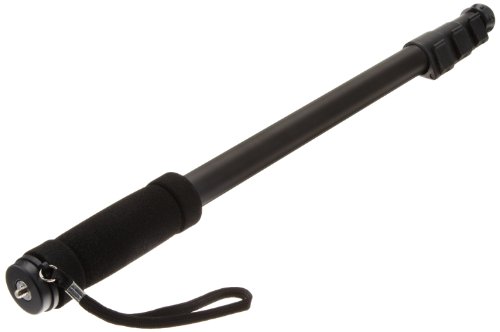
The Amazon Basics monopod is the budget pick, and it covers the fundamentals well. Four aluminum sections extend from 21 to 67 inches, which is the tallest reach in this guide, and the pole supports cameras and camcorders up to 6.6 pounds. That capacity suits entry-level DSLRs, mirrorless bodies, and bridge cameras with kit or standard zoom lenses.
A rubber foot grips smooth floors and pavement, and a carrying bag is included for transport. There is no head, no folding base, and no carbon fiber, so this is a straightforward support pole rather than a feature-rich system. For a first monopod, for occasional sports days, or for a second pole kept in the car, it delivers the core benefit at the lowest cost in this roundup.
Specs
- Material: aluminum
- Sections: 4
- Height range: 21 to 67 inches
- Weight: 15.7 ounces
- Maximum load: 6.6 pounds
- Foot: rubber foot
- Included: carrying bag
How to choose
Start with load capacity. Add the weight of your heaviest camera body, your longest lens, and any head you plan to mount, then choose a monopod rated comfortably above that total. A pole loaded near its limit will flex, and flex defeats the purpose of the support. Wildlife and sports photographers with super-telephoto lenses need the high ratings of the LEOFOTO or Manfrotto models, while a mirrorless body with a standard zoom is fine on any pole here.
Next, check folded length and weight against how you travel. A six-section carbon pole like the SIRUI folds to 15 inches and fits inside a backpack, while a four-section aluminum pole is longer when collapsed and heavier to carry all day. If you fly often or hike to a location, those differences matter more than a small difference in load rating.
Lock type is a matter of habit and conditions. Lever locks are faster and easier with gloves on, while twist locks are slimmer and less likely to snag on a bag strap. Either works well once you learn the motion, so try the style you already know from your tripod if you have one.
Who should skip
A monopod is not a tripod, and it will not hold a camera steady for long exposures, time-lapse work, or night photography. If your shots need the camera to stay perfectly still for several seconds, or if you want to walk away from the camera unattended, buy a tripod instead. A monopod always needs a hand on it.
Studio photographers also gain little from a monopod. In a controlled space with a tripod already in place, a single leg adds nothing. The same applies to landscape photographers who work slowly from a fixed position and to anyone whose camera and lens combination is light enough to handhold comfortably all day. A monopod earns its place when the lens is heavy, the event is long, or the crowd is thick.
Frequently Asked Questions
Is a monopod as steady as a tripod?
No. A monopod removes vertical shake and takes the weight off your arms, but it cannot eliminate horizontal movement the way three legs can. It is a big improvement over handholding, especially with long lenses, yet it is not a substitute for a tripod when absolute stillness is required.
Can I use a monopod for video?
Yes, and video is one of the best uses for a monopod. It smooths pans, steadies handheld footage, and lets you reposition quickly between shots. A folding stand base or a fluid base adds stability for locked-off shots, and a tilt head helps you follow subjects smoothly.
What head should I put on a monopod?
A tilt head is the classic choice because it lets you angle the camera forward and back while the pole handles side-to-side movement. A small ball head adds more freedom for stills, and a fluid video head is best for smooth pans. Match the head load rating to your camera and lens.
How tall should my monopod be?
The monopod should reach at least eye level when fully extended, with a little extra so you are not crouching. Measure from the ground to your eye, add the height of your camera and head, and compare that total with the maximum height in the specifications. A pole that is slightly too tall is fine because you can leave a section partly collapsed.
Final verdict
The Manfrotto XPRO Carbon Fiber Monopod is the best monopod for most photographers. It combines a high load capacity, fast lever locks, retractable feet, and a carbon fiber build that stays rigid under a heavy lens. Travelers who prioritize weight and pack size should choose the SIRUI P-326, and hybrid stills and video shooters will get the most flexibility from the Neewer model with its folding stand base. The LEOFOTO MP-284C is the pick for the heaviest lenses, while the Amazon Basics model proves that a simple aluminum pole still delivers the core benefit at a modest cost.

FAQ
Is a monopod as steady as a tripod?
Can I use a monopod for video?
What head should I put on a monopod?
How tall should my monopod be?
More from Amazon
Programs that pair well with the guide above. Offers and eligibility are set by Amazon and may change.
A free business account with business pricing and bulk-buying tools for work, shop or home office.
Create a business accountFree shipping on eligible items, Prime Video and more. Eligible new members can start with a free trial.
Start a Prime free trialAudiobooks and podcasts to listen to on the go. Eligible new members can start with a free trial.
Try Audible freeAd-free music streaming. Eligible new subscribers can start with a free trial.
Try Music Unlimited freeAs an Amazon Associate we earn from qualifying purchases.

Write Your Review
No reviews yet. Be the first to share your experience!