
Key takeaways
- Compare lacrosse sticks for kids by lengths, head widths and mesh, with the soft-ball-first rule and wall-ball-before-games habit families use.
A kids’ lacrosse stick is a complete stick: a head already strung with a working pocket, mounted on a shaft short and light enough for a child to control with both hands close to the body. That is a different product from the adult game, where players buy heads and shafts apart and string their own pockets, and it is a different product from a lacrosse goal, which is the net a player shoots at and has its own guide. Every stick in this guide is a youth complete stick in a mini or youth attack and midfield length, strung at the factory, and sized for players from the youngest clinic ages up to the under-12 game. All five are boys’ game sticks; the girls’ game is played with a much shallower pocket by rule, so a girl starting out needs a stick built for the girls’ game, not one of these.
The safety rules come first, and they are the headline of this guide. New players learn with soft practice balls before a hard game ball ever goes in the pocket: a soft ball forgives a missed catch, and a child who is not flinching learns to meet the ball with soft hands instead of stabbing at it. For any game-speed play, a helmet and a mouthguard go on before the first whistle, every time, with no backyard exception once sticks are swinging at full pace. The stick itself must match the child’s height: stood on its end beside the player, a first stick should reach no higher than the chest to chin range, so the head stays where small arms can govern it instead of being swung like a flag. And before league play, the pocket gets a depth check: with a ball seated in the pocket and the stick held level, the top of the ball must stay visible above the bottom rail of the sidewall. A pocket deeper than that fails inspection and teaches a loose, lazy cradle, so it gets fixed before the season, not during it.
Disclosure: As an Amazon Associate, I earn from qualifying purchases. Product details were verified at the time of writing.
This guide compares five youth complete sticks: the Signature Lacrosse The Starter, a 28-inch stick for players ten and under; the STX Stallion 50, a 39-inch youth stick with a soft-molded head for the youngest league players; the STX Stallion 200, a 41-inch first league stick with soft mesh on an alloy handle; the Warrior Burn Next, an under-12 stick with stiffened sidewalls for two-way play; and the StringKing Complete 2 Intermediate, the step-up stick for older kids who have their cradle down and want a pocket that throws the same way every day.
How to Choose a Lacrosse Stick for a Kid
Start with length, because length is control. A first stick that runs too long jams into a small player’s ribs and forces pushing, broom-like passes. Youth lengths run from mini sticks around 26 to 28 inches for the youngest players, through 39-inch youth completes, up to the 40-to-42-inch attack and midfield length of the older youth game. Match the stick to the child’s height with the stand-it-beside-them check in the intro, and let a coach trim a shaft rather than handing down an older sibling’s full-length stick.
Buy the complete stick, not parts. Stringing a head well is a skill of its own, and a badly strung pocket makes a new player blame their hands for the stick’s faults. A factory-strung complete stick arrives with a pocket that catches and throws in a predictable way, so the child learns cause and effect: good form in, good pass out. Heads and shafts bought apart are for players who already know what pocket shape they want.
Read the head width as a catching tool. A wider face gives a new player a bigger target and more margin on a bouncing pass, which is why youth heads flare wider than the pinched heads older attackers choose. Ground balls matter just as much: a scoop that glides flat along the grass, rather than digging its nose in, turns a scramble into a pickup the child can finish.
Mesh beats traditional stringing for a learner. A woven mesh pocket holds its shape in wet grass and dry heat alike and asks for almost no upkeep. Traditional pockets built on leather runners stretch, soak up water, and need constant adjusting, which is one more variable a beginner does not need. Within mesh, soft mesh seats the ball gently for catching, while the newer pre-formed pockets trade some feel for a channel that never changes shape at all.
Check the pocket before league play, and keep checking it. Mesh settles and stretches with use, so a pocket that passed the depth check in the first week can sag deeper by mid-season. The check takes ten seconds: ball in the pocket, stick held level, top of the ball visible above the bottom sidewall rail. Do it before the season and again whenever throws start sailing high, because a deepening pocket holds the ball longer and later on every pass.
Build the wall-ball habit before games. Twenty minutes against a wall, alternating hands, teaches passing, catching, and stick protection faster than any drill with a partner, because the wall never drops the return. Families who make wall ball the standing habit before league games start see the cradle quiet down: the stick stops waving, the ball sits in the pocket through a full turn, and both hands get equal work from the first month.
The 5 Best Lacrosse Sticks for Kids
1. Signature Lacrosse The Starter 28-Inch Youth Stick

The Starter is the shortest stick in this guide and the one built for the youngest hands. At 28 inches overall it is a true youth length, sized by its maker for players ten and under, and that short lever is the whole point: a small child can hold it close, cradle without the butt end catching a hip, and learn the shape of a pass before arm strength enters the picture. The pocket arrives professionally strung rather than machine-flat, so the ball settles into a real channel from the first catch and throws come off the top strings in a repeatable way. It is a first stick in the honest sense, meant for clinics, gym classes, and the first season or two, and a growing player will trade up in length once the 28 inches start to feel like a toy. For a five-to-eight-year-old meeting the sport for the first time, that trade-up path is exactly right.
Specs
- Format: complete stick, head strung on shaft
- Overall length: 28 inches
- Player tier: youth, ages 10 and under as the maker sizes it
- Pocket: professionally strung, game-ready channel
- Intended use: first clinics and first seasons
2. STX Stallion 50 Youth Complete Stick, 39 Inches

The Stallion 50 is the youngest player’s league stick: a 39-inch complete that fits inside the 37-to-42-inch length window the youngest age groups play under. STX molds the head from a softer material than its game heads, and that forgiving flex is a teaching feature, because a catch that would clank off a stiff head stays in the soft one and the child learns that meeting the ball works. The handle is shorter and thinner than a standard shaft at 7/8 of an inch across, sized for small hands to wrap fully, and the soft mesh stringing is drawn from STX’s elite line. The maker is plain about the limits: this is a youth stick for entry-level boys’ play, not a high school or college stick, and not a girls’ game stick. Expect a child to outgrow it as they approach the under-12 level, when field sticks must run at least 40 inches; until then it is the easiest first league stick here to catch with.
Specs
- Format: complete stick, factory strung
- Overall length: 39 inches
- Head: soft-molded, forgiving response, inspired by the elite Stallion 500 head
- Handle: shorter, thinner youth handle, 7/8 inch across
- Pocket: soft mesh stringing
- Game: boys’ youth, entry level
3. STX Stallion 200 Boys Complete Stick
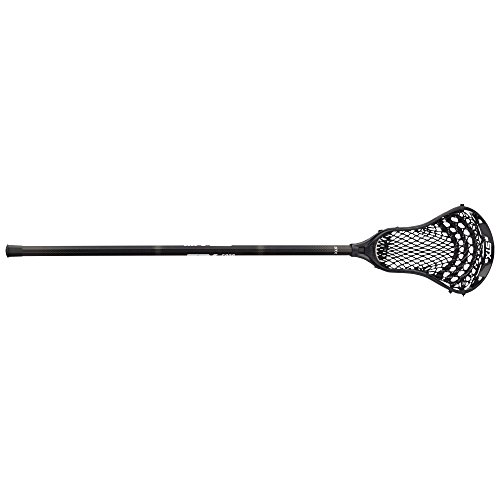
The Stallion 200 is the first full league stick in the guide, and the one seen in half the bags at any town practice. The head takes its shape from STX’s elite Stallion U550, with a wide face flare and a forgiving scoop that help a new player corral bouncing passes and finish ground balls on thick grass. It comes strung with soft mesh for easy catching, and the handle is STX’s 6000 series alloy at 41 inches overall, printed with tonal hand-placement graphics that show a learner where the top and bottom hands belong. The stick meets NCAA and NFHS rules as the maker states, so unlike a pure youth stick it can stay in the bag as a player moves from youth ball toward school play. Two honest notes: the factory mesh arrives stiff and wants the pocket pounded with a ball before the first practice, and at about 0.8 pounds the alloy handle has more heft than the youth sticks above, which is the trade for a stick that refuses to bend in a ground-ball scrum.
Specs
- Format: complete stick, factory strung
- Overall length: 41 inches, attack and midfield
- Head: Stallion 200, inspired by the elite Stallion U550
- Handle: STX 6000 series alloy with hand-placement graphics
- Pocket: soft mesh
- Weight: about 0.8 lb as listed
- Rules: meets NCAA and NFHS rules as the maker states
4. Warrior Burn Next Complete Stick, Under-12

The Burn Next is the physical pick of the five, built for the under-12 player who gravitates to two-way midfield or close defense and throws poke checks and lift checks in heavy ground-ball piles. Warrior stiffens the head with reinforced sidewall struts and a slightly wider face, so the head holds its shape when it delivers a check and knocks down passes in transition instead of flexing away. The rounded EZ-Scoop lip glides over grass and turf without digging in when a player attacks a loose ball at full sprint, which turns more scrambles into clean pickups. It is sized by its maker, model BNAC1, specifically for players twelve and under, and that sizing is the honest limit: an older player needs the senior version of the line. The factory pocket comes strung fairly shallow, so plan on pounding the pocket and putting in wall-ball time to deepen the channel before the first game.
Specs
- Format: complete stick, factory strung
- Model: Warrior BNAC1
- Player tier: ages 12 and under as the maker sizes it
- Head: reinforced sidewall struts, wider face profile
- Scoop: rounded EZ-Scoop for ground balls
- Pocket: semi-soft mesh, strung shallow from the factory
5. StringKing Complete 2 Intermediate Attack Stick

The Complete 2 Intermediate is the step-up stick, for the older kid whose cradle is quiet and who is ready for a pocket that behaves like a strung-by-hand one. StringKing builds the line in age tiers, and the Intermediate tier pairs the Legend head with the A135 alloy shaft, a 30-inch handle at attack length, strung with the maker’s Type 3 semi-soft mesh in a defined mid-low channel. That channel is the teaching tool: the ball settles in the same spot on every catch and leaves off the same release point on every throw, so a developing player learns their own mechanics instead of compensating for a pocket that changes with the weather. There is no break-in period to speak of, and the setup pulls out of the box ready for practice. It asks more of the player than the four sticks above, in length, in precision, and in the upkeep of a real mesh pocket, which is why it sits last: it is the stick a child grows into after a season or two on a youth complete, not the stick a first practice should start with.
Specs
- Format: complete stick, factory strung
- Tier: Intermediate, the middle age tier of the Complete 2 line
- Shaft: A135 alloy, 30 inches, attack length
- Head: Legend
- Pocket: Type 3 semi-soft mesh, mid-low channel
- Break-in: none needed as the maker states
Questions Families Ask
When should a child move from soft balls to a game ball? Once catches are quiet and consistent with the soft ball at close range, and always with a helmet and mouthguard on once a hard ball and game-speed throws enter the session. The soft ball is the learning tool, not a season-long substitute.
Can a stick be cut down for a smaller child? Youth programs do it often, and a coach or shop can trim an alloy shaft so the length matches the player’s height. Cut the stick for the player in front of you, and keep league minimum lengths in mind: the youngest groups play in a 37-to-42-inch window, and under-12 field sticks must run at least 40 inches.
How often should the pocket depth be checked? Before the season, after the first few wet practices, and whenever passes start releasing late. Mesh stretches as it settles, and the ten-second check in this guide catches a deepening pocket before an official does.
Do these sticks work for girls’ lacrosse? No. The girls’ game is played with a shallow pocket by rule, and a boys’ pocket fails that check. A girl starting out needs a complete stick built and strung for the girls’ game.
The Short Version
For the youngest players, start short and soft: the 28-inch Signature Starter for clinic ages, then the 39-inch Stallion 50 for a first league season. The Stallion 200 is the dependable first full-length league stick, the Burn Next is the tough under-12 option for two-way players, and the StringKing Complete 2 Intermediate is the step-up once the cradle is quiet. Whichever one comes home, the habits decide how fast a child improves: soft balls first, helmet and mouthguard for game-speed play, a length matched to the child’s height, a pocket checked before league play, and wall ball before games.
More from Amazon
Programs that pair well with the guide above. Offers and eligibility are set by Amazon and may change.
A free business account with business pricing and bulk-buying tools for work, shop or home office.
Create a business accountFree shipping on eligible items, Prime Video and more. Eligible new members can start with a free trial.
Start a Prime free trialAudiobooks and podcasts to listen to on the go. Eligible new members can start with a free trial.
Try Audible freeAd-free music streaming. Eligible new subscribers can start with a free trial.
Try Music Unlimited freeAs an Amazon Associate we earn from qualifying purchases.


Write Your Review
No reviews yet. Be the first to share your experience!