
Key takeaways
- Find the best pogo sticks for kids with sturdy frame picks, foam grip designs, and weight matched springs for safe driveway bouncing fun every day.
A spring pogo stick is the older-kid step up from the foam jumper. The toddler class, covered in our foam pogo jumpers guide, is a soft foam base and a bungee cord that gives a small hop in place. The sticks in this guide are a different build: a metal frame, a real spring, foot pegs, and handles, and they travel across the ground as they bounce. That build is what makes them fun for school-age kids, and it is also why the fit rules matter more here. Every pick below is a spring stick with a stated maker weight band, and the whole guide turns on one idea: match the stick to the child in front of you, put a helmet on that child, and bounce on flat pavement with room to fall. None of the foam jumper picks from the toddler guide appears here, and none of these spring sticks belongs in a toddler’s hands.
Disclosure: As an Amazon Associate, I earn from qualifying purchases. Product details were verified at the time of writing.
How to Choose a Pogo Stick for a Kid
Match the weight band first, before color, before brand. The weight band on a pogo stick listing is a maker figure for the spring, and it is a working range, not a ceiling to grow into. A child below the bottom of the band cannot compress the spring enough to bounce at all, so the stick feels dead and the child leans and twists to force it, which is how falls happen. A child above the top of the band bottoms the spring out on every landing, which slams the frame, shortens its life, and throws the bounce off line. A stick that is too strong is unsafe for a light child, and a stick that is too weak is unsafe for a heavy one. Weigh the rider, read the band, and buy the stick whose band holds the child near its middle, with headroom to grow but not a whole size up.
Treat a helmet as part of the purchase, not an extra. A pogo stick puts a child’s head higher than standing height on a moving, spring-loaded frame, and every learner falls, usually sideways, in the first sessions. A bike helmet that fits snugly and sits level is required kit for every bounce session, along with closed shoes that grip the pegs. Knee and elbow pads earn their place for the first weeks. If a child will not wear the helmet, the stick stays in the garage; that rule is the whole safety culture of this toy in one line.
Pick the bouncing ground like it matters, because it does. Spring sticks belong on flat, dry pavement: a clear driveway with no cars moving in or out, a quiet patio, or an empty stretch of sidewalk. Keep the space away from traffic, street edges, slopes, gravel, wet leaves, and grass, where the tip can skate or sink. A driveway only counts as a bouncing space while it is closed to cars; a stick session and a reversing car never share the same slab. Clear the fall zone of bikes, stones, and garden tools before the first hop.
Look for an enclosed spring and a covered frame. The better kids’ sticks hide the spring inside the frame or a tube, which keeps fingers, shoelaces, and shirt hems out of the coil and keeps grit off the moving parts. Foam wrapping over the metal frame softens the knock when a learner’s shin or chest meets the stick mid-fall. Wide, textured foot pegs and a wide bounce tip give a new rider a bigger target and a steadier landing, and foam or rubber grips keep hands on the handles when palms get sweaty.
Keep the youngest bouncers on foam. A child under five, or any child who cannot yet jump with both feet and land in balance, is not ready for a spring stick, whatever the birthday math says. The foam jumper class exists for exactly that stage: it hops in place, it cannot travel, and a fall lands on soft parts. Graduate to a spring stick when the child can hop in place repeatedly, stop on purpose, and follow the helmet and clear-space rules without being reminded every minute.
Check the stick before each session. Look at the bounce tip for wear, the pegs for tightness, the grips for splits, and the frame for bends or cracks, especially after a hard fall. A worn tip that slips on pavement and a loose peg are small faults that cause real falls. Retire a stick with a bent frame or a cracked weld rather than handing it down.
The 5 Best Pogo Sticks for Kids
1. Flybar Maverick Pogo Stick, Black/Silver
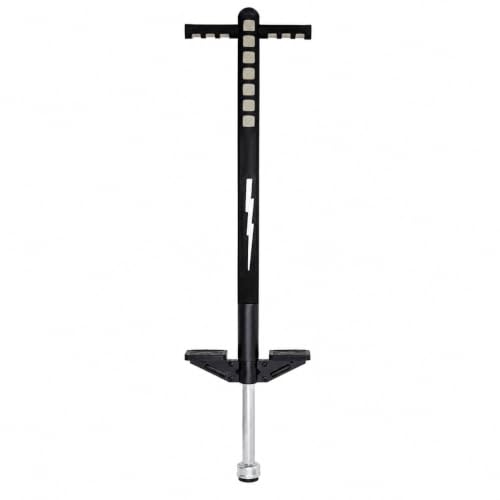
The classic first spring stick, and the one most families should start with. Flybar has made pogo sticks since 1918, and the Maverick is its junior model: a metal frame wrapped in foam, a fully enclosed spring, extra-wide textured foot pegs, easy-grip handles, and a rubber bounce tip. The maker band runs from 40 to 80 pounds for children aged five and up, which covers most early grade-school riders, and the stick arrives fully assembled at 37.5 inches tall and about 4 pounds, light enough for a child to carry to the driveway alone. The foam-covered frame matters most in the first week, when falls are frequent and the stick is usually part of the landing. Tips, grips, and footrests are replaceable parts on this line, so a worn tip does not end the stick’s life. For a first spring stick in the 40 to 80 pound band, this is the benchmark the rest of the shelf is measured against.
Specs
- Brand: Flybar
- Model: 2050
- Design: Foam-covered metal frame, fully enclosed spring
- Maker weight band: 40 to 80 pounds
- Maker age line: 5 years and up
- Item weight: 4 pounds
- Item dimensions: 9.5 x 2.6 x 37.5 inches
- Assembly: None required
- ASIN: B0017W5U1E
2. Flybar Jolt Pogo Stick, Leopard

The playful sibling of the Maverick, built for beginners in the same weight band with a lighter, slimmer feel. The Jolt carries a foam-wrapped frame, foam handles that small hands can hold securely, and anti-slip foot pegs, and Flybar frames it for children aged six and up in the 40 to 80 pound band. Where the Maverick is the plain benchmark, the Jolt sells motivation: the leopard print and the other bright finishes in the line are what get a hesitant child outside for the daily practice that turns wobbly hops into steady bouncing. The build is a step lighter in the hand than the Maverick, which suits a smaller six-year-old at the bottom of the band who finds the bigger stick tiring to hold upright between hops. Same band rules apply: a rider well under 40 pounds will not work this spring either, and that child belongs on a foam jumper for another season.
Specs
- Brand: Flybar
- Model: FB101597
- Design: Foam-wrapped frame, foam handles, anti-slip foot pegs
- Maker weight band: 40 to 80 pounds
- Maker age line: 6 years and up
- Finish: Leopard print (other finishes in the line)
- Assembly: None required
- ASIN: B08PTK1HB7
3. Geospace Jumparoo Boing! JR. Pogo Stick

The steel junior pick, for the bigger young rider who sits above the Flybar junior band. Geospace builds the Boing! JR. around a steel frame with the spring fully encased in a steel housing tube, so there is no exposed coil anywhere along the stick. The foot pegs use non-slip grip tape rather than molded rubber, the T-handle carries foam grips, and the stick stands about 36 inches tall with roughly 4 inches of foot space per peg. The maker band runs from 50 to 90 pounds, a step higher than the junior Flybars, which makes this the honest fit for a solid seven- to ten-year-old who bottoms out a 40 to 80 pound stick. The encased spring and the wide rubber foot give it a planted, steady feel on pavement. Buy it when the rider’s weight, not age, says the junior band is already too soft.
Specs
- Brand: Geospace
- Design: Steel frame, spring fully encased in a steel tube
- Foot pegs: Non-slip grip tape surface
- Handles: T-handle with foam grips
- Maker weight band: 50 to 90 pounds
- Maker age line: 5 years and up
- Height: About 36 inches
- ASIN: B00727FN60
4. Razor Gogo Pogo Stick

The fold-up pick, for families short on storage and for bouncing away from home. Razor builds the Gogo around a fully enclosed spring mechanism with low-friction bushings, so the moving parts stay sealed inside the pole, away from grit, water, and small fingers. Its foot pegs fold flat against the frame, which makes the stick easy to store in a closet corner or carry in a car trunk to a grandparent’s driveway. The maker line covers riders aged six and up to 143 pounds, a wide band that spans older kids and lighter teens on one stick. That wide band cuts both ways: a light six-year-old near the bottom of it will work harder to get the bounce going than on a junior stick sprung for 40 to 80 pounds, so for a small beginner the junior picks above remain the easier first ride. For an older child who needs one stick that folds away, the Gogo is the practical answer.
Specs
- Brand: Razor
- Model: Gogo
- Part number: 10068001
- Design: Enclosed spring with low-friction bushings, folding foot pegs
- Maker weight band: Up to 143 pounds
- Maker age line: 6 years and up
- Frame: Metal pole with sealed inner parts
- Storage: Foot pegs fold flat
- ASIN: B00C4Z5PIQ
5. Flybar Master Pogo Stick

The full-size step up, for tweens and teens who have outgrown the junior bands. The Master is Flybar’s bigger stick: a foam-wrapped metal frame, a fully enclosed spring, non-slip foot pads, easy-grip handles, and a wide bounce tip for stability at the higher bounce a stronger spring gives. The maker band runs from 80 to 160 pounds for riders aged nine and up, and the stick stands 42 inches tall at about 7 pounds. This is the stick a child graduates to when a junior spring bottoms out under them, and the band rule matters most here in reverse: do not buy the Master early for a 60 pound child to grow into, because that child cannot compress its spring and will fight it from the first hop. Bought at the right weight, it carries a rider through the teen years, and it arrives ready to bounce with no assembly.
Specs
- Brand: Flybar
- Model: Master
- Part number: 4015
- Design: Foam-wrapped metal frame, fully enclosed spring, wide bounce tip
- Maker weight band: 80 to 160 pounds
- Maker age line: 9 years and up
- Item weight: 7 pounds
- Item dimensions: 12.25 x 2.5 x 42 inches
- Assembly: None required
- ASIN: B00J7U8XQW
Quick Comparison
| Stick | Brand | Maker weight band | Starting age | Standout trait | Best for |
|---|---|---|---|---|---|
| Maverick | Flybar | 40 to 80 pounds | 5 years | Foam-covered frame, replaceable tip and grips | The classic first spring stick |
| Jolt, Leopard | Flybar | 40 to 80 pounds | 6 years | Bright finishes, light in the hand | Beginners who bounce for the fun print |
| Jumparoo Boing! JR. | Geospace | 50 to 90 pounds | 5 years | Spring sealed in a steel tube, grip tape pegs | Bigger young riders above the junior band |
| Gogo | Razor | Up to 143 pounds | 6 years | Folding foot pegs, sealed spring | Storage, travel, older kids on one stick |
| Master | Flybar | 80 to 160 pounds | 9 years | Wide bounce tip, full-size frame | Tweens and teens stepping up |
FAQ
What weight should a child be for a first pogo stick?
Most junior spring sticks are sprung for 40 to 80 pounds, and the rider should sit inside that band, ideally near its middle. Below the bottom of the band the spring will not compress and the stick feels broken; above the top it bottoms out on every landing. Both ends of that mistake are unsafe, so weigh the child and match the band honestly instead of buying a size up to grow into.
Does a child need a helmet for a pogo stick?
Yes, every session. A pogo stick raises a child’s head above standing height on a moving spring frame, and learners fall sideways while they find the rhythm. A snug, level bike helmet is required kit, closed shoes are the footwear, and pads are a sound addition for the first weeks. No helmet, no bouncing is the rule that keeps this toy fun.
Where can kids bounce a pogo stick safely?
On flat, dry pavement with a clear fall zone: a driveway closed to cars, a quiet patio, or an empty sidewalk stretch, always away from traffic and street edges. Grass, gravel, slopes, and wet or leafy surfaces let the tip slip or sink. A driveway with a car coming or going is a road, not a play space, until the car is parked and the keys are inside.
What is the difference between a pogo stick and a foam pogo jumper?
A foam pogo jumper is the toddler class: a wide foam base and a bungee cord, giving a small hop in place with no metal and no spring. A pogo stick is a metal frame with a real spring that travels across the ground as it bounces, and it needs far more body weight to work. Foam jumpers suit children from about age three; spring sticks start around age five and 40 pounds, and the two classes never substitute for each other.
How long will a kids’ pogo stick last?
Usually until the rider outgrows the weight band, which is the natural replacement point. The frame and spring outlast the wear parts: check the bounce tip, pegs, and grips before sessions, and replace a worn tip when the maker offers spares, as Flybar does for the Maverick line. A bent frame, a cracked weld, or a spring that no longer returns evenly are retirement signs, and that stick should not be handed down.
Verdict
Start most children on the Flybar Maverick: its 40 to 80 pound band, foam-covered frame, and enclosed spring make it the soundest first spring stick for riders aged five and up. The Flybar Jolt is the same band in a lighter, brighter package for the beginner who needs a fun finish to stay motivated, while the Geospace Jumparoo Boing! JR. is the right call when a bigger young rider already sits in the 50 to 90 pound range and needs its sealed steel build. The Razor Gogo earns its place where storage and travel matter, folding flat and spanning older kids on one wide band, and the Flybar Master is the honest step up for tweens and teens in the 80 to 160 pound band. Whichever stick comes home, the rules travel with it: match the weight band, helmet on for every session, flat pavement with the cars kept out, and foam jumpers, not spring sticks, for the youngest bouncers.
More from Amazon
Programs that pair well with the guide above. Offers and eligibility are set by Amazon and may change.
A free business account with business pricing and bulk-buying tools for work, shop or home office.
Create a business accountFree shipping on eligible items, Prime Video and more. Eligible new members can start with a free trial.
Start a Prime free trialAudiobooks and podcasts to listen to on the go. Eligible new members can start with a free trial.
Try Audible freeAd-free music streaming. Eligible new subscribers can start with a free trial.
Try Music Unlimited freeAs an Amazon Associate we earn from qualifying purchases.
Write Your Review
No reviews yet. Be the first to share your experience!