
Key takeaways
- Compare the best toddler tool sets with wooden benches, plastic tools, and carry cases sized for small hands learning to hammer, turn, and build safely.
A toddler tool set is a pretend play kit: chunky toy hammers, screwdrivers, and wrenches sized for small hands, with toy screws and bolts that actually turn, thread, and come apart again. That boundary defines this guide, and it is worth stating plainly. Every pick below is a toy, made of wood or molded plastic, with blunt edges and parts too big for a fist to hide. None of them is a real tool. The junior kits sold with small metal hand tools for older children are a different product class for a different age, and so are the grown-up benches and tool chests covered elsewhere on this site. If a listing shows steel edges, a working blade, or an age line that starts at eight, it does not belong in a toddler’s hands, no matter how it is marketed.
Within the toy class, the five picks split by format and material. Two are wooden carry-along toolboxes in the classic mold, one is a full plastic workbench with battery-powered pretend power tools, one is a small electronic toolbox that talks a toddler through simple projects, and one is a recycled-plastic set built for the youngest builders in the group. All five give a child something real to do with their hands: a bolt that threads into a nut, a screw that sinks into a board, a peg that takes a hammer tap and pops back out. That working feedback, not lights or logos, is what separates a tool set a toddler returns to from one that ends up at the bottom of the toy bin.
Disclosure: As an Amazon Associate, I earn from qualifying purchases. Product details were verified at the time of writing.
How to Choose a Toddler Tool Set
Match the format to the space and the child. A carry-along toolbox holds a dozen or two pieces, travels to a grandparent’s house, and stores on a shelf. A workbench holds far more, anchors a play corner, and gives two children room to work side by side, but it claims floor space full time and takes assembly before the first session. Children who like to follow a caregiver from room to room with a project in hand usually do better with a box; children who set up elaborate pretend jobs do better with a bench.
Wood and plastic play differently. Wooden sets feel solid, survive being handed down, and keep their play quiet: a wooden screw turns with a soft scrape, not a click. Plastic sets can do things wood cannot, including battery drills that spin and whir, molded parts in bright colors that small eyes track easily, and pieces that wash clean after a sandbox session. Neither material is automatically safer. What matters is the finish and the fit: paint that does not flake, parts molded in one piece where a toddler will pry, and fasteners big enough to stay out of a mouth.
Working parts teach more than decoration. The sets that hold attention longest let a child complete a small loop: choose a tool, fit it to a fastener, turn or tap until something changes, then undo it and start again. Look for screws that thread into real holes, nuts that spin onto bolts, and a vice or peg board that holds the workpiece still. A printed picture of a screw on a flat board offers none of that, and toddlers figure out the difference within a day.
Count the loose pieces honestly. More pieces means more building options and more cleanup. Sets in this guide run from 15 pieces to 75, and the big workbench count includes dozens of screws, nuts, and nails that will migrate under furniture. For a first set at age two, fewer and larger pieces are the right call. For a four-year-old who sorts and inventories, a bigger count is a feature. Either way, a box or bench with a place for every piece makes the end-of-day reset far more likely to happen.
Check the age line and the small parts. Every pick below carries a maker age line of two or three years and up, and the wooden sets earn their three-plus line honestly: their nuts, bolts, and screws are the smallest parts in this guide. A set that suits a three-year-old may not suit a mouthing eighteen-month-old, even a sturdy one. Read the age line on the box, keep loose fasteners counted and stored up high between sessions for the youngest builders, and retire any piece that cracks, splinters, or loses a chunk.
1. Melissa & Doug Take-Along Tool Kit Wooden Construction Toy (24 Pieces)

The Take-Along Tool Kit is the reference wooden toolbox, and its strength is that everything in it works. The 24 pieces include a wooden hammer, wrench, and screwdriver with easy-grip handles, plus wooden nails, screws, nuts, and bolts that fit into holes and peg boards and connect to each other in different combinations. A toddler can drive a nail into the board, thread a nut onto a bolt, then pack the whole project into the sturdy toolbox with its carry handle and take it to the next room. The solid wood construction shrugs off the drops and throws of daily play, and the bright painted finish has made this set a hand-me-down staple for years. It asks nothing from batteries and makes no noise of its own, which many households count as a feature. Choose it for a child of three or older who is ready for real threading and fitting, and who will use the box as much as the tools.
Specs
- Style: wooden carry-along toolbox set
- Pieces: 24, including toolbox, hammer, wrench, screwdriver, wooden nails, screws, nuts, bolts, and boards
- Material: solid wood with painted finish
- Skills: fine motor skills, hand-eye coordination, imaginative play, number recognition
- Age: 3 years and up (maker range 36 months to 6 years)
- Dimensions: 9.84 x 4.72 x 5.51 in
- Item weight: 800 g
- Model: 494
2. Hape Fix-It Tool Box and Accessory Play Set

Hape’s Fix-It Tool Box is the other classic wooden carry set, and it leans harder into the building side of the bench. Alongside the hammer, screwdriver, and wrench, the box carries a ruler and a working vice, plus screws, bolts, and flat wooden construction pieces that bolt together into small assemblies. That last part matters: where many sets stop at poking fasteners into a board, this one lets a child join two pieces, carry the result around, and take it apart again. The parts are cut from wood with water-based finishes in Hape’s usual muted palette, and the box itself doubles as the work surface, with holes along its sides sized for the included hardware. It suits the same three-and-up crowd as the Melissa & Doug kit; pick between them on whether your builder prefers a fuller toolbox of loose fasteners or construction pieces that become little projects.
Specs
- Style: wooden carry-along tool box set
- Includes: hammer, screwdriver, wrench, ruler, vice, screws, bolts, and wooden construction pieces
- Material: wood
- Age: 3 years and up
- Dimensions: 7.09 x 5.51 x 10.24 in
- Item weight: 0.9 kg
- Model: E3001
3. BLACK+DECKER Junior Power Tool Workshop (75 Pieces)

This is the big plastic workbench of the group, built by JAKKS Pacific under the BLACK+DECKER name, and it is the pick for a child who wants the full workshop rather than a box of hand tools. The bench stands 38 inches tall with storage trays and a backboard, and the 75 tools and accessories include a miter saw, a drill press, a hand saw, a screwdriver, a hammer, a wrench, a vice, a bonus flashlight, and a toy phone, plus 15 screws, 5 nails, 22 nuts, and wood pieces a child assembles into a tool caddy of their own. The battery-powered stations add the lights and sounds of a working shop floor, which is exactly the draw for preschoolers who watch real projects happen in the garage. It needs adult assembly, floor space, and batteries, and its fasteners are the smallest and most numerous here, so it fits best from age three up in a home with a play corner to spare.
Specs
- Style: freestanding plastic workbench with storage trays
- Pieces: 75 tools and accessories, including miter saw, drill press, vice, hand saw, hammer, wrench, screwdriver, flashlight, 15 screws, 5 nails, 22 nuts, and buildable tool caddy pieces
- Features: battery-powered action with lights and sounds
- Material: plastic
- Age: 3 to 6 years (maker range 36 months to 6 years)
- Dimensions: 38 x 16.25 x 21 in
- Item weight: 4 kg
- Model: 81878
4. VTech Drill and Learn Toolbox
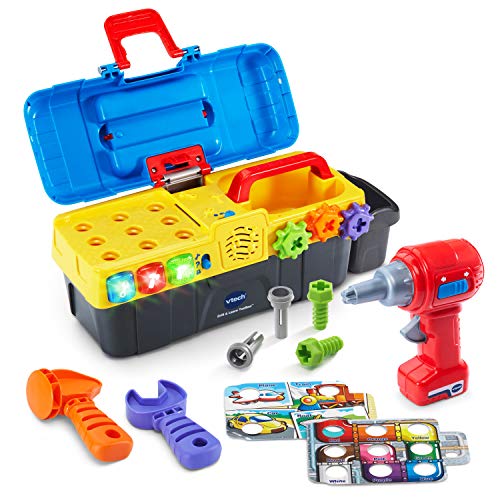
The VTech toolbox is the electronic pick, sized for the younger end of the range. Inside the carry case sit a hand-powered toy drill, a hammer, and a wrench, two nails and two screws, and an electronic project tray that works with two double-sided activity cards. Slotting a card in and pressing the light-up buttons walks a child through simple fix-it jobs with songs, phrases, and tool sounds, and the drill spins the included screws into the tray for a satisfying cause-and-effect loop. There is less open-ended building here than in the wooden sets: the projects are guided, and the fastener count is small. What it offers instead is a gentle on-ramp for a two-year-old who is not ready to thread a nut but is very ready to press, spin, and hammer with feedback. Everything packs back into the case, which keeps the small part count manageable.
Specs
- Style: electronic carry-along toolbox with project tray
- Includes: hand-powered toy drill, hammer, wrench, 2 nails, 2 screws, electronic project tray, 2 double-sided activity cards
- Features: light-up buttons, songs, phrases, and tool sounds tied to guided projects
- Age: 2 to 5 years
- Model: 80-178200
5. Green Toys Tool Set, Pink (15 Pieces)

Green Toys builds this set in the USA from 100 percent recycled plastic, and it is the simplest, youngest-skewing kit in the guide. The 15 pieces are a toolbox, a Phillips screwdriver, a flat screwdriver, a hammer, a saw, a wrench, pliers, two two-hole connectors, two nails, two bolts, and two nuts, and the toolbox sides carry holes that accept the hardware so the box itself is the first project. Each tool has its name printed on the handle, a quiet vocabulary lesson that also helps a caregiver ask for the wrench by name. The plastic contains no BPA, phthalates, or PVC, has no external coatings to chip, and goes in the dishwasher when play gets grubby, which makes this the easiest set here to hand to a two-year-old and the easiest to clean afterward. The trade-off is depth: with two of each fastener, builds stay small, and a four-year-old will outgrow it sooner than the bigger kits.
Specs
- Style: recycled plastic carry-along tool set
- Pieces: 15, including toolbox, Phillips and flat screwdrivers, hammer, saw, wrench, pliers, 2 connectors, 2 nails, 2 bolts, and 2 nuts
- Material: 100 percent recycled plastic, no BPA, phthalates, or PVC
- Care: dishwasher safe
- Origin: made in the USA
- Age: 2 years and up
- Model: TLSP2-CB2
Comparison Table
| Pick | Format | Pieces | Material | Age | Defining strength |
|---|---|---|---|---|---|
| Melissa & Doug Take-Along Tool Kit | Carry toolbox | 24 | Wood | 3+ | Working wooden fasteners that thread and fit |
| Hape Fix-It Tool Box | Carry tool box | Construction set with vice and ruler | Wood | 3+ | Pieces bolt together into small assemblies |
| BLACK+DECKER Junior Power Tool Workshop | Freestanding workbench | 75 | Plastic | 3–6 | Full bench with powered stations and lights |
| VTech Drill and Learn Toolbox | Electronic toolbox | Guided project set | Plastic | 2–5 | Talking tray and cards guide first projects |
| Green Toys Tool Set, Pink | Carry tool set | 15 | Recycled plastic | 2+ | Dishwasher safe, sized for the youngest builders |
FAQ
What age is right for a first toddler tool set?
Most children are ready for a simple set around age two, when they can grip a chunky handle and enjoy copying a caregiver’s motions. At two, choose large pieces, few fasteners, and no small loose hardware, like the recycled plastic and electronic picks in this guide. From age three, children gain the finger strength and patience for threading nuts onto bolts, and the wooden sets with real working fasteners become the better match.
Are wooden or plastic tool sets better for toddlers?
Both work, and the better question is what kind of play you want. Wooden sets are quiet, heavy in the hand, and built around mechanical play: turning, fitting, tapping. Plastic sets can add spinning drills, lights, and sounds, and they wash clean easily. A household that values open-ended building usually lands on wood; a household with a two-year-old who loves buttons usually lands on an electronic plastic set first.
How is a toddler tool set different from a junior real tool kit?
A toddler tool set is a toy through and through: blunt molded or wooden edges, oversized handles, and fasteners too large to swallow, designed for pretend repairs. A junior kit contains actual small hand tools with metal edges, sold for older children to use on real projects with an adult beside them. The two classes share shelf space and search terms, so check the age line and materials on any listing before it goes near a toddler.
What should I check for safety before the first play session?
Read the maker’s age line and follow it, since it reflects the smallest part in the box. Run a hand over wooden pieces for splinters and over plastic pieces for cracked or sharp molding seams. Count the loose fasteners so you know when one has wandered off, and store small hardware out of reach between sessions for children under three. Retire any piece that cracks or breaks rather than taping it back together.
How do I get more play out of a tool set once the novelty fades?
Set up pretend jobs with a purpose: a wobbly toy chair to fix, a cardboard box garage to build, a stuffed animal ambulance to repair. Work alongside your child with your own toy tool and narrate the steps, since copying an adult is the engine of this kind of play. Rotating the set away for a few weeks and bringing it back also works; toddlers greet a returning toolbox like an old friend.
Verdict
For most families, the Melissa & Doug Take-Along Tool Kit is the first buy: real threading fasteners, a box that carries everything, and wood that survives years of daily work. Choose the Hape Fix-It Tool Box instead if your builder wants construction pieces that bolt together into finished little projects, and step up to the BLACK+DECKER Junior Power Tool Workshop when a preschooler needs a full bench with powered stations and room for a friend. The VTech Drill and Learn Toolbox is the gentlest start for a two-year-old who learns by pressing and listening, and the Green Toys Tool Set is the pick for the youngest builders and the easiest cleanup, in recycled plastic that goes straight in the dishwasher. Whichever set lands on the workbench, keep the fasteners counted, the sessions supervised, and the pretend jobs coming.
More from Amazon
Programs that pair well with the guide above. Offers and eligibility are set by Amazon and may change.
A free business account with business pricing and bulk-buying tools for work, shop or home office.
Create a business accountFree shipping on eligible items, Prime Video and more. Eligible new members can start with a free trial.
Start a Prime free trialAudiobooks and podcasts to listen to on the go. Eligible new members can start with a free trial.
Try Audible freeAd-free music streaming. Eligible new subscribers can start with a free trial.
Try Music Unlimited freeAs an Amazon Associate we earn from qualifying purchases.





Write Your Review
No reviews yet. Be the first to share your experience!