
Key takeaways
- Compare soccer balls for kids by sizes, panel builds and textures, with the right-size-by-age rule and soft-inflation-check habit families use.
A soccer ball is the one piece of gear a young player touches on every single play, and the decision that matters most is not the brand on the panel — it is the size number stamped beside the valve. A ball matched to the child’s age band is one they can dribble close, strike cleanly, and trap without it bouncing off a shin. A ball a size too big teaches the opposite of control: toe pokes, shinned clearances, and a foot that never learns where the surface is. The five balls below are all youth balls in sizes 3 and 4, the two sizes that cover the years from a first kickabout to the end of grade school. They span the three panel builds families will meet — machine-stitched synthetic leather, a firm PVC training cover, and a textured training casing — and both bladder types, butyl and latex. This guide is about balls sold on their own: the soft balls packed inside toddler goal sets are toys for set play, rubber kickballs are a different playground tool, and the size 5 ball is the adult match size, deliberately left out here.
Disclosure: As an Amazon Associate, I earn from qualifying purchases. Product details were verified at the time of writing.
How to Choose a Soccer Ball for a Kid
Size is matched to age band, and the chart is the rule. Youth soccer runs on a fixed ladder. Size 1 is a mini skills ball, about 18 to 20 inches around, for the youngest toddlers and for juggling games. Size 2, at 20 to 21 inches, suits roughly ages 3 and 4. Size 3 measures 23 to 24 inches in circumference and is the league ball for players under 8. Size 4 measures 25 to 26 inches and covers ages 8 through 12. Size 5, at 27 to 28 inches, is the adult match ball and the standard from about age 13 up — it does not belong in this guide or under a young child’s foot. Buy the size the chart gives for the age the child is now. A ball bought big to grow into is a ball the child cannot control today, and control is the whole point of these years.
Panel build decides touch and lifespan. Machine-stitched synthetic leather is the classic youth build: the seams give the foot something to feel, the cover stays soft enough for close dribbling, and the ball behaves like the ones used in league play. A PVC cover is the hard-wearing training build — firmer underfoot, less forgiving on a cold morning, but it shrugs off driveway and playground duty that would scuff a softer panel. Textured casings add grip to the surface, which helps a ball stay honest on damp grass and gives a young striker a more predictable strike. Thermally bonded covers, seamless and water-shedding, belong mostly to the older match shelf and are not what the balls below are built on.
The bladder is the air story. A butyl bladder holds its pressure for weeks, so the ball that felt right on Saturday feels right at the next session — that is why four of the five picks use one. A latex bladder gives a livelier bounce off the foot, the feel match players prefer, but it breathes air slowly and needs topping up far more often. For a family ball that lives in a garage between practices, butyl is the practical build; a latex pick is a fine ball as long as someone owns the pump habit that comes with it.
Inflate to the figure printed on the ball — and no further. Every ball carries its inflation figure printed near the valve, and that number is the target, not a starting point. A rock-hard ball is the wrong ball: it stings young feet, bounces off shins instead of settling, and is exactly the ball a child should not be heading. The check families use is a soft one — press both thumbs into a panel and the surface should give slightly under firm pressure while the ball still holds a clean round shape. Moisten the needle before it goes into the valve, every time: a dry needle pushed in dry tears the valve lining, and a torn valve is the slow leak no pump schedule can fix. Top up little and often rather than forcing a soft ball back to hard in one session.
Where the ball is played is a safety decision. Keep play on grass or a closed court, away from roads, and set the rule before the first kick for the youngest players: a ball that rolls toward the street stays there until an adult fetches it — nobody chases a ball into a road, ever, at any score. Check the ball itself before sessions too: split seams, panels lifting at the stitching, and a valve that hisses are all retire-or-repair signals, because a ball that fails mid-kick goes wherever it wants. On wet days, wipe the cover down and let it dry out of direct heat so the panels do not stiffen and crack.
The 5 Best Soccer Balls for Kids
1. Wilson Traditional Soccer Ball, Size 3

The default first real ball, and the one most families should start from. The Traditional wears the classic black-and-white panel look a young player recognizes from televised matches, in a genuine size 3 scaled for the under-8 years. The cover is synthetic leather over machine-sewn panels, which gives it the stitched feel of a league ball rather than the slick surface of a toy, and the butyl bladder underneath is the air-holding build — the ball keeps its pressure between sessions instead of greeting the weekend half soft. At about 11 ounces it is light enough for a young leg to strike through cleanly, yet it still rolls true on grass, which is the combination a first ball has to get right. The honest limits are the class limits: it is a recreational and training ball rather than a club match ball, the cover scuffs sooner on pavement than on grass, and the pressure wants a check before sessions rather than blind trust. None of that changes its place — it is the straightforward size 3 that looks, feels, and behaves like the real thing.
Specs
- Size: 3 (23–24 in circumference), for players under 8
- Cover: Synthetic leather
- Panels: Machine-sewn, traditional black-and-white design
- Bladder: Butyl rubber
- Weight: Just over 11 oz
- Best for: First league seasons and backyard practice, roughly ages 5 to 8
- ASIN: B001C3O8O8
2. GoSports Classic Soccer Ball, Size 4

The size 4 stepping stone, sold as a complete setup rather than a ball alone. GoSports ships this ball with a hand pump in the box, and that inclusion is the point: a ball nobody can inflate lives in the garage, so the pump is not an accessory but the difference between a ball that gets used and one that does not. The build follows the same recipe as the Wilson above — synthetic leather cover, butyl bladder — in the larger size 4 form for the 8-to-12 years, with more surface to strike and a slightly heavier feel through the foot as legs grow into it. A small detail earns its mention: the inflation needle stores inside the pump handle, so the one part every ball owner eventually loses has a home. The trade-offs are plain ones. Air retention can vary between balls, so the thumb-press check before sessions matters here, and the cover shows wear faster under mostly-concrete duty. For one player moving up from a size 3, it is the simplest single purchase in the guide.
Specs
- Size: 4 (25–26 in circumference), for ages 8 to 12
- Cover: Synthetic leather
- Bladder: Butyl
- Included: Hand pump with needle stored in the handle
- Best for: The move up from size 3; backyard practice and casual games
- ASIN: B06XFKPC8M
3. Wilson Team FX Soccer Ball, Size 4
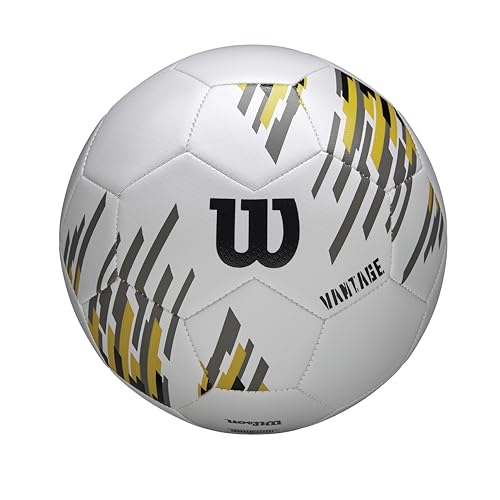
The second size 4 in the guide, and the pick for the child whose practice runs into dim evenings. The Team FX is built on a 32-panel casing of machine-stitched synthetic leather, a softer-touch build than a bonded cover, with a butyl bladder holding the shape and pressure through daily backyard sessions. Its distinguishing feature is the reflective panel graphics: under flat, overcast light or late-day sun, the panels catch what light there is and stay easier to track, which matters more than it sounds for an eight-year-old judging a moving ball. The weight sits comfortably in the size 4 band for the 8-to-12 years. The limits are the stitched build’s own: seams loosen eventually under heavy artificial-turf duty, so a child playing mostly on turf will wear this ball faster than a grass player will, and it is a training and recreational ball rather than a certified match ball. On grass, for the league-age player who practices after school until the light goes, it is the right tool.
Specs
- Size: 4 (25–26 in circumference), for ages 8 to 12
- Cover: Machine-stitched synthetic leather
- Panels: 32-panel casing with reflective graphics
- Bladder: Butyl
- Best for: Grass practice and league training in low or flat light
- ASIN: B0DF8RVR23
4. Franklin Sports Competition 100 Soccer Ball, Size 4

The hard-wearing training ball, built for the family that goes through balls rather than collecting them. The Competition 100 wears a PVC cover, the firmest build in this guide: it feels harder underfoot than the synthetic leather picks and gives less back on a cold morning, and in exchange it takes driveway, playground, and fence-line duty that would chew a softer panel apart. Inside is a latex bladder, the lively build — the ball comes off the foot with more spring, and the honest trade for that liveliness is air: latex breathes, so this ball wants the pump more often than any butyl pick here, and the moistened-needle habit matters double. Bright colorways keep it visible in long grass and crowded practice bags. Framed plainly, it is the practice ball for high-volume kicking — the one that goes to the park, takes the wall work, and gets replaced without ceremony when it finally wears through, while a softer ball stays home for league days.
Specs
- Size: 4 (25–26 in circumference), for ages 8 to 12
- Cover: PVC
- Bladder: Latex — livelier bounce, needs more frequent topping up
- Colors: Bright colorways for visibility
- Best for: Driveway and park training, wall work, multi-ball practice sets
- ASIN: B000067R1G
5. Nike Pitch Team Soccer Ball, Size 4

The drill-work ball, from the training line Nike builds for repetition rather than ceremony. The Pitch Team casing is machine-stitched with a textured surface, and the texture is functional: on damp grass the panels keep a grip that smooth covers lose, so passes and first touches behave the same in the third drill as in the first. A butyl bladder holds the pressure steady across a week of sessions. The Pitch Team line is sold across sizes 3, 4, and 5; the pick here is the size 4, the 8-to-12 league size, and families with a younger player should order the same ball in its size 3 form rather than sizing a child up early. It is firmer in feel than a hand-stitched match ball and carries no match certification — it is not trying to. It is the ball a coach would fill a practice bag with: consistent flight, a surface that survives daily turf and grass contact, and a touch that stays predictable while a young player puts in repetitions.
Specs
- Size: 4 on this pick (the line also runs sizes 3 and 5)
- Cover: Machine-stitched synthetic casing with textured panels
- Bladder: Butyl
- Best for: Team training sessions and daily drill work, ages 8 to 12
- ASIN: B0DBZFH325
Comparison Table
| Product | Size | Cover | Bladder | Best for |
|---|---|---|---|---|
| Wilson Traditional | 3 | Synthetic leather, machine-sewn | Butyl | First real ball, under 8 |
| GoSports Classic | 4 | Synthetic leather | Butyl | Size 4 step-up with pump included |
| Wilson Team FX | 4 | Synthetic leather, machine-stitched, 32-panel | Butyl | League-age practice in flat or fading light |
| Franklin Competition 100 | 4 | PVC | Latex | Hard-wearing driveway and park training |
| Nike Pitch Team | 4 | Synthetic, textured panels | Butyl | Team drills and daily repetition |
Verdict
For the under-8 years, the Wilson Traditional is the ball to buy first: a genuine size 3 with a stitched synthetic leather cover, a butyl bladder, and the classic look that makes practice feel like the real game. When a player moves into the 8-to-12 band, the GoSports Classic is the easiest step up because the pump travels with it, while the Wilson Team FX suits the child practicing on grass into the evening and the Franklin Competition 100 takes the driveway and wall work that would wear the others down. The Nike Pitch Team is the training-bag ball, textured for wet grass and built for daily repetition. Whichever one comes home, the rules do not change: size matched to the age band, inflation set to the figure printed on the ball and checked with a thumb press, the needle moistened before it ever meets the valve, and play kept on grass away from roads — with a ball that rolls toward the street left for an adult to fetch.
FAQ
What size soccer ball does my child need?
Match the size to the age band, not to height or enthusiasm. Size 3 is the ball for players under 8, size 4 covers ages 8 through 12, and size 5 is the adult match size from about 13 up. Sizes 1 and 2 are mini and toddler balls for the youngest children and for skills games. If your child plays in a league, its age chart settles the question — order the size the league plays with.
How firm should a kids’ soccer ball feel?
Inflate it to the figure printed near the valve on the ball itself, then check with your thumbs: the panel should give slightly under a firm press while the ball holds a clean round shape. A rock-hard ball is over the mark — let a little air out. A ball pumped past its figure stings young feet, bounces off shins, and is the wrong ball for any heading practice.
Why does the needle need to be moistened?
A dry needle dragged into a dry valve tears the soft lining that seals the bladder, and a torn valve leaks slowly forever after. A drop of water or a lick on the needle before it goes in — pushed straight, never wiggled — keeps the valve intact for the life of the ball. It is the smallest habit in this guide and the one that saves the most balls.
Butyl or latex bladder — which should a family pick?
Butyl for most families: it holds pressure for weeks, so the ball is ready whenever practice is. Latex feels livelier off the foot and is the match player’s build, but it loses air steadily and needs topping up far more often. A latex ball like the Franklin above is a good ball only in a house where the pump habit already exists.
When should a child move up a size?
When the age band says so, and not before. An eight-year-old on a size 3 is not behind — but a seven-year-old handed a size 4 is fighting the ball instead of learning from it. The move from 3 to 4 usually lands with the league change around age 8, and size 5 waits until about 13, however much a strong 11-year-old asks for the big ball.
More from Amazon
Programs that pair well with the guide above. Offers and eligibility are set by Amazon and may change.
A free business account with business pricing and bulk-buying tools for work, shop or home office.
Create a business accountFree shipping on eligible items, Prime Video and more. Eligible new members can start with a free trial.
Start a Prime free trialAudiobooks and podcasts to listen to on the go. Eligible new members can start with a free trial.
Try Audible freeAd-free music streaming. Eligible new subscribers can start with a free trial.
Try Music Unlimited freeAs an Amazon Associate we earn from qualifying purchases.
Write Your Review
No reviews yet. Be the first to share your experience!