
Key takeaways
- Looking for the best mirrorless camera under 1000? Compare five capable APS-C and Micro Four Thirds cameras with 4K video, fast autofocus, and kit lenses.
A mirrorless camera under 1000 is the sweet spot for anyone moving up from a phone or an older DSLR. These cameras drop the mirror box, so bodies stay compact while sensors stay large, and every model below pairs a proven sensor with 4K video and fast autofocus.
The five cameras in this guide all accept interchangeable lenses, yet they suit different shooters. One is built for stills first, one is a vlogging specialist, one is the lightest travel companion, and one is the oldest design here, still earning its place through a huge lens catalog.
As an Amazon Associate, we earn from qualifying purchases.
Our top picks
Quick Answer
The Canon EOS R50 with the RF-S 18-45mm kit lens is the best mirrorless camera under 1000 for most people, thanks to its 24.2 megapixel sensor, fast subject tracking, and simple controls. Vloggers should look at the Sony ZV-E10, and the Nikon Z30 suits creators on a tighter budget.
1. Canon EOS R50 with RF-S 18-45mm Lens Kit

The Canon EOS R50 is the most balanced camera in this roundup, doing everything well rather than excelling at one narrow job. Its 24.2 megapixel APS-C sensor and DIGIC X processor deliver clean files, while Dual Pixel CMOS AF II tracks people, animals, and vehicles across the frame with 651 autofocus zones.
The R50 records 6K oversampled 4K video at up to 30 frames per second without a crop, and Full HD slow motion reaches 120 frames per second. The vari-angle touchscreen flips around for selfies and vlogging, and the electronic viewfinder gives a clear view in bright sunlight. The included RF-S 18-45mm f/4.5-6.3 IS STM lens covers wide angle to short telephoto, so a second lens is not needed on day one.
Specs
- Sensor: 24.2 megapixel APS-C CMOS with DIGIC X processor
- Autofocus: Dual Pixel CMOS AF II with 651 zones and subject detection
- Video: 6K oversampled 4K up to 30 fps, Full HD up to 120 fps
- Screen: 3.0 inch vari-angle touchscreen, 1.62 million dots
- Viewfinder: 0.39 inch OLED electronic viewfinder, 2.36 million dots
- Continuous shooting: up to 12 fps, 15 fps with electronic shutter
- Lens: RF-S 18-45mm f/4.5-6.3 IS STM kit lens
- Price grouping: mid-range
2. Sony Alpha a6400 with 16-50mm Lens Kit
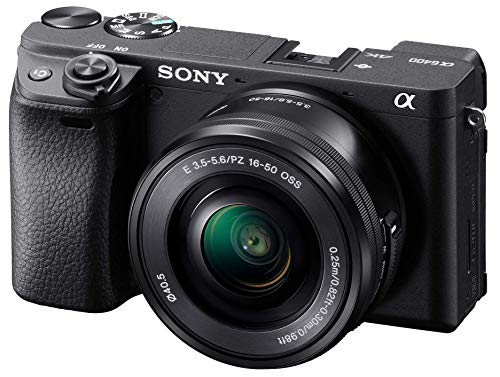
The Sony Alpha a6400 is the autofocus champion of this group, and its focusing system still outperforms most newer budget cameras. Its 24.2 megapixel APS-C Exmor CMOS sensor pairs with the BIONZ X processor, and the 425 phase detection plus 425 contrast detection points cover most of the frame. Real-Time Eye AF locks onto eyes and holds them through movement.
Burst shooting reaches 11 frames per second with continuous autofocus, so sports and wildlife are within reach at this level. Video records in 4K with full pixel readout, oversampled from 6K, and supports HDR, S-Log3, and Full HD at 120 frames per second. The 3 inch LCD tilts up 180 degrees for self recording, and touch focus starts tracking with a tap. There is no in-body image stabilization, so the lens or a tripod does the steadying, and the menu system takes time to learn.
Specs
- Sensor: 24.2 megapixel APS-C Exmor CMOS with BIONZ X processor
- Autofocus: 425 phase detection and 425 contrast detection points, Real-Time Eye AF
- Video: 4K with full pixel readout, HDR, S-Log3, Full HD 120 fps
- Screen: 3.0 inch tiltable touchscreen, 180 degree flip for self recording
- Viewfinder: electronic viewfinder
- Continuous shooting: up to 11 fps with continuous autofocus
- Lens: 16-50mm f/3.5-5.6 power zoom kit lens
- Price grouping: mid-range
3. Sony Alpha ZV-E10 Body

The Sony Alpha ZV-E10 is the only camera here built from the ground up for vlogging, and that focus shows in every design choice. It uses the same 24.2 megapixel APS-C sensor and BIONZ X processor as the a6400, with the same 425 point autofocus system, Real-Time Eye AF, and Real-Time Tracking, so video and stills stay sharp. The side flip screen makes framing a selfie shot simple, and the directional three capsule microphone picks up voices from in front of the camera.
A Product Showcase mode shifts focus instantly from a face to an object held up to the lens, and background defocus can be switched on with one button for a soft, blurred backdrop. The camera records 4K video and slow motion in Full HD, and offers a headphone jack plus a Multi Interface shoe for digital microphones. This listing is for the camera body only, so a lens must be bought separately, and there is no electronic viewfinder, so composing in bright sunlight relies on the rear screen.
Specs
- Sensor: 24.2 megapixel APS-C CMOS with BIONZ X processor
- Autofocus: 425 autofocus points, Real-Time Eye AF and Real-Time Tracking
- Video: 4K video, Full HD slow motion, Product Showcase mode
- Screen: 3.0 inch side flip vari-angle touchscreen
- Viewfinder: none, composition uses the rear LCD screen
- Continuous shooting: up to 11 fps
- Lens: body only, lens sold separately, Sony E mount
- Price grouping: budget
4. Nikon Z30 with 16-50mm Lens Kit

The Nikon Z30 is the smallest and lightest Z series camera, and it is aimed squarely at creators who want good video without a steep learning curve. Its 20.9 megapixel APS-C sensor records crisp 4K video at up to 30 frames per second, and eye detection autofocus tracks people and pets. The flip out touchscreen faces forward for self recording, a red light shows when the camera is rolling, and the built-in microphone has adjustable sensitivity.
The Z30 works as a plug and play webcam over USB-C for Full HD streaming, and it can stream 4K over HDMI, with constant power over USB-C so long sessions are not cut short. The included NIKKOR Z DX 16-50mm f/3.5-6.3 VR lens is a compact retractable zoom, and the Z mount accepts the full range of NIKKOR Z lenses, so the kit grows as skills grow. The Z30 skips an electronic viewfinder, which keeps the body small but makes bright daylight shooting a screen only affair.
Specs
- Sensor: 20.9 megapixel APS-C CMOS
- Autofocus: eye detection for people and pets, 209 autofocus points
- Video: 4K up to 30 fps, Full HD 60p streaming over USB-C
- Screen: 3.0 inch vari-angle touchscreen, 1.04 million dots
- Viewfinder: none, composition uses the rear LCD screen
- Continuous shooting: up to 11 fps
- Lens: NIKKOR Z DX 16-50mm f/3.5-6.3 VR kit lens
- Price grouping: budget
5. Panasonic Lumix G7 with 14-42mm Lens Kit

The Panasonic Lumix G7 is the veteran of this group, and it earns its place through a combination of a low entry cost, a mature lens system, and video features that were ahead of their time. Its 16 megapixel Micro Four Thirds sensor is smaller than the APS-C sensors above, which keeps the body and lenses compact, and the 14-42mm f/3.5-5.6 Mega O.I.S. kit lens covers a useful 28 to 84 millimeter equivalent range. The 4K Photo mode extracts still frames from 4K video at 30 frames per second, so a fleeting expression can be caught after the fact.
Video reaches 4K UHD, and the camera offers a microphone port and a remote port, which are rare at this level. The 2.36 million dot OLED electronic viewfinder is bright and detailed, and the 3 inch free angle touchscreen flips and tilts for awkward angles. The smaller sensor shows its limits in low light, and 16 megapixels leaves less room to crop. The Micro Four Thirds mount answers with one of the largest lens catalogs in mirrorless photography.
Specs
- Sensor: 16 megapixel Micro Four Thirds Live MOS
- Autofocus: contrast detection with face detection, 49 points
- Video: 4K UHD, 4K Photo mode, microphone port
- Screen: 3.0 inch free angle touchscreen
- Viewfinder: OLED electronic viewfinder, 2.36 million dots
- Continuous shooting: up to 7 fps
- Lens: 14-42mm f/3.5-5.6 Mega O.I.S. kit lens
- Price grouping: budget
How to Choose a Mirrorless Camera Under 1000
Start with the sensor and the lens mount, because those two choices shape everything that follows. APS-C sensors gather more light than Micro Four Thirds and give a shallower depth of field. Micro Four Thirds keeps bodies and lenses smaller and cheaper, which suits travel. Lenses last longer than bodies, so check that the lenses you want exist in the mount before committing.
Next, weigh autofocus and video together. Fast eye detection matters for portraits and pets, while 4K video with a flip screen matters for vlogging and streaming. A viewfinder matters for stills in bright sun, while a fully articulating screen matters for self recording. Handling the cameras in person often settles the choice faster than a specification sheet.
Who Should Skip These Cameras
These five cameras suit beginners, hobbyists, and creators, but they are not the right pick for everyone. Professional wedding and sports photographers need faster burst rates, dual card slots, and weather sealing that budget bodies do not offer. Anyone who wants the shallowest depth of field and the cleanest high ISO files should consider a full frame camera, at a higher cost. Travelers who want the smallest possible kit may prefer a premium compact camera.
Frequently Asked Questions
Is a mirrorless camera under 1000 good enough for professional work?
It depends on the work. These cameras produce sharp stills and clean 4K video that suit portraits, events, product photography, and online content. Paid work that demands dual card slots and heavy weather sealing calls for a higher tier body, but many creators start here and upgrade later.
Do I need to buy a lens separately?
Four of the five cameras here include a kit lens in the box, so they are ready to shoot on day one. The Sony ZV-E10 listing in this guide is for the body only, so a lens must be bought separately. A 16-50mm or 18-45mm kit lens is the usual first choice.
Which mirrorless camera under 1000 is best for vlogging?
The Sony ZV-E10 is the strongest vlogging pick because it was designed for creators, with a directional microphone, Product Showcase mode, and a side flip screen. The Canon EOS R50 and Nikon Z30 are close behind, with vari-angle screens and reliable face tracking.
Can these cameras shoot 4K video?
Yes, all five cameras in this guide record 4K video. The Canon EOS R50 oversamples from 6K for extra detail, the Sony a6400 and ZV-E10 record full pixel readout 4K, the Nikon Z30 records 4K at up to 30 frames per second, and the Panasonic G7 records 4K UHD.
Final Verdict
The Canon EOS R50 is the best mirrorless camera under 1000 for most buyers, because it combines a 24.2 megapixel sensor, class leading subject tracking, oversampled 4K video, and a friendly interface. The Sony a6400 suits photographers who prize autofocus speed, the Sony ZV-E10 suits dedicated vloggers, the Nikon Z30 suits creators who want the simplest path to good video, and the Panasonic Lumix G7 suits learners who want the lowest cost entry.
FAQ
Is a mirrorless camera under 1000 good enough for professional work?
Do I need to buy a lens separately?
Which mirrorless camera under 1000 is best for vlogging?
Can these cameras shoot 4K video?
More from Amazon
Programs that pair well with the guide above. Offers and eligibility are set by Amazon and may change.
A free business account with business pricing and bulk-buying tools for work, shop or home office.
Create a business accountFree shipping on eligible items, Prime Video and more. Eligible new members can start with a free trial.
Start a Prime free trialAudiobooks and podcasts to listen to on the go. Eligible new members can start with a free trial.
Try Audible freeAd-free music streaming. Eligible new subscribers can start with a free trial.
Try Music Unlimited freeAs an Amazon Associate we earn from qualifying purchases.



Write Your Review
No reviews yet. Be the first to share your experience!