
Key takeaways
- Find the best power bank for cameras, phones, and tablets. Compare capacity, charging speed, weight, and ports to pick reliable portable power for travel.
A dead camera battery ends a shoot, and a dead phone ends the navigation, the calls, and the payment apps that a working day depends on. A power bank is the simplest insurance against both problems, and it fits in the same pocket as a lens cap. For photographers, the right bank keeps a mirrorless body, a phone, and a tablet topped up between locations without adding a heavy brick to the bag.
The best power bank is not always the biggest one. Capacity, output speed, port choice, weight, and recharge time all pull in different directions, and a bank that suits a weekend trip may be the wrong pick for a long shoot day. This guide compares five portable chargers across those trade-offs so you can match one to the gear you carry.
As an Amazon Associate, we earn from qualifying purchases.
Quick Answer
For most photographers and travellers, the Anker PowerCore 10K is the best power bank overall, because it balances a pocketable size with enough capacity for two phone charges. The Nitecore NB10000 GEN2 is the lightest pick for location work, the Nitecore NB20000 Gen 3 adds capacity for tablets and long days, and the Anker PowerCore 26800 suits multi-device kits that need a week of power.
Anker Power Bank (PowerCore 10K)

The Anker PowerCore 10K is the most straightforward pick in this roundup. It holds 10,000mAh, enough to recharge a typical phone twice, and its compact, travel-ready shape slides into a camera bag side pocket or a jacket pocket. Anker pairs PowerIQ charging with VoltageBoost, so the bank adjusts its output to suit the connected device rather than delivering a fixed, slow trickle.
This model carries one USB-C port and one USB-A port. The USB-C port handles both input and output, while the USB-A port handles output only, and a micro USB input is also available for recharging the bank itself. Output reaches 15W, which suits phones, earbuds, and small accessories. A full recharge takes around five hours, so an overnight charge is the practical routine. It is a budget pick that covers the most common use case: keeping a phone alive through a long day away from power.
Specs
- Capacity: 10,000mAh
- Output: up to 15W
- Ports: 1 USB-C, 1 USB-A, micro USB input
- Model number: A1229
- Charging tech: PowerIQ and VoltageBoost
- Recharge time: around 5 hours with a suitable charger
- Price group: budget
Anker PowerCore 10000 PD Redux
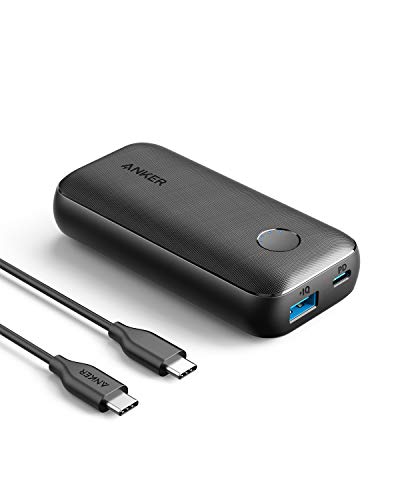
The Anker PowerCore 10000 PD Redux is the pick for anyone who wants faster USB-C charging from a 10,000mAh bank. Its USB-C Power Delivery port outputs up to 18W, which shortens the time a phone or tablet spends tethered to the bank, and the USB-A port adds a second output for a companion device. It also supports trickle charging, a low-power mode for earbuds, smartwatches, and other small accessories that draw very little current.
Capacity matches the PowerCore 10K above, so the choice between them comes down to output speed rather than runtime. The PD Redux recharges in around three hours with an 18W USB PD wall charger. That matters on a shoot day with a short break between locations, when the bank itself needs a fast top-up. It is a mid-range pick for photographers who charge a phone and a camera accessory at the same time.
Specs
- Capacity: 10,000mAh
- Output: up to 18W USB-C Power Delivery
- Ports: 1 USB-C PD, 1 USB-A
- Model number: AK-A1239011
- Charging tech: Power Delivery, PowerIQ, trickle charging
- Recharge time: around 3 hours with an 18W USB PD charger
- Price group: mid-range
Nitecore NB10000 GEN2

The Nitecore NB10000 GEN2 is built for people who count every gram. Its carbon fiber shell keeps the weight at 150 grams, and at 10.6mm thick it is about half the thickness of a conventional 10,000mAh bank. That makes it an easy fit in a camera bag that is already full of lenses, and it disappears into a jacket pocket on a hike or a location scout.
Despite the light build, the bank carries a full 10,000mAh cell and supports two-way PD and Quick Charge 3.0 through its USB-C port, with a USB-A port as the second output. It also has a low-current mode for earbuds, wearables, and other low-draw devices. The carbon fiber construction adds rigidity without the weight of a metal shell. It is a premium pick, and the extra cost buys weight savings rather than extra capacity, so it suits buyers who value a light kit above all else.
Specs
- Capacity: 10,000mAh
- Output: up to 18W USB-C
- Ports: 1 USB-C, 1 USB-A
- Model number: NB10000
- Weight: 150 grams
- Thickness: 10.6mm
- Material: carbon fiber shell
- Price group: premium
Nitecore NB20000 Gen 3

The Nitecore NB20000 Gen 3 doubles the capacity of the banks above while keeping the same carbon fiber approach. Its 20,000mAh cell can recharge a phone several times over, and it has enough headroom for a tablet, a camera body, and a phone across a long day. Two USB-C ports let it charge two devices at once, and it can also recharge itself through one port while powering a device from the other.
Each USB-C port outputs up to 22.5W, the fastest single-port output in this roundup, and a USB-C to USB-A adapter is included for older cables. Four blue LED indicators show the remaining charge at a glance, and the low-current mode carries over for earbuds and wearables. The shell is rated IPX5 for water resistance, a useful safeguard outdoors in rain. It is a premium pick for photographers who run a tablet for tethered shooting or client previews and need one bank to cover the whole kit.
Specs
- Capacity: 20,000mAh
- Output: up to 22.5W per USB-C port
- Ports: 2 USB-C, USB-A via included adapter
- Model number: NB20000
- Weight: 10.26 ounces
- Material: carbon fiber shell
- Water resistance: IPX5
- Price group: premium
Anker PowerCore 26800
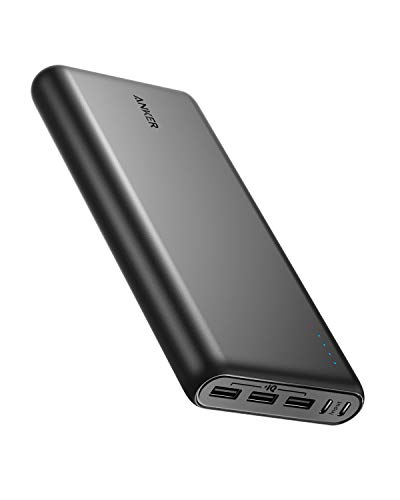
The Anker PowerCore 26800 is the high-capacity pick in this roundup. Its 26,800mAh cell can charge a phone more than six times, and it can recharge a tablet at least twice, which makes it the right choice for multi-day trips, long events, and kits that include several devices. Three USB-A ports let it charge three devices at the same time, so a phone, a camera accessory, and a tablet can all draw power together.
Dual micro USB inputs cut the recharge time to around six and a half hours when both ports are used. The trade-off is weight: at 1.09 pounds, it is the heaviest bank here, and it belongs in a bag rather than a pocket. It has no USB-C port, so USB-C devices need a USB-A to USB-C cable. It is a mid-range pick for photographers who work far from wall power for days at a time and prioritise total capacity over portability.
Specs
- Capacity: 26,800mAh
- Output: up to 6A total across three USB-A ports
- Ports: 3 USB-A, 2 micro USB inputs
- Model number: A1277
- Weight: 1.09 pounds
- Recharge time: around 6.5 hours using both input ports
- Price group: mid-range
How to choose
Start with capacity. A 10,000mAh bank covers a phone for a day and a half of normal use, a 20,000mAh bank covers a phone and a tablet, and a 26,800mAh bank covers several devices across several days. Bigger capacity always means more weight, so buy only as much as the trip demands.
Next, check output speed and ports. USB-C Power Delivery matters for tablets and cameras that accept USB-C charging, because a slow port can take hours to add a useful amount of charge. Count the devices that will charge at once, and make sure the bank has enough ports for them.
Weight and recharge time are the final filters. A light carbon fiber bank is worth the premium when the kit is carried on foot all day, while a heavy high-capacity bank is the better buy when it rides in a car or a rolling case. Airline rules allow power banks up to 100 watt-hours in cabin baggage, and every bank in this roundup sits within that limit, but always confirm the current rules with the airline before flying.
Who should skip
A power bank is the wrong buy when wall power is always nearby. Studio photographers who work next to outlets, and office workers who charge at a desk, gain little from carrying extra weight. A wall charger and a spare cable cover those cases better.
Skip the high-capacity banks when the kit travels light. A 26,800mAh bank is overkill for a short walk with one camera and one phone. Likewise, skip banks without a USB-C port when every device in the kit already uses USB-C. Finally, anyone who needs to charge a laptop should look for a bank with a higher USB-C Power Delivery output than the models here, because none of these five is designed as a primary laptop charger.
Frequently Asked Questions
What size power bank is best for a camera bag?
A 10,000mAh bank is the best size for most camera bags. It recharges a phone twice, tops up a camera body or a tablet once, and adds very little weight. Step up to 20,000mAh for a tablet used in tethered shooting, and reserve 26,800mAh banks for multi-day trips away from wall power.
Can a power bank charge a camera directly?
Many modern mirrorless cameras accept USB-C charging, and a bank with a USB-C output can charge them while they are switched off or, in some models, while shooting. Check the camera manual first, because some bodies only charge when powered down, and older cameras with no USB-C port need a dedicated battery charger.
How many times will a 10,000mAh power bank charge a phone?
A 10,000mAh bank typically recharges a modern phone about twice. Conversion losses mean the usable energy is less than the labelled capacity, and the exact number depends on the phone battery size and whether the phone is in use while charging.
Is it safe to take a power bank on a plane?
Power banks must travel in cabin baggage, never in checked luggage, and most airlines accept banks up to 100 watt-hours without prior approval. Every bank in this roundup falls within that limit, so check the airline rules before travelling, since policies can change.
Final verdict
The Anker PowerCore 10K is the best power bank for most photographers and travellers, because it covers the common case of a phone and a small accessory at a budget grouping and a pocketable size. The Anker PowerCore 10000 PD Redux is the better pick when faster USB-C charging matters, and the Nitecore NB10000 GEN2 is the best choice for anyone who carries a kit on foot all day. For longer days and tablet use, the Nitecore NB20000 Gen 3 covers the whole kit, while the Anker PowerCore 26800 is the right answer for multi-day trips with several devices. Pick the capacity that matches the longest day away from wall power, and the rest of the decision follows from weight and ports.
FAQ
What size power bank is best for a camera bag?
Can a power bank charge a camera directly?
How many times will a 10,000mAh power bank charge a phone?
Is it safe to take a power bank on a plane?
More from Amazon
Programs that pair well with the guide above. Offers and eligibility are set by Amazon and may change.
A free business account with business pricing and bulk-buying tools for work, shop or home office.
Create a business accountFree shipping on eligible items, Prime Video and more. Eligible new members can start with a free trial.
Start a Prime free trialAudiobooks and podcasts to listen to on the go. Eligible new members can start with a free trial.
Try Audible freeAd-free music streaming. Eligible new subscribers can start with a free trial.
Try Music Unlimited freeAs an Amazon Associate we earn from qualifying purchases.





Write Your Review
No reviews yet. Be the first to share your experience!