
Key takeaways
- Compare tackle boxes for kids by tray layouts, latches and sizes, with the hook-covers-on rule and one-box-per-child habit fishing families use.
A tackle box is the piece of fishing gear a child actually owns. The rod is often shared, the boat belongs to someone else, but the box — its trays, its lures, its one perfect bobber — is theirs. That ownership is the point of this guide: five boxes sized for children, from a fish-shaped starter kit a five-year-old can carry in one hand to a classic one-tray box an older kid will still be using in the teen years. These are boxes only. The rod and reel outfits that sometimes ship with a small box in the bag live in our fishing kits guide; here, the box itself is the product, whether it arrives empty or with a starter load of tackle inside.
The safety theme of this whole class is hooks, and it deserves a plain paragraph before the picks. A tackle box exists to keep sharp things in their slots. A hook stored loose in a tray — or worse, a lure with treble hooks tossed in uncovered — is exactly the injury this box is meant to prevent: a small hand reaching in for a bobber and finding a point instead. So the rules are simple and they do not bend. Hooks live covered or seated in their own compartment, never loose. Lures with treble hooks are handled by an adult for young kids, both on the bank and when the box is being packed. The box gets latched before it is carried, every time — an unlatched box tipped on a dock spills hooks across boards small feet walk on. And the small lead weights in these kits are adult-handled pieces: an adult pinches them on, and hands get washed after rigging, before snacks.
Disclosure: As an Amazon Associate, I earn from qualifying purchases. Product details were verified at the time of writing.
How to Choose a Tackle Box for Kids
Start with the latch, because the latch is the safety system. Everything else in this guide is convenience; the latch is what keeps hooks inside the box between the car and the water. A brass bail latch flips up with one thumb and stays shut when the box is dropped. A snap closure is easier still for small fingers, but it can pop if the box is kicked over. Whatever you choose, run the home test before the first trip: the child opens it, closes it, and carries it across the room by the handle. A box a child cannot latch alone is a box that travels unlatched.
Match the tray layout to how the child fishes. A single tray over a deep bin suits a beginner: bobbers, hooks, and split shot in the tray where small hands can see them, bulkier things below. Fixed compartments keep each hook type in its own slot, which is the habit that keeps fingers safe. Adjustable dividers suit the older child whose lure shelf keeps changing. A flat, pocket-size utility box is a different tool — it holds a handful of lures for a child who fishes beside an adult carrying the main kit.
Decide whether tackle comes inside. Four of the five picks here arrive with tackle in the box: hooks, bobbers, weights, and a lure or two, sorted by an adult before the first trip. That is the easy route for a first box. An empty box is the better buy when the family already owns tackle, or when an adult wants to build the kit around one pond and one species. Either way, read the included list for treble hooks — those lures are tied on by adult hands, not dug out by small ones.
Keep the weight honest. A box a child cannot carry is a box an adult carries, and then the sorting habit never forms. Under a pound empty is a good target for kids under seven. Around thirteen inches long is about right for a ten-year-old who fishes most weekends. The one-box-per-child habit matters more than the box itself: each child carries, opens, and latches their own, and each box comes home with the same hooks it left with — counted in slots, not scattered in a shared bin.
Treat the maker age line as a floor, not a promise. A box marked for young children still holds real hooks. The age line speaks to size and latch strength, not to a child’s judgment around sharp tackle. The adult sorts the box, the adult handles the treble hooks, and the child’s independence grows one taught step at a time.
The 5 Best Tackle Boxes for Kids
1. Shakespeare Customize-It Kids Tackle Box

The Customize-It is built around a simple idea: a child looks after a box that feels like theirs. It ships with three sheets of stickers — letters, shapes, and fish — so the first job is covering the lid in stickers, and the second is learning where everything goes. Inside, a spill-proof tray keeps small pieces in their compartments when the box gets tipped in the car, and two quick-access compartments in the lid hold the bobber and lure a child reaches for most. The 29 included pieces cover the standard first rigs, and the two practice casting plugs are worth more than any lure in the box: a child can rehearse the cast in the yard with nothing sharp on the line. The honest limits: at just under two and a half pounds with its tackle inside, it is the heaviest pick here, and its single tray fills faster than a multi-tray box once a child starts collecting lures in earnest. As a first box for a child of five to nine, it is the one most likely to be carried, latched, and looked after — because it has their name on it, in stickers.
Specs
- Brand: Shakespeare
- Type: Hard-sided tray box with tackle included
- Size: 13 × 8 × 8 in
- Weight: 2.46 lb with tackle inside
- Tray: Spill-proof tray, two quick-access compartments in the lid
- Tackle included: 29 pieces of assorted tackle
- Extras: 2 practice casting plugs, 3 sticker sheets
- Best for: A first box a child decorates and claims as their own
2. Flambeau Outdoors Wild Bite Bass Tackle Box Kit

The Wild Bite is the youngest-skewing box here, and it leans into that honestly: the box is shaped like a bass, weighs well under a pound, and opens to seven compartments a small hand can understand at a glance. The 25 included pieces — hooks, weights, and bobbers — are the panfish basics, and the box adds two teaching pieces most kits skip: a spade-and-plier multi-tool sized for the bank, and a printed pocket guide that names the bass, panfish, and trout a child is actually likely to meet. It is made in the USA, and at under nine ounces it is the one box in this guide a five-year-old carries from car to dock without handing it off. The honest limits are the flip side of its size: the shallow body holds a starter kit and little more, there is no deep bin for bulkier gear, and a child who fishes every weekend will outgrow it within a couple of seasons. That is the right trade for a first box — small, light, and fully understood beats big and half empty.
Specs
- Brand: Flambeau Outdoors
- Model: Wild Bite Bass Kit
- Type: Fish-shaped hard box with tackle included
- Size: 10.75 × 7 × 1.88 in
- Weight: 8.6 oz
- Compartments: 7
- Tackle included: 25 pieces — hooks, weights, and bobbers
- Extras: Spade-and-plier multi-tool, printed pocket fish guide
- Origin: Made in the USA
- Best for: Kids under seven carrying their first box
3. Wakeman Outdoors Single Tray Tackle Box with 55-Piece Tackle Kit
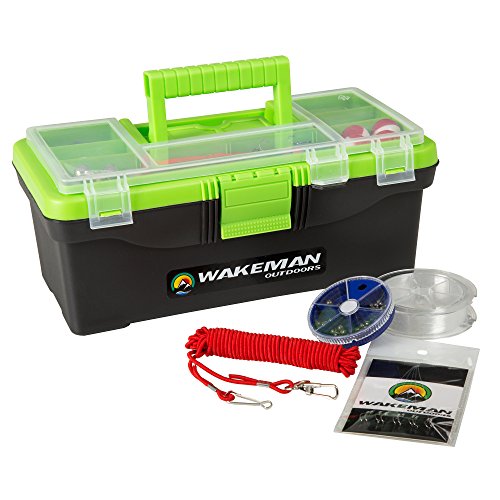
The Wakeman is the most tackle-forward pick in this guide: 55 pieces in a classic single-tray layout, aimed at the older child who fishes often enough to need a real assortment. The removable tray holds the small pieces over a main bin, a storage compartment in the lid keeps the most-used items on top, and the included kit runs wider than the other starter loads here — snelled hooks and jig heads, a spoon and a crankbait, soft plastics, sinkers, bobbers, plus a line clipper, a hook remover, and a spool of line. That width is also the honest caution: the crankbait carries treble hooks, and this box should be sorted by an adult before its first trip, with the treble-hook lures set aside as adult-tied pieces. At close to thirteen inches it is a lot of box for a small child, but for a ten-year-old who fishes every weekend it is about right — one tray, everything visible, nothing buried.
Specs
- Brand: Wakeman Outdoors
- Type: Single-tray hard box with tackle kit included
- Size: 12.75 × 7 × 5.5 in
- Tray: Removable tray over main bin, storage compartment in the lid
- Tackle included: 55 pieces — snelled hooks, jig heads, spoon, crankbait, soft plastics, sinkers, bobbers
- Tools included: Line clipper, hook remover, fishing line
- Best for: Older kids who fish most weekends and want the full assortment in one box
4. Plano Take Me Fishing One-Tray Tackle Box

This is the classic red box, built the way tackle boxes have been built for decades: one tray with ten fixed compartments over bulk storage, closed by a brass bail latch that flips up with a thumb and stays shut when the box is dropped on a dock. It arrives with a starter tackle kit inside, so a child can fish the day it comes home, and Plano directs part of the proceeds to the Future Fisherman Fund. The fixed compartments are the teaching feature: each hook type gets its own slot, and a slot left empty at the end of the trip means a hook left somewhere it should not be — the count-in, count-out habit this whole guide is built on. The honest limits: at just under a pound and a half with its tackle, it is mid-weight here, and the fixed layout cannot be rearranged as a child’s lure shelf changes shape. For a family that wants the traditional box a child grows into rather than out of, this is the pick.
Specs
- Brand: Plano
- Type: One-tray hard box with starter tackle included
- Color: Red
- Weight: 1.39 lb
- Tray: 10 fixed compartments, bulk storage below
- Latch: Brass bail latch
- Tackle included: Starter tackle kit
- Origin: Made in the USA
- Best for: The classic first box, and the count-in, count-out hook habit
5. Catch Co Lil’ Prowler Kids Sling Pack

The Lil’ Prowler is the soft-pack answer for the child who walks the bank instead of sitting on a dock. It is a water-resistant sling worn over the shoulder or around the waist, with three pouches that hold a few lures, a small handful of terminal tackle, and one bonus lure that ships in the pack, plus a sticker sheet for the same claim-it-as-yours effect as the Shakespeare. The strap adjusts from 22 to 42 inches, so it fits a child and still works as they grow. The honest limits define the pick: nine by four and a half inches holds a short list, not a full kit, and a sling has no hard tray — hooks belong in their pouches, in a small lidded insert, never loose against the fabric. This is the second box, not the first: the one a child grabs for an hour of walking a pond shore while the main box waits in the car.
Specs
- Brand: Catch Co (Mystery Tackle Box)
- Model: Lil’ Prowler
- Type: Soft sling pack, worn over the shoulder or around the waist
- Size: 9 × 4.5 × 3 in
- Weight: 9.9 oz
- Pouches: 3
- Strap: Adjustable, 22–42 in
- Material: Water-resistant fabric
- Extras: 1 bonus lure, sticker sheet
- Best for: Bank-walking kids who want their hands free
Quick Comparison
| Box | Layout | Size | Tackle included | Best for |
|---|---|---|---|---|
| Shakespeare Customize-It | Spill-proof tray, lid compartments | 13 × 8 × 8 in | 29 pieces + casting plugs | A first box a child decorates |
| Flambeau Wild Bite Bass Kit | 7 compartments, fish-shaped | 10.75 × 7 × 1.88 in | 25 pieces | Kids under seven |
| Wakeman Single Tray Kit | Removable tray over bin | 12.75 × 7 × 5.5 in | 55 pieces + tools | Older kids fishing most weekends |
| Plano Take Me Fishing | One tray, 10 fixed compartments | Classic one-tray size | Starter kit | The count-in, count-out habit |
| Catch Co Lil’ Prowler | 3-pouch sling pack | 9 × 4.5 × 3 in | 1 bonus lure | Walking the bank, hands free |
Care and Handling Tips
Latch it before it moves. The rule has no exceptions and no short distances: a box carried ten feet unlatched is a box that spills hooks on the dock. Latch, carry, set down, then open — in that order, every trip, until it is reflex.
Count hooks in and out. Each hook type has a slot. At the end of the trip the slots get counted before the box is latched; an empty slot means a hook is in the grass, in a sleeve, or in the car carpet, and finding it now is the whole point of the layout.
Wash hands after rigging. Split shot, sinkers, and jig heads are lead pieces handled by adults, and the habit is simple: rig, wash, then snacks. The same wash covers a day of handling lures and fish slime, and it asks nothing but a bottle of water and thirty seconds.
Dry the box open. A box latched shut wet will grow a smell and rust every hook in it by the next trip. At home it sits open on a shelf until the trays are dry, and any hook showing rust gets replaced, not filed — a dull, rusted point is the one that tears instead of sliding out.
FAQ
Should each child have their own box?
Yes — one box per child is the habit that makes the rest of this guide work. A child with their own box learns its layout, notices a missing hook, and latches it without being asked, because it is theirs. Shared boxes belong to no one, and no one counts the hooks. Start each child with a small box they can carry and let the box grow with them.
Who should handle lures with treble hooks?
An adult, for young kids — tying them on, taking them off, and packing them in the box. A treble lure carries three exposed points and moves when a fish shakes it, which is a job for practiced hands. In the box, treble lures sit in their own compartment with the points covered or the lure seated so the hooks touch nothing a small hand will grab.
Empty box or a box with tackle inside?
With tackle inside, for a first box: the hooks, bobbers, and weights are already the right small sizes, and an adult sorting the kit before the first trip doubles as the safety lesson. An empty box suits a child who already owns tackle, or a family building a kit around one pond. Four of the five picks here arrive loaded; the sling carries just a bonus lure and expects to be filled from the main box.
How big should a first tackle box be?
Small enough to carry without help and big enough for one season of tackle. Under a pound empty and around ten to thirteen inches long covers most children. A box that is too big gets left in the car; a box that is too small gets overfilled, and an overfilled tray is where hooks end up loose. When the tray is full, the answer is a bigger box — not hooks in the bin.
What goes in the box besides hooks and lures?
Bobbers, split shot, and swivels in their own slots; a small spool of spare line; the practice casting plug, which lives in the box so backyard practice is always an option; and, in an adult’s box rather than a child’s, the line clipper and hook remover. Sunscreen, snacks, and the fish guide ride in a pocket or a bag, not in the tray.
Verdict
For a first box, take the Shakespeare Customize-It if the child is five to nine and the sticker ritual will make the box feel owned — ownership is what builds the latching and counting habits. Under seven, the Flambeau Wild Bite is the honest pick: the lightest box here, seven compartments, nothing to overwhelm. The Plano Take Me Fishing is the classic route — fixed slots, a brass latch, and a layout that teaches the count-in, count-out habit by design. Older kids who fish most weekends should go straight to the Wakeman and its 55-piece assortment, sorted once by an adult. Add the Catch Co sling later, when a child starts walking the bank. Whichever box comes home, keep the pattern from the top of this guide: hooks covered or in their slots, treble lures in adult hands, the box latched before it moves, and hands washed after the lead pieces are handled.
More from Amazon
Programs that pair well with the guide above. Offers and eligibility are set by Amazon and may change.
A free business account with business pricing and bulk-buying tools for work, shop or home office.
Create a business accountFree shipping on eligible items, Prime Video and more. Eligible new members can start with a free trial.
Start a Prime free trialAudiobooks and podcasts to listen to on the go. Eligible new members can start with a free trial.
Try Audible freeAd-free music streaming. Eligible new subscribers can start with a free trial.
Try Music Unlimited freeAs an Amazon Associate we earn from qualifying purchases.
Write Your Review
No reviews yet. Be the first to share your experience!