
Key takeaways
- Compare swim fins for kids by blade lengths, foot pocket styles and size bands, with the pool-deck walking rule and rinse routine fins need after use.
A pair of fins is the simplest kick teacher a young swimmer can own. The extra blade area rewards a long, steady flutter kick, lifts the legs toward the surface, and lets a child feel what a good body line does to their speed. The wrong pair teaches the opposite lesson: blades that are too long turn kicking into slow, bicycling churn, and a loose heel slides off mid-length. The five fins below are all sold as fins for children or juniors, in kids’ size bands, and they split into the shapes that matter at lessons: one long floating fin for first body position, one adjustable open-heel fin for growing feet, and three short-blade trainers for technique work.
This guide covers fins sold on their own for pool training. It is not about snorkel bundles: our snorkel kits guide looks at mask, tube, and fin sets for travelers, which is a different purchase. Goggles and swim caps for kids each have their own guides on this site, and kickboards, the other lesson-bag staple, are covered separately as well.
Disclosure: As an Amazon Associate, I earn from qualifying purchases. Product details were verified at the time of writing.
How to Choose Swim Fins for Kids
Start with the deck rule, because it decides where fins live. Fins are never walked in on the pool deck. They go on while the swimmer sits at the pool edge with feet in the water, and they come off the same way before standing up. Walking in fins is a fall hazard on wet tile, and it bends and cracks blade tips. Any fin routine that starts with a child waddling from the changing room is the wrong routine, whatever the brand.
Treat fins as a lesson tool, never as a float aid. Fins add push; they do not hold a child up, and they are not a safety device. A child who cannot yet swim a length without support uses fins only with an adult or coach in the water alongside, working on kick drills. Buoyant fins like the FINIS pair below lift the legs and help body position, but that lift is a teaching effect, not flotation a parent can rely on.
Match blade length to the job. Long floating fins suit the youngest swimmers because the buoyant blade holds the legs up and slows the kick down into long, easy beats. Short blades are the training standard once a child swims real sets: they keep the kick quick and narrow, build leg strength, and work the ankles without the knee-bending churn a long blade invites. Adult freediving and scuba blades are far too long for this job and are not in this guide.
Fit is a heel check, not a toe check. The foot pocket should feel snug all over, with toes just reaching the end, and the deciding test is the heel: it must stay seated in the pocket when the swimmer points their toes and kicks. A heel that lifts and slips will chafe first and come off in the water second. Between sizes, fin socks can take up a little room, but they cannot rescue a pocket that is a full size too big.
Follow the maker’s size band as a floor, not a suggestion. Every maker below sizes by shoe size, and the bands differ between brands, so a size that fits in one line is not the same in another. Measure the child’s foot, read that maker’s own chart, and do not buy two sizes up to grow into: a fin bought for next year teaches this year’s swimmer to kick in a sloppy pocket. Open-heel designs with adjustable straps forgive growth best, which is why one is on this list.
Rinse, dry, and store flat. Chlorine and salt shorten the life of rubber and silicone alike. Fins get a fresh-water rinse after every swim, dry out of direct sun, and live flat rather than bent into a bag corner. That routine keeps pockets from cracking and blades from taking a permanent curl.
1. FINIS Long Floating Fins — Best for First Body Position

The Long Floating Fins are the classic first fin, and the design explains itself the moment a beginner puts them on: the natural rubber blade floats, so the legs ride high, the body flattens out, and a child who normally kicks with their head up and hips down suddenly feels the streamlined position a coach keeps describing. The long blade slows the kick into big, patient beats, which is exactly the rhythm young swimmers need before anyone asks them to kick faster. The full-foot pocket is closed at the heel, so there are no straps to fuss with, and FINIS color-codes the sizes so a parent or coach can spot the right pair across a crowded deck. The honest limits are the flip side of the design: the long blade is a body-position tool, not a strength tool, and a swimmer who has moved on to fast kick sets will find it slow. For the first season or two of lessons, though, this is the pair that teaches the most per kick.
Specs
- Type: Long-blade floating training fin
- Foot pocket: Closed heel, full foot
- Material: Natural rubber that floats in fresh and salt water
- Sizing: By US kids’ shoe size, color-coded by size
- Best use: Beginner lessons, body position and long, slow kick work
2. Arena Junior Open Heel Fins — Best for Growing Feet

Arena’s junior fin takes the open-heel route, and for families that is the practical headline: an adjustable heel strap lets one pair follow a growing foot through more than one season, and it lets siblings share a pair at the beach house without a fight over fit. The blade is short, with hydrodynamic slits that flex on the downbeat, so the fin works for proper pool training as well as holiday snorkeling, and the open heel drains and dries faster than a closed pocket after a session. Fit still needs the heel test from the How to Choose section: the strap should be set so the heel stays seated under a pointed toe, and rechecked as feet grow, because an open heel set loose will flap. As a junior line from a racing brand, the size bands run by shoe size like the rest of this list, and the smallest band is the floor for starting, not a target to grow toward.
Specs
- Type: Short-blade open-heel fin
- Foot pocket: Open heel with adjustable strap
- Blade: Short blade with hydrodynamic slits
- Sizing: Junior bands by shoe size
- Best use: Training and snorkeling crossover, kids between sizes
3. Gintenco Swim Fins for Kids — Best Silicone Trainer With a Carry Bag

Gintenco’s kids’ fin is the tidy lesson-bag pick: a short silicone blade, a soft full-foot pocket, and a mesh carry bag in the box, so the fins travel to lessons wet and come home draining instead of soaking a towel. Silicone is the comfort story here. It stays supple, shrugs off chlorine, and is gentle on skin that blisters easily in stiffer rubber pockets, which makes this a kind pick for children swimming several sessions a week. The short blade keeps the kick quick and narrow for technique sets, and the closed heel means the fit is set by the pocket alone, so the maker’s shoe-size chart deserves a careful read before ordering: order the band the foot measures in now. The same line is sold in teen and adult bands as well, which makes it easy to keep a swimmer in a familiar fin as they size up over the years.
Specs
- Type: Short-blade training and travel fin
- Foot pocket: Closed heel, full foot
- Material: Silicone
- Extras: Mesh carry bag included
- Sizing: By shoe size, kids’ bands in a line that runs to adult sizes
- Best use: Weekly lessons, swim-team practice, travel
4. Prsca Kids Short Swim Fins — Best Soft Rubber Lap Trainer

Prsca builds its kids’ fin for the pool first: a short, flexible rubber blade and a snug closed-heel pocket shaped for lap swimming rather than reef wandering. The soft rubber is forgiving on young ankles and kind to skin during longer practice, and the short blade promotes the fast, small kick that builds technique and leg strength without letting a swimmer muscle through sets with slow, deep beats. This is the pair for a child who already swims lengths and is starting to do real kick sets with a squad or a coach. The snug fit is the point and the caution in one: it should feel close all over without pinching, fin socks help if the pocket rubs at the toes, and the heel-seat check matters here as much as anywhere, because a training fin that shifts during a hard set teaches nothing but frustration.
Specs
- Type: Short-blade lap training fin
- Foot pocket: Closed heel, full foot, snug fit
- Material: Soft rubber
- Sizing: Kids’ bands by shoe size
- Best use: Lap swimming, kick sets, technique and leg strength work
5. Fanwill Kids Short Blade Fins — Best for the Youngest Beginners
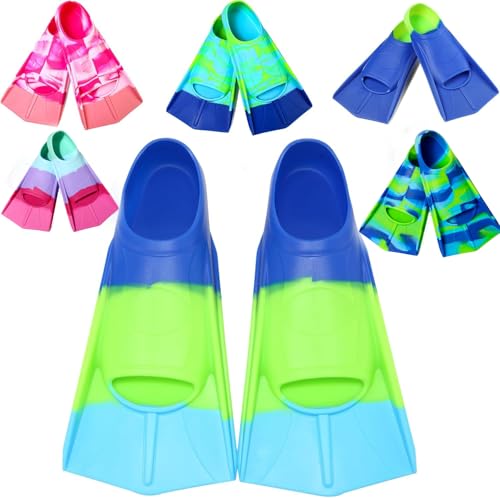
Fanwill’s short-blade fin earns its place on sizing alone: the line runs down to an XXS band, which puts a proper training fin on the smallest feet that most other makers skip. The blade is short and flexible, so a young beginner gets gentle resistance and a natural ankle motion rather than a fight against a stiff plank, and the closed-heel pocket keeps the fin simple to pull on at the edge of the pool. A treaded sole pattern helps grip at the water’s edge during the seated put-on and take-off routine, though the deck rule still applies in full: fins are carried to the edge, never walked in. For a five- or six-year-old starting lessons whose feet are too small for the junior bands above, this is the fin that actually fits, and a fin that fits is the one that teaches.
Specs
- Type: Short-blade beginner training fin
- Foot pocket: Closed heel, full foot
- Blade: Short, flexible blade for gentle resistance
- Sizing: Kids’ bands by shoe size, running down to XXS
- Best use: First lessons for younger and smaller beginners
Comparison Table
| Product | Blade | Foot pocket | Material | Standout trait |
|---|---|---|---|---|
| FINIS Long Floating Fins | Long, floating | Closed heel | Natural rubber | Lifts legs for body position |
| Arena Junior Open Heel Fins | Short, slitted | Open heel, adjustable strap | Synthetic | One pair spans growing feet |
| Gintenco Swim Fins for Kids | Short | Closed heel | Silicone | Mesh carry bag included |
| Prsca Kids Short Swim Fins | Short | Closed heel, snug | Soft rubber | Lap and kick-set training |
| Fanwill Kids Short Blade Fins | Short, flexible | Closed heel | Flexible synthetic | Sizes down to XXS |
Frequently Asked Questions
Are fins safe for a child who is still learning to swim?
Fins are a lesson tool, not a float aid, and they never replace supervision or a proper flotation device. A learner uses fins with an adult or coach in the water, for short kick drills, and only in water where the supervising adult is comfortable. A child who cannot yet swim should not be sent off in fins to keep up with stronger swimmers.
What is the rule about walking in fins?
There is one rule and it has no exceptions: fins are never walked in on deck. They go on seated at the pool edge with feet dangling in the water, and they come off the same way before the swimmer stands. Walking in fins trips children on wet surfaces and damages the blades.
How do I check the fit before the first session?
Have the child put the fins on dry, point their toes hard, and give a few practice kicks in the air. The heel must stay seated in the pocket without lifting or sliding. Then check the maker’s shoe-size band against the child’s measured foot: the band the foot measures in today is the size to swim in, and anything bought bigger for growing room fails the heel test that matters.
Long blades or short blades for lessons?
Long floating fins first, while the goal is body position and a slow, long kick. Short blades once the swimmer is doing real kick sets, because they keep the kick quick, build leg strength, and flex the ankle the way unaided swimming demands. Most lesson programs move a child from the first shape to the second within a season or two.
How should fins be cared for between swims?
Rinse them in fresh water after every session, let them dry out of direct sunlight, and store them flat. That is the whole routine, and it is the rinse routine that keeps rubber and silicone pockets from cracking and blades from curling over a season of lessons.
Verdict
For a first pair, the FINIS Long Floating Fins teach body position better than anything else here, because the buoyant blade does the lifting while the swimmer learns the kick. Growing feet and shared gear point to the Arena Junior Open Heel Fins and their adjustable strap. The Gintenco silicone fin is the tidy weekly-lessons pick, bag included, while the Prsca is the soft rubber trainer for children already swimming kick sets. The Fanwill, with sizes down to XXS, is the one that fits the youngest beginners the other lines leave out. Whichever pair you choose, keep the deck rule absolute, keep an adult in the water for fin work, and size from the maker’s chart for the foot your child has now.
More from Amazon
Programs that pair well with the guide above. Offers and eligibility are set by Amazon and may change.
A free business account with business pricing and bulk-buying tools for work, shop or home office.
Create a business accountFree shipping on eligible items, Prime Video and more. Eligible new members can start with a free trial.
Start a Prime free trialAudiobooks and podcasts to listen to on the go. Eligible new members can start with a free trial.
Try Audible freeAd-free music streaming. Eligible new subscribers can start with a free trial.
Try Music Unlimited freeAs an Amazon Associate we earn from qualifying purchases.
Write Your Review
No reviews yet. Be the first to share your experience!