
Key takeaways
- Shop the best play food sets with cutting food, baskets, and wooden picks that stock a toddler play kitchen for years of pretend cooking and sharing.
A play food set is the pantry that makes a toy kitchen work. Without food to chop, carry, sort, and serve, a play kitchen is just furniture; with a crate of wooden groceries and a basket of soft plastic produce, it becomes a market, a café, and a family dinner all at once. The five sets in this guide cover the main ways toddlers actually play with pretend food. There is a soft, chunky market set built for the youngest toddlers, a sliceable fruit set with a wooden knife, a food-groups set that sorts into crates, a cutting board basics set from a wooden toy specialist, and a stackable burger and hot dog set for little grill cooks.
One safety note belongs up front, because play food lives in small hands and, inevitably, near small mouths. These are toys, not teethers, and none of them belongs in a real crib, a real lunchbox, or anywhere near actual food prep. For children under 3, size is the whole game: choose large, one-piece foods with nothing to pull apart, and save the cutting sets — whose halves, tabs, and play knives are designed for preschool hands — for age 3 and up, exactly as their makers label them. Whatever the set, look pieces over now and then and retire anything cracked, split, or shedding paint.
Disclosure: As an Amazon Associate, I earn from qualifying purchases. Product details were verified at the time of writing.
How to Choose a Play Food Set
Match the material to the child’s age and stage. Soft plastic food is squeezable, light, and forgiving — the right call for toddlers under 3 who still mouth everything and drop things on tile. Painted wooden food is heavier, lasts for years, and feels real in the hand, which is why most cutting sets and grocery staples are wood. Felt pieces appear as soft extras in a few sets, standing in for lettuce and cheese. There is no wrong answer here, only a wrong age match.
Decide whether your child is ready for cutting play. Sliceable foods join with self-stick tabs and pull apart with a wooden knife, making a soft crunch that toddlers find deeply satisfying. Cutting play builds hand strength, bilateral coordination, and the early idea of part and whole. It also means smaller halves and a utensil to manage, which is why every cutting set in this guide carries a 3-and-up label. Younger toddlers do better with whole pieces they can carry, stack, and sort.
Count pieces, then check the storage. A first set of 15 to 30 pieces is plenty; very large sets mostly mean more pieces under the sofa. Storage matters more than raw count — crates, baskets, and boxes that come in the package give the food a home and turn cleanup into a sorting game. A set with no container needs a bin of yours from day one.
Look for food that teaches while it plays. The strongest sets double as first lessons: food groups to sort, colors to name, halves to match, and familiar meals to act out. Foods your child already eats — eggs, bread, apples, cheese — get played with most, because the pretend version connects to a real routine they know.
Plan for cleaning. Play food gets mouthed, shared at playdates, and dropped on every floor in the house. Wooden pieces wipe clean with a damp cloth and should never be soaked or washed, which can lift the paint; soft plastic pieces tolerate a proper wash in warm soapy water and air drying. Check each maker’s care note, because the rule differs by material.
1. Learning Resources New Sprouts Deluxe Market Set
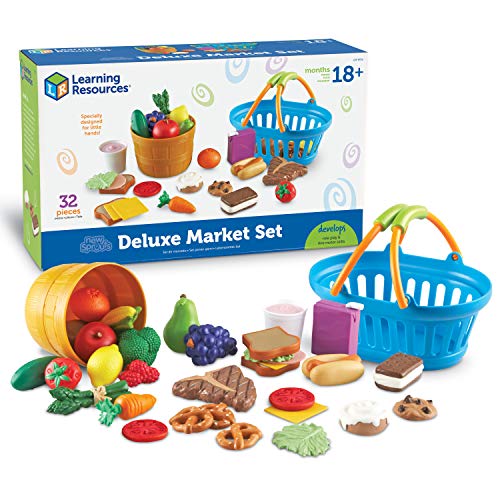
This is the set to buy for the youngest cook in the house. The Deluxe Market Set packs 32 pieces of soft, squeezable plastic food — apples, pears, lemons, strawberries, grapes, corn, carrots, broccoli, and cucumbers alongside steak, a hot dog, salami, bread, cheese, lettuce, and tomato, plus treats like a cinnamon roll, an ice cream sandwich, and a cookie. Every piece is a single chunky mold with nothing to detach, sized for small hands that are still learning to grip, and the soft plastic survives drops, throws, and enthusiastic chewing attempts better than paint does. Two baskets come in the box — a shopping basket and a bushel basket — so the set supports the full market routine: shop, carry, unload, cook, serve. Learning Resources builds its New Sprouts line specifically for toddlers, and it shows in the proportions. For a child between 18 months and 3 years, this is the safest and most-played-with starting point in the category.
Specs
- Pieces: 32, including 30 food types
- Material: soft, durable plastic
- Storage: shopping basket and bushel basket included
- Foods include: produce, steak, hot dog, salami, bread, cheese, cookie, juice box, pretzel
- Model: LER9725
- Age: 18 months and up
2. Melissa & Doug Cutting Fruit Set

The Cutting Fruit Set is the classic first cutting set, and it earns the spot. Seven wooden fruits — among them a melon, an orange, a lemon, a pear, and a strawberry — join with self-stick tabs and slice apart with the included wooden knife, coming apart into 17 pieces with a soft crunching sound as the blade goes through. The slicing is the lesson: it takes two hands, real pressure, and aim, and it introduces part, whole, and halves in a way a toddler can hold. The hand-painted pieces are chunky and satisfying to handle, and everything packs into the included wooden crate, which doubles as the market stall and the serving tray. Because the halves are smaller than whole play foods and the knife work takes coordination, the maker labels it for age 3 and up — respect that line, and this set easily serves three or four years of play after it.
Specs
- Pieces: 17 (7 sliceable fruits, wooden knife, wooden storage crate)
- Material: wood with self-stick tabs
- Cutting play: yes — fruits separate into halves and pieces
- Model: 4021
- Package size: 12.01 x 11.22 x 2.17 in
- Age: 3 years and up
3. Melissa & Doug Food Groups
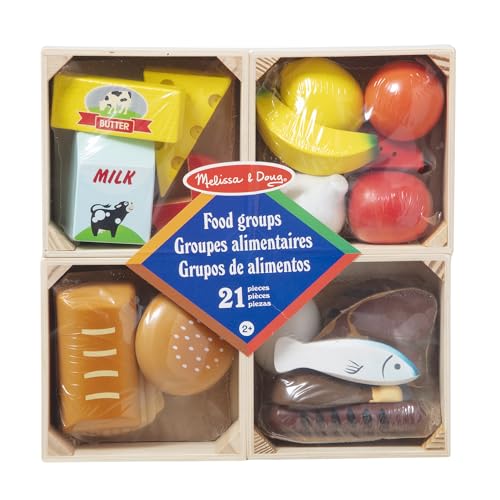
Where the cutting sets teach slicing, Food Groups teaches the grocery list itself. Twenty-one hand-painted wooden foods — watermelon, corn, milk, cheese, fish, eggs, bread, steak, and more — arrive with four wooden crates, one for each crate category: dairy, produce, grains, and meat and fish. Sorting the groceries into their crates is the built-in game, and it gives parents an easy, natural way to talk about balanced plates and where food comes from. The pieces are solid and one-piece, with no tabs or moving parts, so the set suits children who are past the cutting stage or not yet trusted with it — and it stands up well to classroom and daycare use, where play food takes real punishment. It is also the natural stocking set for a new play kitchen: one purchase fills the fridge, the shelves, and the counter in a single, organized pass.
Specs
- Pieces: 21 wooden foods plus 4 wooden crates
- Material: hand-painted wood
- Cutting play: no — solid one-piece foods
- Learning focus: five food groups, sorting, color naming
- Model: 271
- Age: 3 years and up
4. Hape Chef’s Choice Wooden Play Food Basics Set

Hape’s Chef’s Choice is the compact cutting board set: the everyday ingredients of a first kitchen rather than a themed feast. Inside are bread, cheese, vegetables, and eggs that slice apart on hook-and-loop tabs, plus a cutting board and a child-safe wooden knife to work with. The play pattern is meal prep in miniature — slice the egg, halve the vegetables, build a sandwich — and the pieces mix freely with any other play food a household already owns, which makes this a strong second set as well as a first one. Hape finishes its wooden toys with child-safe, water-based paint over solid wood, and the care rule matches: wipe with a dry or damp cloth and never wash or soak the pieces. It is the smallest set in this guide, and that is its charm — a complete little prep station that stores in its own box and comes out for one focused job.
Specs
- Contents: bread, cheese, vegetables, eggs, cutting board, child-safe knife
- Material: solid wood with hook-and-loop tabs; water-based paint
- Cutting play: yes — sliceable ingredients
- Model: E3110
- Package size: 7.88 x 3.94 x 10.24 in
- Age: 3 years and up
5. Hape Hamburger and Hot Dogs

Some toddlers do not want a market; they want a grill. This set hands them the full cookout: two hamburgers and two hot dogs, with every layer separate so the chef builds each order to spec. Burger buns split into tops and bottoms around two patties, felt lettuce, felt cheese, and wooden tomato slices; hot dog buns cradle two franks with ketchup and mustard toppings. Stacking and restacking the layers is fine motor practice disguised as lunch, and taking orders — who wants cheese, who wants extra lettuce — is some of the richest pretend conversation a 3-year-old can have. The mix of solid wood and soft felt keeps the pieces light, quiet, and gentle on furniture, and the set pairs naturally with any other Hape food sets a family adds later. For the child deep in a restaurant or backyard barbecue phase, this is the set that gets ordered from daily.
Specs
- Contents: 2 hamburgers with stackable layers, 2 hot dogs with buns and toppings
- Material: solid wood and felt; water-based paint
- Cutting play: no — stacking and assembling instead
- Model: E3112
- Package size: 7.8 x 3.9 x 10.1 in
- Age: 3 years and up
Play Food Sets Compared
| Pick | Material | Pieces | Cutting play | Storage included | Age |
|---|---|---|---|---|---|
| New Sprouts Deluxe Market Set | Soft plastic | 32 | No | Shopping basket and bushel basket | 18 months+ |
| Cutting Fruit Set | Wood | 17 | Yes | Wooden crate | 3 years+ |
| Food Groups | Wood | 21 plus 4 crates | No | 4 wooden crates | 3 years+ |
| Hape Chef’s Choice | Wood | Prep set with board and knife | Yes | Storage box | 3 years+ |
| Hape Hamburger and Hot Dogs | Wood and felt | 2 burgers, 2 hot dogs, layers | No | Storage box | 3 years+ |
Frequently Asked Questions
What age is play food right for?
Soft, one-piece plastic sets start as early as 18 months, when toddlers play by carrying, dumping, and naming. Wooden sets and all cutting sets are labeled 3 years and up, because the halves are smaller and the play takes more coordination. Follow the maker’s age line on the box rather than the child’s enthusiasm — the line is drawn around piece size, and piece size is the safety issue.
Is wooden or plastic play food better?
They do different jobs. Soft plastic is light, washable, and safe for the youngest toddlers to mouth and throw, but it looks and feels less like real food. Wood is heavier, more realistic, and lasts for years of daily play, but its painted finish only wipes clean and can chip if pieces are soaked or chewed hard. Many families start with plastic at 18 months and add wood at 3, which is the path this guide is built around.
How do I clean play food?
Wipe wooden pieces with a damp cloth and dry them right away; never soak wood or run it through a wash, because water lifts paint and can split the piece. Soft plastic food can go in warm soapy water and air dry. Felt pieces spot-clean only. Clean shared sets after playdates and after any illness in the house, and retire any piece that cracks or starts shedding its finish.
How many pieces does a toddler actually need?
Fewer than the big sets suggest. Around 20 to 30 pieces cover the familiar foods a toddler knows and keep cleanup manageable; beyond that, duplicates and strays take over the bin. A set with its own crates or baskets effectively adds storage to the count, which is worth more than extra pieces. Add a themed set later — burgers, breakfast, desserts — when a child’s pretend play asks for it.
Are cutting food sets safe for a 2-year-old?
Not yet, as a rule. Cutting sets are labeled 3 years and up because the sliced halves are smaller than whole foods and the play knife, while blunt and wooden, is still a hard utensil in an unsteady hand. A 2-year-old is better served by whole, one-piece foods they can carry and sort. The cutting sets keep — buy one for the third birthday and it will be played with for years.
The Verdict
Start with the New Sprouts Deluxe Market Set for any child under 3: the soft, chunky pieces, two baskets, and 30 familiar foods make it the most complete first pantry in the category. At 3, add the skill builders — the Cutting Fruit Set for slicing practice with its crate and crunch, or Hape’s Chef’s Choice for a compact prep board that mixes with everything else. Choose Food Groups when the goal is stocking a new play kitchen in one organized purchase, with sorting built in. And for the toddler running a backyard grill in their imagination, the Hamburger and Hot Dogs set turns stacking layers into taking orders. Stock the pantry once, stock it by age, and the play kitchen stays busy for years.
More from Amazon
Programs that pair well with the guide above. Offers and eligibility are set by Amazon and may change.
A free business account with business pricing and bulk-buying tools for work, shop or home office.
Create a business accountFree shipping on eligible items, Prime Video and more. Eligible new members can start with a free trial.
Start a Prime free trialAudiobooks and podcasts to listen to on the go. Eligible new members can start with a free trial.
Try Audible freeAd-free music streaming. Eligible new subscribers can start with a free trial.
Try Music Unlimited freeAs an Amazon Associate we earn from qualifying purchases.






Write Your Review
No reviews yet. Be the first to share your experience!