
Key takeaways
- Compare landscape staples, checking length, gauge, shape and steel for gardens, fabric, beds, yards, drip lines, sod edges and holding ground cover firmly.
Landscape fabric only works if it stays put. A single windy afternoon can lift an unpinned edge, fold a seam back, and leave soil exposed exactly where weeds find their opening. Landscape staples — the U-shaped steel pins also sold as sod staples, ground stakes, and fabric pins — are the small hardware that keeps weed barrier fabric, ground cover, drip lines, and fresh sod flat against the soil. They are simple tools, but the differences in length, wire gauge, top shape, and coating decide whether a pin drives cleanly, holds through a storm, and comes out intact when you rework a bed.
Disclosure: As an Amazon Associate, I earn from qualifying purchases. Product details were verified at the time of writing.
This guide compares five staple sets that cover the main jobs around a home landscape: a modest starter pack for one or two beds, two bulk 200-count boxes for whole-yard fabric work, a gasket kit that protects drip tubing and delicate fabric, and a long, thick 12-inch staple for loose soil and slopes. Each pick lists its length, gauge, and pack count so you can match the pin to your soil and the size of the project.
How to Choose Landscape Staples
Length comes first. Six inches is the standard for fabric over normal garden soil: long enough to grip, short enough to drive by hand or with a mallet. Drop to shorter pins only on dense, compacted ground. Go longer — 8 to 12 inches — in sandy soil, fresh loose mulch beds, steep slopes, and anywhere wind gets under fabric edges, because holding power comes from the soil gripping the legs along their full length.
Gauge is wire thickness, and lower numbers are thicker. Most home staples are 11 gauge (about 3 mm), which balances strength with easy driving. An 8-gauge staple (about 4 mm) is noticeably stiffer: it resists bending when it hits a stone or root and suits erosion blankets and contractor work, but it needs a mallet in firm ground. Thin bargain wire bends at the first pebble and is a false economy.
Shape matters more than it looks. A square or flat top sits flush on fabric and spreads pressure across a wider strip, which helps on thin weed barrier. A trapeze profile — narrow at the top, wider at the bottom — wedges into the soil as it is driven and resists pull-out. Round-top U pins are the generalists. Whatever the shape, look for angled or chisel-cut points; blunt ends push fabric down into a dimple instead of piercing it cleanly.
Coating decides lifespan. Galvanized steel carries a zinc layer that slows rust, and hot-dip galvanizing lays that layer on thicker for staples you plan to pull up and reuse season after season. Uncoated steel rusts quickly; that rust actually grips soil, which some installers like for permanent sod work, but the pin weakens over time and snaps when you try to remove it.
Count your pins before you buy. A common spacing is one staple every 12 inches along seams and edges, plus a few across the middle of each sheet on windy sites. A 3-by-50-foot fabric roll can easily take 60 to 80 pins, so a 25-pack rarely finishes a real project. Finally, if you are pinning drip tubing or thin fabric that tears, consider staples bundled with buffer gaskets: the flat pad spreads the load so the wire does not cut through.
1. FEED GARDEN 6 Inch Landscape Staples, 50 Pack

FEED GARDEN’s 50-pack is the sensible starter set for a couple of flower beds or a short run of weed barrier along a fence. Each staple is 6 inches long, bent from 11-gauge (3 mm) hot-dip galvanized steel, with a 1-inch top that flares to about 1.5 inches at the leg tips. That trapeze shape is the detail to notice: as the pin goes in, the widening legs wedge against the soil, so the staple resists the slow upward creep that loosens straight pins over a season. The hot-dip coating is heavier than a light electro-galvanized wash, which matters if you pull staples in autumn and reuse them on next spring’s beds. Fifty pieces is not a whole-yard supply, but for pinning fabric in raised beds, anchoring a drip line, or staking down holiday decorations, it is a tidy, well-finished box to keep in the shed.
Specs
- Length: 6 inches
- Gauge: 11 gauge (3 mm wire)
- Top width: 1 inch, flaring to 1.5 inches at the base
- Material: hot-dip galvanized steel
- Pack count: 50 staples
- Item weight: 1.8 pounds
2. Ashman Galvanized Landscape Staples, 200 Pack

When the project grows from two beds to a full side yard of fabric, pack size becomes the deciding factor, and this 200-count box from Ashman is built for that scale. The staples are 6-inch, 11-gauge pins in hot-dipped zinc-coated steel, measuring 6 inches long by 1.15 inches across the top. Ashman sells the same staple in counts from 50 up to 1,000, and the 200 box lands at the sweet spot for a weekend of laying weed barrier, pinning artificial turf seams, or anchoring a dog fence wire around a garden perimeter. The zinc coating keeps rust at bay in wet soil, and the pins are stiff enough to push through landscape fabric without the legs splaying. At 6.75 pounds for the box, there is real steel here — enough to keep seams stapled every foot without rationing pins.
Specs
- Length: 6 inches
- Gauge: 11 gauge
- Top width: 1.15 inches
- Material: hot-dipped galvanized (zinc-coated) steel
- Pack count: 200 staples
- Item weight: 6.75 pounds
3. Sandbaggy 6-Inch Landscape Staples, 200 Count

Sandbaggy supplies farms and job sites, and its staple shows that heritage in two details: a square top and chisel points. The flat, square crown sits evenly on fabric and gives your palm, boot, or mallet a clean striking face, while the angled chisel-cut tips slice through weed barrier and erosion-control matting instead of pushing a fold of fabric into the ground. The pins are 6-inch, 11-gauge low-carbon steel with a galvanized finish, sized at 1 inch across the top. The maker is candid that galvanizing is the version to choose for reuse, since plain steel rusts in place. For securing synthetic turf, jute netting, drip irrigation tubing, and sod across a big area, this 200-count box is the workhorse pick, and its 7.98-pound heft reflects a full measure of steel per pin.
Specs
- Length: 6 inches
- Gauge: 11 gauge
- Top width: 1 inch, square (flat) top
- Material: galvanized low-carbon steel
- Tip style: sharp chisel points
- Pack count: 200 staples
- Item weight: 7.98 pounds
4. Bakulyor Landscape Staples with Gaskets, 50 Pack
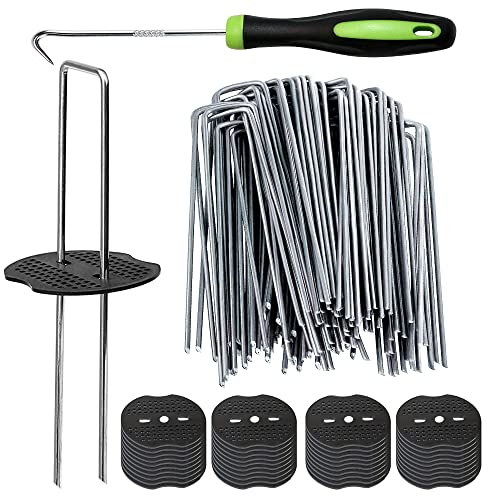
A bare wire staple concentrates all its pressure on two thin lines, which can slice delicate fabric or pinch a drip tube shut. Bakulyor answers that with a kit: 50 U-shaped, 6-inch, 11-gauge galvanized staples plus 50 matching buffer gaskets that sit between the staple crown and whatever you are pinning. The pad spreads the load across a wider patch, so fabric is held firmly without tearing and drip lines stay round and flowing. This is the set to reach for on slopes planted through fabric, around soaker hoses, and under bird netting or row cover where a torn hole quickly becomes a bigger problem. The galvanized finish handles wet soil well, and the 6-inch length suits normal garden ground. If your pinning list is mostly tubing, netting, and lightweight covers rather than heavy barrier fabric, this kit protects the materials you are fastening.
Specs
- Length: 6 inches
- Gauge: 11 gauge
- Shape: U-shaped with buffer gaskets
- Material: galvanized steel
- Pack count: 50 staples and 50 gaskets
- Best for: drip tubing, netting, and tear-prone fabric
5. FUIJOL 12 Inch Heavy Duty Landscape Staples, 100 Pack

Some ground will not hold a 6-inch pin: freshly tilled beds, sandy soil, deep mulch, and slopes all let short staples walk out. FUIJOL’s answer is a staple twice as long and far thicker — 12 inches of 8-gauge galvanized steel, about 4 mm wire, with a 1.5-inch top and legs that open to 2.5 inches at the bottom. Driven deep, these anchor erosion blankets, heavy ground cover, fencing, and irrigation lines in soil that shrugs off standard pins. The trade-off is effort: 8-gauge wire this long wants a mallet, and in stony ground it will find every rock. The 100-count box weighs 12.27 pounds, which tells you how much steel is in each piece. For a retaining-wall planting, a hillside bed, or a windy rural yard, this is the staple that stays where you put it.
Specs
- Length: 12 inches
- Gauge: 8 gauge (about 4 mm wire)
- Top width: 1.5 inches, opening to 2.5 inches at the base
- Material: galvanized steel
- Pack count: 100 staples
- Item weight: 12.27 pounds
Comparison Table
| Product | Length | Gauge | Top width | Pack count | Extras |
|---|---|---|---|---|---|
| FEED GARDEN 50 Pack | 6 in | 11 gauge | 1 in (flares to 1.5 in) | 50 | Hot-dip galvanized |
| Ashman 200 Pack | 6 in | 11 gauge | 1.15 in | 200 | Hot-dipped zinc coating |
| Sandbaggy 200 Count | 6 in | 11 gauge | 1 in, square top | 200 | Chisel points |
| Bakulyor with Gaskets | 6 in | 11 gauge | U-shape | 50 + 50 gaskets | Buffer pads included |
| FUIJOL 100 Pack | 12 in | 8 gauge | 1.5 in (opens to 2.5 in) | 100 | Extra-long heavy wire |
FAQ
How many staples do I need for a roll of landscape fabric?
Plan on one staple every 12 inches along edges and seams, plus extra pins across the middle on exposed or windy ground. A 50-foot run of fabric typically takes 60 to 80 staples, which is why bulk packs suit whole beds and short packs suit repairs.
Will galvanized staples rust in the ground?
The zinc coating slows rust considerably, and hot-dip galvanized pins usually survive several seasons of reuse. Any coating eventually wears in wet, acidic soil, but a rusted staple still holds; it just becomes harder to pull out cleanly.
Can I reuse landscape staples?
Yes, if you pry them out with a flat tool rather than bending them sideways. Galvanized 11-gauge pins come out straight enough to use again. Pins that hit stones and bent at the tip are best retired, since a crooked leg will not drive true a second time.
When should I choose 12-inch staples over 6-inch ones?
Choose the long staples for loose, sandy, or freshly dug soil, deep mulch, slopes, and erosion-control blankets — anywhere a short pin can work loose. On firm, established garden soil, standard 6-inch staples hold well and drive much faster.
Verdict
For most home gardens, the Ashman 200 Pack is the staple box to buy first: full-size 6-inch, 11-gauge pins in a count that finishes real projects, with a hot-dipped coating that allows reuse. The FEED GARDEN 50 Pack covers smaller jobs with the same sensible dimensions and a trapeze shape that grips well. Sandbaggy’s square-top, chisel-point pins are the pick for turf, matting, and large fabric runs where clean driving matters. Choose the Bakulyor kit when drip lines or fragile covers need a gentler hold, and step up to the FUIJOL 12-inch, 8-gauge staples when loose soil or a slope defeats standard pins. Match the pin to your ground, space them a foot apart, and the fabric will stay exactly where you laid it.
More from Amazon
Programs that pair well with the guide above. Offers and eligibility are set by Amazon and may change.
A free business account with business pricing and bulk-buying tools for work, shop or home office.
Create a business accountFree shipping on eligible items, Prime Video and more. Eligible new members can start with a free trial.
Start a Prime free trialAudiobooks and podcasts to listen to on the go. Eligible new members can start with a free trial.
Try Audible freeAd-free music streaming. Eligible new subscribers can start with a free trial.
Try Music Unlimited freeAs an Amazon Associate we earn from qualifying purchases.

Write Your Review
No reviews yet. Be the first to share your experience!