
Key takeaways
- Compare wrist wraps by lengths, stiffness levels and closures, with the wrap-above-wrist-bone rule and between-sets-off habit pressers rely on.
A heavy bar does its damage at the wrist first. As the load climbs on bench press, overhead press and low-bar squats, the wrist wants to fold backward, and every degree of fold leaks force out of the press and loads the small bones of the joint instead of the forearm. A wrist wrap is a simple answer: a length of stiff elastic with a thumb loop and a hook-and-loop closure that you wind around the joint to hold it stacked and straight. This guide compares five wraps by length, stiffness and closure, and it is wraps only — no lifting straps, no gloves, nothing that ties your hand to the bar.
Disclosure: As an Amazon Associate, I earn from qualifying purchases. Product details were verified at the time of writing.
One placement rule governs everything below: the wrap sits above the wrist bone, high enough that part of the fabric crosses the base of the hand, and your hand must still be able to make a full fist. If your fingers tingle or go numb, the wrap is too tight — loosen it and start again. And the habit that keeps circulation normal: wraps come off, or at least fully loose, between sets. A wrap is a brace for the seconds under the bar, not a band you wear through the whole session.
Our top picks
1. Gymreapers Weightlifting Wrist Wraps, 18 Inch

The Gymreapers wrap is the all-round reference point in this class: an 18-inch, 3-inch-wide elastic wrap with a reinforced thumb loop and a wide hook-and-loop closure, built to a competition pattern and carried on the approved gear lists the maker publishes for the major powerlifting federations. The elastic blend gives a firm cast with enough stretch to wind tight for a top single or sit looser for volume work, and the thumb loop is bar-tack stitched so it survives being used as the anchor on every wrap. Expect a short break-in: the edges feel firm against the skin for the first few sessions before they soften.
Specs
- Length: 18 in
- Width: 3 in
- Material: polyester and elastic blend
- Closure: hook-and-loop with reinforced thumb loop
- Stiffness: firm, competition pattern
- Sold as: one pair
- ASIN: B0FS8VFNJ1
2. Inzer Iron Z Wrist Wraps, 20 Inch

The Iron Z is the stiff end of the shelf. Its 20-inch wrap is woven from a dense polyester and rubber blend that barely stretches once it is wound, so the finished wrap feels closer to a cast than a band — the choice for lifters whose only goal is zero backward bend on a maximal bench or squat. Both wraps are built identically, so there is no left and right to sort out in the gym bag. That stiffness is also the trade-off: for high-rep circuits or long sessions the Iron Z is more brace than most wrists want, and it earns its place on heavy days.
Specs
- Length: 20 in
- Material: polyester and rubber competition weave
- Closure: hook-and-loop with wide thumb loop
- Stiffness: very stiff, cast-like
- Build: symmetrical, no left or right wrap
- Sold as: one pair
- ASIN: B00GVHYEZS
3. Iron Bull Strength Powerlifting Wrist Wraps, 20 Inch

Iron Bull builds its powerlifting wrap long and dense: 20 inches of cotton-elastic weave with active recoil, so the wrap pulls back against the joint as you wind it and holds strong compression across the whole wrist. The hook-and-loop patch is extra wide, which matters more than it sounds — a broad patch has more grip area to hold against as forearms pump up through a session, and it is the detail that keeps a wrap from peeling open mid-set. The thumb loop is reinforced with heavy stitching. The finished wrap is bulky, in a good way for heavy pressing and a noticeable way under a squat bar.
Specs
- Length: 20 in
- Material: cotton and elastic blend, dense weave
- Closure: extra-wide hook-and-loop patch with reinforced thumb loop
- Stiffness: stiff with active stretch
- Sold as: one pair
- ASIN: B0BS6WQFYG
4. Rip Toned Wrist Wraps, 18 Inch
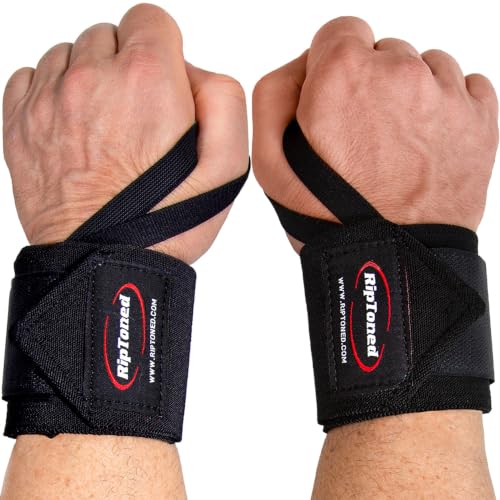
Rip Toned sells one 18-inch wrap in two stiffness levels, and that choice is the pick’s whole appeal. The Flex version stretches enough to let the wrist move through a fuller arc for general training and overhead work; the Stiff version locks down for bench days. Both share the same 3-inch width, thumb loop and hook-and-loop closure, and the maker lists the wraps as approved for USPA and USAPL competition. For a first pair of wraps, the Flex is the sensible default; for a presser who already knows a loose wrap feels like no wrap, go straight to Stiff.
Specs
- Length: 18 in
- Width: 3 in
- Material: nylon and elastic blend
- Closure: hook-and-loop with thumb loop
- Stiffness: two versions, Flex and Stiff
- Sold as: one pair
- ASIN: B01LVXIUX8
5. DMoose Fitness Wrist Wraps, 18 Inch

The DMoose wrap is the breathable everyday option: an 18-inch cotton-elastane blend that wraps softer against the skin than the dense competition weaves above, with a reinforced thumb loop and a strong hook-and-loop strap. The maker lists it as USPA and IPL approved, and the same design is also sold in a 12-inch length for lifters who want a lighter wrap — the ASIN below is the 18-inch listing. It gives up some cast-like stiffness to the Inzer and Iron Bull picks, and in exchange it is the wrap here most likely to stay comfortable through a full pressing session with several movements.
Specs
- Length: 18 in (this listing; a 12 in version exists)
- Width: 3 in
- Material: cotton and elastane blend
- Closure: hook-and-loop with reinforced thumb loop
- Stiffness: medium-firm
- Sold as: one pair
- ASIN: B06XXZN5YH
How to Choose
Length sets the ceiling. A wrap can only brace as hard as the number of turns it makes around the joint. Eighteen inches is the standard training length and suits most pressing. Twenty inches adds a further turn and suits maximal bench and squat work, at the cost of more bulk and a longer wind-up between sets.
Stiffness is a dial, not a contest. The stiffest wrap is not the best wrap; it is the best wrap for a near-maximal single. Match the weave to the day: cast-like weaves for top sets, medium elastic for volume, and never train every set at maximum tightness — the joint still needs to do its share of the work on lighter days.
Placement beats tightness. Follow the headline rule: wrap above the wrist bone so the fabric bridges the joint and the base of the hand, then test the fist. A full fist with straight fingers means the brace is set. Numb or tingling fingers mean it is too tight, full stop — unwrap and go again with one notch less tension. Slip the thumb loop off your thumb before you grip the bar; the loop is a winding aid, not part of the finished brace.
Wraps support position; they do not fix technique. If your wrist bends back under the bar because the bar sits high in your palm or your grip is too wide, a wrap will mask the bend while the load still travels through a bad line. Set the bar low across the heel of the hand, squeeze it hard, and let the wrap hold that good position rather than rescue a poor one.
Build the between-sets habit. The moment the set ends, pop the closure open or take the wraps off entirely and let blood flow back into the hands. Shake the fingers out. Re-wrap fresh for the next set — a wrap wound once and left on all session slowly creeps, and your hands pay for it.
Check the elastic each season. Elastic dies quietly. If a wrap stretches noticeably further than it did when new, if the closure fuzz no longer grips, or if the thumb loop stitching frays, the wrap is done — a dead wrap gives the feeling of support with none of the stopping power.
Safety Notes
- Wrap above the wrist bone and confirm you can make a full fist; numb or tingling fingers mean the wrap is too tight.
- Loosen or remove wraps between every set so circulation in the hands stays normal.
- Remove the thumb loop from the thumb before lifting; it is only there to anchor the first turn.
- Wraps hold a good wrist position — they do not correct a bent-back wrist caused by bar placement or grip.
- Inspect elastic, stitching and closure grip each season and retire wraps with dead stretch.
- Pain that persists away from the bar is a signal to stop and get the wrist looked at, not to wrap tighter.
Verdict
For most pressers, the Gymreapers 18-inch is the balanced first choice: competition pattern, firm support, manageable bulk. Maximal-effort lifters who want the joint locked completely should take the Inzer Iron Z or the Iron Bull 20-inch, and choose between them on feel — cast versus recoil. The Rip Toned pair makes the stiffness decision easy by selling both levels of one design, and the DMoose is the comfortable daily trainer of the five. Whichever pair you pick, the rules do the real work: above the wrist bone, fist test passed, off between sets.
More from Amazon
Programs that pair well with the guide above. Offers and eligibility are set by Amazon and may change.
A free business account with business pricing and bulk-buying tools for work, shop or home office.
Create a business accountFree shipping on eligible items, Prime Video and more. Eligible new members can start with a free trial.
Start a Prime free trialAudiobooks and podcasts to listen to on the go. Eligible new members can start with a free trial.
Try Audible freeAd-free music streaming. Eligible new subscribers can start with a free trial.
Try Music Unlimited freeAs an Amazon Associate we earn from qualifying purchases.



Write Your Review
No reviews yet. Be the first to share your experience!