
Key takeaways
- Find the best telescopes for kids with steady tripod picks, simple finder designs, and clear eyepiece bundles for moon watching on calm nights.
This guide is about real telescopes for school-age kids — roughly ages 6 to 12 — who are ready to aim a tube at the actual sky, focus it themselves, and swap eyepieces to zoom in on the moon. That is a different shelf from the toy telescopes and picture viewers made for toddlers, which show built-in images or give a small fixed view for very young children; those have their own guide on this site. It is also a different instrument from kids’ binoculars, the two-eye option covered in a separate guide here: binoculars are wonderful for short looks and daytime exploring, but they cannot swap eyepieces or climb in magnification the way the telescopes below can. Every pick in this guide is a genuine optical instrument from a real telescope maker, with glass or mirror optics, a finder, and at least two eyepieces.
Set the expectations honestly before the first night, because listings will not. Through any telescope on this list, the moon is spectacular — bright, cratered, and detailed along the shadow line. Jupiter shows as a small disc with its four largest moons strung beside it, and on a steady night a hint of banding. Saturn shows its ring as a small oval silhouette around the planet. Bright star clusters sparkle, and the Orion Nebula shows as a soft grey smudge with stars embedded in it. What no telescope at this size delivers is the poster view: galaxies do not show spiral arms and color, planets stay small, and stars remain points of light — a telescope gathers more of their light so more of them appear, but it never makes a single star bigger. A child who knows that in advance spends the night delighted. A child promised nebula photographs spends it disappointed.
One safety rule outranks every feature in this guide, so it goes first and it is absolute: never point any telescope at the sun, and never sweep one across the daytime sky without an adult setting the target first. A telescope concentrates sunlight the way a burning glass does, and a single glance at the sun through one can damage an eye permanently before a child can blink. None of the five picks below includes any filter or gear that makes sun viewing safe, and no homemade substitute changes that. Eclipse days are for certified eclipse glasses worn on their own, never combined with a telescope. Star nights are after-sunset activities, an adult is always present, and the telescope stands on flat, level ground with its legs fully spread and locked — or, for the tabletop pick, on a solid table that does not rock.
Disclosure: As an Amazon Associate, I earn from qualifying purchases. Product details were verified at the time of writing.
How to Choose a Telescope for a Kid
Aperture is the honest number; headline magnification is not. Aperture — the width of the main lens or mirror, in millimeters — decides how much light the telescope gathers, and light is what makes faint things visible and views bright. Every pick below sits between 70 mm and 80 mm, which is the genuine working range for a first instrument. Magnification, by contrast, is just the telescope’s focal length divided by the eyepiece’s: a 900 mm tube with a 20 mm eyepiece gives 45x, and swapping to a 10 mm eyepiece gives 90x. Any box can print a huge number by bundling a tiny eyepiece and a Barlow lens, but past roughly twice the aperture in millimeters — about 140x to 160x for these scopes, and usually well before that — the image only gets bigger, dimmer, and shakier, never clearer. Judge a telescope by its aperture and its eyepieces, and treat the printed maximum as arithmetic.
Short tubes forgive; long tubes reach. A short, wide-field telescope (400 mm focal length or less) shows a big patch of sky, so a child can find the moon and keep it in view while the sky drifts. A long tube (the 900 mm pick below) narrows the field and magnifies more with the same eyepiece, which rewards a patient older kid with closer lunar and planetary views — and punishes sloppy aiming, because the target slips out of view faster. For a first telescope for a child under 9, wide and forgiving usually wins. For a focused 10- to 12-year-old who wants the planets, reach starts to matter.
The finder is the part your child will actually use first. Nothing gets seen until the telescope is pointed, and the small finder is how pointing happens. Red dot finders project a glowing dot onto a glass window — the child moves the tube until the dot sits on the moon, and the moon is in the eyepiece. Optical finders (the 5×24 tubes on two picks below) show a small magnified view with crosshairs and take a little more practice, plus a one-time daytime alignment by an adult. The app-guided pick replaces aiming skill with a phone that reads the sky and arrows the way. All three systems work; the right one depends on how much aiming your child wants to learn.
A steady mount beats a clever one. Every shake at the eyepiece is magnified along with the sky, so the mount and tripod decide how much of a session is viewing and how much is waiting for wobbles to settle. Full-height tripods should be used at the lowest height that works — legs half-extended are far steadier than legs at full stretch. The tabletop pick skips legs entirely and trades that risk for needing one solid table. Slow-motion controls and pan handles sound adult, but they genuinely help small hands make small movements, which is the whole skill of tracking a planet.
Split the jobs by age, and say so on night one. At this level, kids can aim with the finder, focus, swap eyepieces, and track a target as it drifts. Adults align the finder in daylight, carry the telescope outside, manage the phone on the app-guided pick, and own the sun rule without exception. Sessions end when the adult says so, and the scope comes back indoors, capped, the same night.
The 5 Best Telescopes for Kids
1. Celestron AstroMaster 70AZ — Best All-Round First Telescope

The AstroMaster 70AZ is the classic first real telescope, and its long 900 mm tube is exactly why: with the 20 mm eyepiece it shows the moon at 45x, wide enough to frame whole seas and mountain shadows, and the 10 mm eyepiece takes it to 90x, where individual craters gain depth and Jupiter’s moons resolve into clean separate points. The fully coated 70 mm glass objective keeps the image bright and contrasty at those powers, and the StarPointer red dot finder makes the aiming lesson a two-minute one — dot on the moon, moon in the eyepiece. The altazimuth mount moves up-down and left-right the way a child expects, with a pan handle for the small nudges that tracking takes, and the full-height tripod adjusts down to seated-kid height, where it is also at its steadiest. An erect image diagonal keeps the view right-side up, so the same scope works for daytime landmarks and birds, and Celestron’s Starry Night software download gives the family a sky map for planning. The honest limits: the long tube means a narrow field, so finding a planet the first few times takes patience, and the tripod must be kept low to stay steady. For the child who wants the moon and planets as the main event, this is the pick that grows with them longest.
Specs
- Brand: Celestron
- Model: AstroMaster 70AZ (21061)
- Type: Refractor telescope
- Aperture: 70 mm
- Focal length: 900 mm (f/12.9)
- Eyepieces: 20 mm for 45x, 10 mm for 90x
- Finder: StarPointer red dot finder
- Mount: Altazimuth with pan handle, full-height adjustable tripod
- Extras: Erect image diagonal, accessory tray, Starry Night software download
- Power: None — no batteries
2. Celestron StarSense Explorer LT 80AZ — Best for Finding Things

The hardest part of a first telescope is not looking — it is finding. The StarSense Explorer LT 80AZ removes that barrier: a phone docks on top of the tube, the StarSense app reads the star patterns through the phone’s camera, works out exactly where the telescope is pointing, and puts arrows on the screen that a child follows until the target lands in the eyepiece. It is real plate-solving technology, not a simulation, and it turns “we can never find anything” into a successful first night. The optics back it up: the 80 mm aperture is the largest on this list, gathering the most light for clusters and nebulae, and the short 400 mm tube gives wide, forgiving fields at 16x with the 25 mm eyepiece and 40x with the 10 mm. The full-height tripod, erect image diagonal, and accessory tray round out a complete kit. The honest limits belong in the open: the app needs a parent’s phone for the whole session and a sky dark enough for the camera to read stars, it draws on that phone’s battery, and the short tube tops out sooner on fine planetary detail than the long AstroMaster above. For the family whose first scope gathered dust because nothing was ever in the eyepiece, this is the fix.
Specs
- Brand: Celestron
- Model: StarSense Explorer LT 80AZ (22451)
- Type: Refractor telescope, app-enabled
- Aperture: 80 mm
- Focal length: 400 mm (f/5)
- Eyepieces: 25 mm for 16x, 10 mm for 40x
- Finder: Smartphone dock with StarSense app guidance; red dot finder included
- Mount: Altazimuth, full-height tripod
- Extras: Erect image diagonal, accessory tray
- Power: Uses a smartphone (not included) for guidance; telescope itself needs no power
3. Gskyer AZ70400 — Best Complete Bundle for Travel and Sharing

The Gskyer AZ70400 is built around one idea: everything a family needs in one bag. The 70 mm refractor on its short 400 mm tube is a wide-field sweeper — 16x with the 25 mm eyepiece for finding, 40x with the 10 mm for studying — and the aluminum tripod adjusts across a wide height range, so it works for a seated 6-year-old and a standing adult in the same session. The 5×24 finder scope with crosshairs teaches real aiming, and the bundle leans into sharing: a phone adapter and wireless remote let a parent put the moon on a screen for the whole family at once, which is a genuine kindness for younger siblings who struggle at an eyepiece. The carry bag holds the whole kit for trips to darker skies. Now the honest part, stated plainly because the listing will not: the bundled 3x Barlow lens stacks magnification on paper up to a headline 120x, and the top of that range is empty magnification — bigger and blurrier, not clearer. The working range of this telescope is 16x to about 80x, and inside that range it is a cheerful, capable instrument. Buy it for the bundle and the wide views, not for the biggest number on the box.
Specs
- Brand: Gskyer
- Model: AZ70400 (AZ 70400)
- Type: Refractor telescope
- Aperture: 70 mm
- Focal length: 400 mm (f/5.7)
- Eyepieces: 25 mm for 16x, 10 mm for 40x, plus 3x Barlow lens
- Finder: 5×24 finder scope with crosshairs
- Mount: Altazimuth, adjustable aluminum tripod (about 22 to 46 inches)
- Extras: Phone adapter, wireless camera remote, carry bag, accessory tray
- Weight: About 5.7 pounds
4. Celestron Travel Scope 70 — Best for Trips and Small Spaces

Some first telescopes fail because they live in a closet. The Travel Scope 70 is designed to live in its own backpack, fully packed, at under 4 pounds including the tripod — grab it on the way out the door and it is set up on a campsite table or a grandparent’s lawn in minutes, with no tools and no loose parts to leave behind. The 70 mm aperture and 400 mm focal length match the Gskyer’s wide-field formula: 20x with the 20 mm eyepiece for sweeping star fields and the whole moon at once, 40x with the 10 mm for crater work. Fully coated glass optics, a 5×24 finderscope, and an erect image diagonal that keeps daytime views right-side up make it a complete little instrument rather than a stripped-down travel toy, and the bundled software download helps plan the night. The honest limit is the tripod: it is a travel tripod, and at full extension it is the wobbliest stand on this list. Run it low, or set the tube on a table-height surface, and the views settle down nicely. For families who observe away from home — camping, holidays, a darker-sky relative — this is the telescope that actually comes along.
Specs
- Brand: Celestron
- Model: Travel Scope 70 (22028)
- Type: Refractor telescope, portable kit
- Aperture: 70 mm
- Focal length: 400 mm (f/5.7)
- Eyepieces: 20 mm for 20x, 10 mm for 40x
- Finder: 5×24 finderscope
- Mount: Altazimuth, full-height travel tripod
- Extras: Backpack carrying case, erect image diagonal, software download
- Weight: Under 4 pounds packed, tripod included
5. Orion FunScope 76mm — Best Tabletop for Young Astronomers
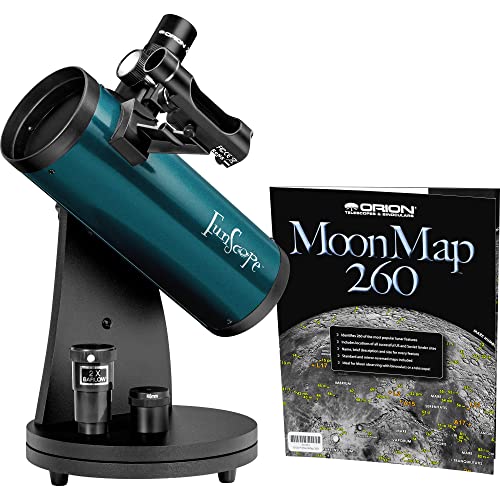
The FunScope takes the opposite approach to every tripod pick above: no legs at all. This 76 mm reflector sits on a small Dobsonian-style tabletop base that a child simply pushes — left, right, up, down — and it arrives assembled, so the first session starts about a minute after the box opens. That push-to-aim simplicity, plus a weight of about 4 pounds, makes it the most manageable real telescope here for the younger end of this guide, the 5- to 7-year-olds who are ready for a real mirror but not for tripod legs and locks. The EZ Finder II red dot sight keeps aiming to the dot-on-the-moon game, the 20 mm Kellner eyepiece gives a wide 15x view that is nearly impossible to lose the moon in, and the 6 mm eyepiece reaches 50x for a closer look. The Moon Map 260 in the box turns that look into a treasure hunt for named craters and seas. Two honest limits: the base needs one solid, steady table — a wobbly folding table ruins it — and the simple spherical mirror softens the image at the highest settings, so this scope’s home ground is wide, bright, low-power sweeping rather than hard planetary close-ups. Within that ground, it is the friendliest first instrument on the list.
Specs
- Brand: Orion
- Model: FunScope 76mm (10033)
- Type: Reflector telescope, tabletop
- Aperture: 76 mm
- Focal length: 300 mm (f/3.9)
- Eyepieces: 20 mm Kellner for 15x, 6 mm Kellner for 50x, plus 2x Barlow lens
- Finder: EZ Finder II red dot finder
- Mount: Tabletop Dobsonian-style base, push to aim; arrives assembled
- Extras: Moon Map 260
- Weight: About 4 pounds
Quick Comparison
| Pick | Type | Aperture | Working range | Finder | Stand |
|---|---|---|---|---|---|
| Celestron AstroMaster 70AZ | Refractor | 70 mm | 45x and 90x | Red dot | Full-height tripod |
| Celestron StarSense Explorer LT 80AZ | Refractor, app-guided | 80 mm | 16x and 40x | Phone app plus red dot | Full-height tripod |
| Gskyer AZ70400 | Refractor | 70 mm | 16x and 40x | 5×24 optical | Adjustable tripod |
| Celestron Travel Scope 70 | Refractor | 70 mm | 20x and 40x | 5×24 optical | Travel tripod, backpack kit |
| Orion FunScope 76mm | Reflector | 76 mm | 15x and 50x | Red dot | Tabletop base |
Care and Handling Tips
Store it capped, indoors, and out of the sun’s path. Lens and eyepiece caps go back on when the session ends — they keep dust and fingerprints off the glass. Never leave a set-up telescope where sunlight can cross it through a window during the day: a parked tube can concentrate that light onto whatever sits behind it. Indoors, capped, in its bag or box, is the whole rule.
Align the finder in daylight, on something far away. Point the main tube at a distant rooftop or chimney, center it in the low-power eyepiece, then adjust the finder until the dot or crosshair sits on the same spot. Five adult minutes in daylight saves the whole first night — and daylight aiming is exactly why the sun rule exists, so the adult chooses a target well away from the sun and does the looking first.
Clean glass rarely, and barely. Dust dims a view far less than a smeared fingerprint does. Blow loose dust off with a squeeze blower, and touch glass only with a clean microfiber cloth when a smudge truly blocks the view. Keep sprays, tissues, and sleeves away from every lens and the FunScope’s mirror.
Leave the mirror screws alone. The reflector pick may one day need its mirror alignment checked by an adult following the maker’s manual, but it is not a child’s adjustment and rarely needs touching. If the view degrades, check eyepiece seating and finder alignment first — those are the usual culprits.
Carry it like the instrument it is. Two hands, tube vertical or cradled, never by the finder or the focuser. Eyepieces travel in their caps or a pocket with a lid; a dropped eyepiece on concrete is the most common first-month loss in this hobby.
FAQ
What will my child actually see?
The moon in real detail — craters, mountain shadows, and the dark seas, changing night by night along the shadow line. Jupiter as a small bright disc with up to four moons lined up beside it, changing places nightly. Saturn’s ring as a distinct oval around a tiny planet in the stronger picks. Bright clusters like the Pleiades filling the eyepiece, double stars splitting into pairs, and the Orion Nebula as a grey glow with stars inside. Not on the list: color, spiral arms, surface detail on Mars, or anything resembling a space-agency photograph. That honesty is what keeps a young astronomer coming back.
Can a child look at the sun or an eclipse with one of these telescopes?
No. Never — with any pick in this guide, with any homemade filter, and with any combination of sunglasses or smoked glass. A telescope gathers and concentrates sunlight, and sun viewing through one without certified, purpose-built solar equipment made for the front of that exact telescope can cause permanent eye damage instantly. None of these five telescopes includes such equipment. On eclipse day, the telescope stays indoors and the family uses certified eclipse glasses on their own, or watches a broadcast.
What age is right for a first real telescope?
Most children can aim with a finder, focus, and track a slow drift from about age 6 or 7, and the tabletop pick suits the younger end of that range because there are no legs to manage. A 10- to 12-year-old gets the most from the long-tube pick’s higher powers. Younger children can absolutely join a session — an adult aims, the child looks — but the operator’s seat, and the sun rule, belong to a child old enough to hold both.
Why do listings promise hundreds of times magnification?
Because magnification is easy arithmetic: divide the focal length by the eyepiece, then multiply by a Barlow. The number is real math and a poor guide to the view. A useful ceiling is roughly twice the aperture in millimeters, and bundled eyepieces often push past the point where the image stays bright and sharp well before that. Every pick above is described by its working range — the eyepiece combinations a child will actually enjoy — rather than by the biggest number its box can print.
Refractor or reflector for a kid?
Refractors — the four lens telescopes above — are sealed, need no mirror alignment, and shrug off being carried around, which suits most families. The reflector pick trades that sealed simplicity for the friendliest mount in the guide and a wide, bright view, in exchange for a mirror that may need an adult’s alignment check someday. Neither family is wrong; choose by how the telescope will be aimed and stored, not by which design sounds more serious.
Do these telescopes work in the daytime?
Yes — birds at a feeder, boats, distant towers, and the moon in a blue sky are all excellent first targets, and daytime is the kindest time to learn focusing and eyepiece swapping. The standing rule applies at full strength: an adult picks the target and aims first, because the sun is up there too, and a sweeping tube must never cross it.
Verdict
Match the telescope to the child who will actually use it. The Celestron AstroMaster 70AZ is the all-round first instrument: honest optics, a red dot finder, and the reach to keep the moon and planets interesting for years. Buy the Celestron StarSense Explorer LT 80AZ when finding things is the barrier — its app guidance and the largest aperture here turn first nights into successes. The Gskyer AZ70400 is the bundle pick, with the phone adapter, remote, and bag making shared family sessions easy, as long as you judge it by its working range rather than its headline number. The Celestron Travel Scope 70 is the one that leaves the house, packed in its backpack at under 4 pounds. And the Orion FunScope 76mm is the gentlest start of all — a real mirror on a push-around tabletop base that the youngest astronomers in this guide’s range can run themselves. Whichever arrives, keep the jobs split the way this guide set them: adults own the sun rule, the finder alignment, and the carrying; children own the looking, the finding, and the questions.
More from Amazon
Programs that pair well with the guide above. Offers and eligibility are set by Amazon and may change.
A free business account with business pricing and bulk-buying tools for work, shop or home office.
Create a business accountFree shipping on eligible items, Prime Video and more. Eligible new members can start with a free trial.
Start a Prime free trialAudiobooks and podcasts to listen to on the go. Eligible new members can start with a free trial.
Try Audible freeAd-free music streaming. Eligible new subscribers can start with a free trial.
Try Music Unlimited freeAs an Amazon Associate we earn from qualifying purchases.




Write Your Review
No reviews yet. Be the first to share your experience!