
Key takeaways
- Compare ice cleats by spike build, fit style and sole coverage, with the test-on-a-quiet-patch rule and take-them-off-indoors habit that helps.
An ice cleat is a web of rubber or elastomer that stretches over your shoe or boot and puts metal between your sole and the ground. What that metal looks like — coils, beads, studs, plates, or chained spikes — decides how the cleat behaves on the mix a winter street actually serves up: packed snow at the curb, polished ice at the crosswalk, bare pavement in between. Two rules govern every pick below. First, fit the cleat over the actual boots you will wear, seated flat with no twist, and size up for insulated boots. Second, take your first walk in them on a quiet icy patch near home, not on the steepest hill in the neighborhood.
Disclosure: As an Amazon Associate, I earn from qualifying purchases. Product details were verified at the time of writing.
One boundary before the picks. None of these is a mountaineering crampon. A true crampon is a rigid frame with long front points, built for stiff mountaineering boots and steep technical ice. Everything here is a stretch-on walking cleat, including the heaviest pick in the lineup — it bites harder than the others, but it still belongs on streets, drives, and packed trails, not on a glacier or a frozen waterfall.
Our top picks
1. Yaktrax Diamond Grip All-Surface Traction Cleats

The Diamond Grip hangs its traction on beads instead of spikes. Case-hardened steel alloy beads, each cut with edges that point in every direction, are strung on aircraft-grade steel cable under the full length of the sole, and the beads swivel as you walk. That swivel is the working idea: snow and grit roll off instead of packing underfoot, so the grip you have when you set out is still there at the end of the block.
The harness is a natural rubber sling that pulls on over shoes and boots, and the maker sells five sizes with plain advice attached — go one size up for regular boots and two for insulated boots. Field testers who have walked these through mixed city terrain call them the most even-tempered of the bead and coil designs, with the honest limit that polished, glassy ice on a slope still defeats them. The same product is also sold under the ICEtrekkers Diamond Grip name; the two are one design, so either label on the box is the same cleat.
Specs
- ASIN: B01BZHFA88
- Traction: case-hardened steel alloy diamond beads on aircraft-grade steel cable
- Harness: natural rubber sling, full-sole coverage toe to heel
- Sizes: 5 sizes, S to 2XL (maker advises one size up for boots, two for insulated boots)
- Weight: about 9.7 oz per pair
- Part family: 0853
- Warranty: 90-day maker warranty
2. Yaktrax Walk Traction Cleats

The Walk is the simplest cleat in this guide: steel coils wrapped around a polyelastomer web, with a heel tab to pull it on. The coils present hundreds of small edges to the ground and grip from every direction, which is why this design has been the default first pair for commuters and dog walkers for years. There are no sharp points anywhere on it, so it folds flat into a coat pocket and will not chew up a car mat while it rides along.
The trade is bite. On packed snow and the thin, rough ice of a salted sidewalk, coils do their job well. On wet, glassy ice — the frozen puddle at the end of the drive — coils skate where studs and spikes dig in, and every honest account of this model says so. The listing behind the ASIN below is the Large; the maker’s chart runs four sizes from XS to L, with the Large at EU 44–46.
Specs
- ASIN: B0094GO8Q8
- Traction: 1.2 mm high-strength steel coils (Skid Lock coil system)
- Webbing: polyelastomer blend with heel pull tab
- Size: Large on this listing (EU 44–46 on the maker’s chart); 4 sizes, XS to L
- Weight: about 2 to 4 oz per pair, by size (maker figures)
- Cold figure: maker sheet gives working flexibility down to -41 °C
- Sharp points: none
3. STABILicers Walk Traction Cleat

STABILicers builds its Walk the way a snow tire is built: heat-treated steel cleat plates are molded into a stretchy thermoplastic elastomer frame at the heel and the forefoot, and the plates are cut to grip in every direction of stride — forward, backward, and sideways on a slope. There are no chains to tangle and no loose studs to pop out, and the frame stays flexible in hard cold.
Two honest notes come with this pick. Sizes run small, so most walkers should buy a size up from their first instinct, especially over boots. And the maker’s warranty is short for winter gear at 90 days, so keep the paperwork. The listing behind the ASIN below is the Large in black, which the maker sizes at men’s 10.5–13 and women’s 12 and up. The pair is made in the USA.
Specs
- ASIN: B000GUCDDG
- Traction: heat-treated steel cleat plates molded into heel and forefoot, multi-directional
- Frame: thermoplastic elastomer (TPE), full-sole coverage
- Size: Large on this listing (Men 10.5–13 / Women 12+); 4 sizes, S to XL — sizes run small, buy up
- Weight: 12.8 oz per pair (Large)
- Part number: NRSTL-BK-L
- Origin: made in the USA
- Warranty: 90-day maker warranty
4. Due North Everyday G3 Ice Cleats
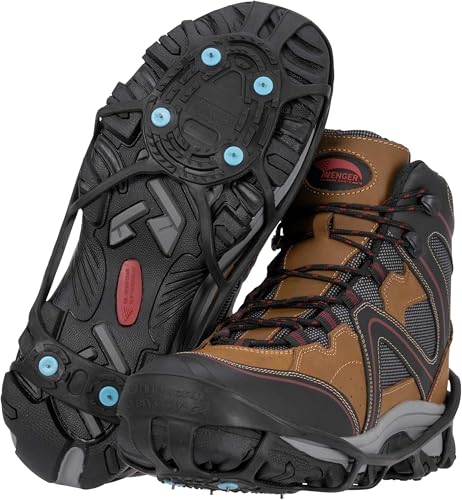
The G3 takes the stud route and makes the studs serviceable. Six tungsten carbide spikes sit in a molded rubber tread under each foot — four toward the front and two at the heel, in what the maker calls a 360-degree pattern — and carbide is far harder than steel, so the points keep their edge through the bare-pavement stretches that dull lesser metal. When a spike finally does wear down, it can be swapped for a fresh one instead of retiring the pair.
The body is a proprietary rubber compound with an enclosed toe that keeps the cleat from creeping forward on the shoe, and a support hole in the heel strap that makes the pull-on easier with gloves. The listing behind the ASIN below is the L/XL; the same cleat is sold in S/M. Due North’s parent, SureWerx, positions the G3 for walking, working, and light running in dress shoes as readily as boots — it is the lowest-profile pick in this guide.
Specs
- ASIN: B00DBR632I
- Traction: 6 tungsten carbide Ice Diamond spikes per foot, replaceable
- Body: proprietary rubber compound, enclosed toe, heel strap with adjustment hole
- Size: L/XL on this listing (part V3551270-L/XL); also sold in S/M
- Weight: 0.37 lb per pair (listing figure)
- Maker: SureWerx (Due North)
- Warranty: 60 days (listing)
5. Kahtoola MICROspikes Footwear Traction

The MICROspikes are the heavy end of this class, and the pick for streets and drives that freeze into steep, rough ice and stay that way. Twelve stainless steel spikes per foot, each 3/8 inch long, hang on welded stainless chains under an elastomer harness with reinforced eyelets. The chains let the spikes settle onto uneven ice instead of skating across the high spots, and the bite is in a different league from coils, beads, and short studs.
The boundary from the intro applies most here: this is still a stretch-on cleat, not a mountaineering crampon — there is no rigid frame and no front points, and it is not made for vertical ice. What it asks in return is a firmer pull-on than the other four picks, a real tug over bulky boots (the maker advises sizing up for them), and care around wet snow, which can clump under the chains. The listing behind the ASIN below is the Medium in black; the maker’s weight figures run from 10.1 to 14.9 ounces a pair across the size range.
Specs
- ASIN: B00RXXJ0V2
- Traction: 12 stainless steel spikes per foot, 3/8 in (9.5 mm) long, on welded stainless chains
- Harness: elastomer with reinforced eyelets; maker figure: stays flexible to -22 °F
- Size: Medium on this listing, black; sizes run by footwear, size up for bulky boots
- Weight: 11.9 oz per pair (Medium); 10.1 to 14.9 oz across sizes (maker figures)
- UPC: 855333000513
- Warranty: 4-year maker warranty
How to Choose Ice Cleats
Match the metal to your ice. Coils and beads are the light end: they handle packed snow and rough, thin ice on flat ground, and they feel the most natural on the bare pavement between patches. Carbide studs and steel plates are the middle: shorter than spikes, harder than steel, and the steadiest choice for a commute that mixes glare ice with cleared sidewalk. Chained spikes are the heavy end: they bite into steep, rough, refrozen ice that defeats everything else here, with weight and a clunkier step on hard floors as the trade.
Fit them over the boots you actually wear. A cleat sized for a shoe will roll off a thick insulated boot, and a cleat that twists or sits crooked is worse than none. Seat it flat, center the traction under the sole, and check that the heel sits fully in the harness. Makers publish their own charts, and several advise going one or two sizes up for winter boots — follow the chart for the pair in your hand, then do the test-on-a-quiet-patch walk before trusting them on a hill.
Coverage is a real difference. Full-sole designs put traction under toe and heel alike, which matters most on slopes, where the heel strikes first on the way down. Low-profile stud patterns feel nearly invisible on flat city blocks but give up bite in deeper or looser snow. If your route is one icy driveway and a mailbox, coverage matters little; if it is a hilly street, it matters most.
Plan for the indoors problem. Every cleat in this guide must come off before you step onto indoor floors. Spikes and studs skate on tile, wood, and laminate — you can be less steady with them on than off — and the metal marks floors as it goes. Coils have no sharp points but slide on smooth floors all the same. Keep a bag in your pocket or pack, take the pair off at the door, and never drive or climb a ladder with cleats on.
Care and Seasonal Checks
Before the first outing of the season, stretch each harness and look for splits, cracks, or rubber that has gone stiff and pale — the harness is the part that fails first on every design here. Count the metal: a missing spike, a worn-flat stud, a broken coil, or a torn strap means the pair is done, and mid-season is the wrong time to learn it. One older model in this brand family carries a recall worth knowing about if you buy secondhand: the Stabilicers Lite cleats sold by L.L.Bean in blue, orange, and pink (model BNX9) were recalled in 2009 because the harness could detach. No pick in this guide is that model, but the lesson stands — inspect the harness before you trust it.
During the season, rinse road salt off the metal, let the pair dry before storing it, and keep spiked pairs in their bag so the points do not puncture a pack or a jacket. After any fall or any walk where a cleat shifted underfoot, check the fit before the next outing; a harness that has stretched loose will do it again.
Verdict
For most winter streets, the Yaktrax Diamond Grip is the balanced answer — full-sole bead traction that sheds snow, feels steady across mixed ground, and asks nothing fussy of the walker. The Yaktrax Walk is the light, simple pair for packed snow and short errands, and the STABILicers Walk brings molded steel plates and an American-made frame for walkers who want grip in every direction of stride. The Due North Everyday G3 is the low-profile commuter pick, with carbide studs you can replace instead of replacing the pair. Save the Kahtoola MICROspikes for the steep, rough, refrozen ice that defeats the rest — and whichever pair you choose, remember that cleats improve grip; no cleat makes ice safe. Short steps, flat feet, and a hand near the rail still rule.
More from Amazon
Programs that pair well with the guide above. Offers and eligibility are set by Amazon and may change.
A free business account with business pricing and bulk-buying tools for work, shop or home office.
Create a business accountFree shipping on eligible items, Prime Video and more. Eligible new members can start with a free trial.
Start a Prime free trialAudiobooks and podcasts to listen to on the go. Eligible new members can start with a free trial.
Try Audible freeAd-free music streaming. Eligible new subscribers can start with a free trial.
Try Music Unlimited freeAs an Amazon Associate we earn from qualifying purchases.






Write Your Review
No reviews yet. Be the first to share your experience!