
Key takeaways
- Compare compression boots by chamber build, size range and controls, with the start-on-low-pressure rule and zip-them-off-slowly habit that helps.
Compression boots are full-leg sleeves lined with overlapping air chambers. A pump fills the chambers in sequence, from the foot upward, so each section squeezes, holds briefly and lets go before the next one takes over. The wave of pressure moves up the leg in cycles for the length of the session, and the idea is simple: help tired legs move fluid along after hard training, then deflate and get on with the evening. You lie back, the boots do the squeezing, and the settings decide how firm each cycle feels.
This guide covers full-leg pneumatic compression systems only. Calf-and-foot wraps that merely vibrate or warm up are leg massagers, a different product with no sequential chambers, and passive compression socks are elastic garments with no pump at all — neither appears here. Every pick below is a genuine air system, measured on the same points: chamber count, pressure levels as the maker publishes them, size range, controls, and how the system is powered.
Disclosure: As an Amazon Associate, I earn from qualifying purchases. Product details were verified at the time of writing.
One rule comes before all the shopping advice: begin on the lowest pressure setting, every time you try a new system. Pressure that feels gentle in the first minute can feel like plenty by the tenth, and the lowest setting on any of these systems is firm enough to learn on. The health gate matters just as much: anyone with circulation problems, a known or suspected clot, recent surgery, heart failure, or an open wound or infection on the legs should talk to a clinician before using any boot in this guide. That is not fine print — it is the first buying decision.
How to Choose Compression Boots
Chambers and the sequence
Four or five overlapping chambers per leg is the working range in this class. Overlapping matters: each chamber tucks under the next, so the squeeze hands over smoothly instead of leaving an untouched band of leg between sections. What you want to see in the maker’s description is a sequence — chambers filling in order from foot to thigh — rather than the whole boot inflating at once. A whole-leg squeeze with no sequence is a massager wearing a boot’s shape.
Pressure levels, read as maker figures
Makers publish pressure two ways: as numbered levels on their own scale, or as mmHg figures. Neither scale converts cleanly to the other, so compare within one maker’s range rather than across brands. More levels means finer steps between too gentle and too much, which is worth having, because the right setting is a personal line that moves with how beaten up the legs are. Whatever the ceiling figure says, the lowest setting is where every first session belongs.
Size range decides whether the boot fits your leg
Boots are sized by leg length or inseam, and the maker’s chart is the only safe way to choose. A boot that runs short leaves the top of the thigh outside the chambers, and one that runs long bunches behind the knee and folds a chamber over itself. Measure before ordering, match the chart exactly, and treat a system with three sizes as a better bet for an exact fit than one sold in a single length for every leg.
Controls: unit, boot panel, or phone
Three control styles appear in this guide. A separate control unit sits beside you and runs both boots through hoses — the widest settings usually live here. On-boot panels put time and pressure buttons on the boot itself, with nothing else to carry. Phone apps add saved routines and finer zone control on the systems that offer them. None of these is automatically better; the question is whether you will recover on the sofa in one room, or in hotel rooms and locker rooms wherever training takes you.
Corded, battery unit, or fully cordless
Corded systems never need charging and suit a fixed recovery corner at home. A battery control unit keeps the hoses but frees you from the wall socket for a few hours per charge. Fully cordless boots build a small pump into each boot — no hoses, no unit, the easiest pack-and-travel format, and usually the fewest settings. Battery figures below are maker figures, quoted as the makers state them.
Session length follows the maker
Timers in this class run from short fixed settings up to an hour, and some systems allow continuous running. Follow the time guidance in your manual rather than improvising longer sessions: the makers set those windows for their own pumps and chambers. Twenty to forty minutes covers most post-training use on the systems here, and a session that ends with the deflate-and-unzip routine below beats a longer one you cut short by standing up in inflated boots.
The 5 Best Compression Boots
1. Hyperice Normatec 3 Legs (Standard)

The reference system for the class, and the one most physio rooms reach for. A rechargeable control unit drives both boots through hoses, filling five overlapping chambers per leg in sequence. Seven pressure levels give fine steps on the maker’s scale, and ZoneBoost lets a single zone — a tight calf, say — take an extra squeeze while the rest of the leg runs gentler. The Hyperice app connects over Bluetooth for control from the sofa, and the maker’s chart puts this Standard size on heights from 5 ft 4 in to 6 ft 3 in.
Two honest notes. The hoses and unit make this a system that lives in one room rather than travelling in a kit bag, and the app is a bonus, not a requirement — every setting is reachable on the unit itself. For a fixed recovery corner and the deepest control in this guide, this is the pick.
Specs
- Format: full-leg boots with separate control unit and hoses
- Chambers: 5 overlapping per leg
- Pressure: 7 levels on the maker’s scale
- Controls: control unit and Hyperice app over Bluetooth; ZoneBoost zone targeting
- Power: rechargeable control unit, up to 3 hours per charge (maker figure)
- Sizing: Standard, for heights 5 ft 4 in to 6 ft 3 in (maker chart)
- Weight: control unit about 3 lb
- ASIN: B0B72QBWHC
2. Hyperice Normatec Elite (Standard)

The Elite takes the Normatec recipe and removes the furniture: each boot carries its own built-in pump, so there is no control unit and no hoses to coil afterward. Five overlapping chambers per leg fill in the same foot-to-thigh sequence, seven pressure levels and ZoneBoost carry over, and control lives on a panel built into the boot, with the Hyperice app available as well. The maker puts battery life at up to 4 hours per charge.
The honest trade is weight carried on the leg itself and a system that asks to be charged like a gadget, not plugged in like an appliance. For athletes who recover wherever the day ends — hotel rooms, the back of a car between sessions, a corner of the gym — that trade is the whole point.
Specs
- Format: fully cordless boots, pump built into each boot
- Chambers: 5 overlapping per leg
- Pressure: 7 levels on the maker’s scale
- Controls: on-boot panel and Hyperice app; ZoneBoost zone targeting
- Power: built-in rechargeable battery, up to 4 hours per charge (maker figure)
- Sizing: Standard size
- ASIN: B0D4876TX4
3. Therabody JetBoots Prime (Regular)

Therabody’s travel-first design: two connected boots with a built-in pump that inflates both legs in sync, then folds down into the drawstring backpack in the box. Four overlapping chambers run Therabody’s TruGrade gradient, where pressure is highest at the foot and eases as the wave climbs, with a FastFlush cycle that completes a full fill-and-empty in about a minute. Unusually for this class, the maker publishes pressure in plain mmHg: four levels at 25, 50, 75 and 100 mmHg.
Session time is set on the boots — 20, 40 or 60 minutes, or continuous — and the battery is good for up to 180 minutes per charge by the maker’s figure, charging over USB-C. This Regular size fits leg lengths of about 32 to 37 inches; Short and Long sizes exist on their own listings, so match the maker’s chart before choosing. At 6 lb all-in, this is the system most likely to actually travel with you.
Specs
- Format: fully wireless boots, built-in pump, no hoses
- Chambers: 4 overlapping per leg
- Pressure: 4 levels — 25, 50, 75 and 100 mmHg (maker figures)
- Session time: 20, 40 or 60 minutes, or continuous
- Controls: panel built into the boots; TruGrade gradient and FastFlush cycle
- Power: rechargeable battery, up to 180 minutes per charge (maker figure); USB-C charging
- Sizing: Regular, for leg lengths about 32 to 37 in and inseams about 29 to 34 in (maker chart)
- Weight: 6 lb (Regular)
- Included: drawstring backpack
- ASIN: B0DGRPRYD9
4. Air Relax AR-1 Professional Compression Boots
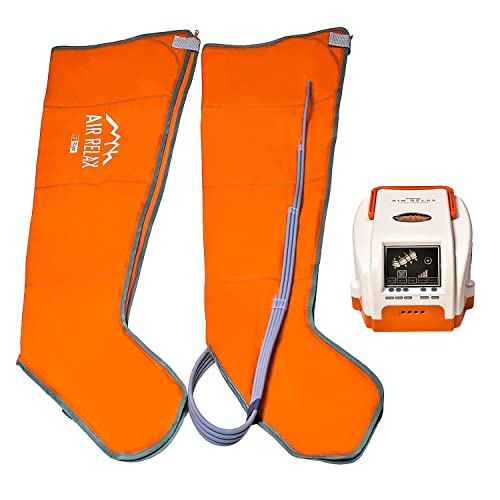
Air Relax builds for clinics and serious home users, and the AR-1 is its corded workhorse: a mains-powered control unit, four chambers per leg, and three therapy modes that change how the chambers sequence and hold. Four pressure levels keep the controls simple — this is a system you set once and use, not one you fine-tune from a phone. The maker sells the AR-1 as a medical-grade recovery system, and the build follows that brief: plain, sturdy, and indifferent to fashion.
The listing covered here is the size 2 boot (model AR1-S2), so check the maker’s size chart against your leg length before ordering — other sizes sit on their own listings. Choose this one if a fixed home setup, a corded unit that never needs charging, and mode variety matter more than travel.
Specs
- Format: full-leg boots with corded control unit
- Model: AR1-S2 (size 2 on this listing)
- Chambers: 4 per leg
- Modes: 3 therapy modes
- Pressure: 4 levels
- Power: corded electric control unit
- ASIN: B01N6E0CNV
5. QUINEAR Air Compression Recovery System (QN-071A, Medium)

The QUINEAR system is the value-shaped end of the class done properly: a real sequential system with four air chambers per leg, not a mere vibration wrap. Its corded handheld controller offers eight intensity steps — the finest ladder in this guide — across three modes, with three session-time settings. The maker’s own description is plain about the job: sequential airwave pressure to work the legs after training, standing work, or long days seated.
This listing is the Medium (model QN-071A); a Large sits on its own listing, and the whole system weighs 3 kg. The controller is tethered and the boots are home furniture rather than travel gear, but for a first full-leg system with genuine chamber sequencing and small steps between intensities, it earns its place.
Specs
- Format: full-leg boots with corded handheld controller
- Model: QN-071A (Medium on this listing)
- Chambers: 4 per leg
- Intensities: 8 levels
- Modes: 3
- Timer: 3 session-time settings on the controller
- Power: corded electric
- Weight: 3 kg
- ASIN: B09LCTXQB3
Using Compression Boots Safely
Begin on the lowest pressure setting. First sessions should also be short ones. Build up over days as you learn how a given setting feels at minute ten rather than minute one, and treat numbness, tingling, pins and needles, or any sharp discomfort as a stop signal: end the session, let the boots deflate, and drop a level next time.
The health gate comes first. These boots squeeze the legs hard enough to move fluid, which is exactly why some legs should not be in them without medical guidance. Talk to a clinician before use if you have circulation problems of any kind, a known or suspected clot, recent surgery on the legs, heart failure, an implanted electronic device, or an open wound, sore or infection where a boot would sit. Therabody’s own manual lists known or suspected deep vein thrombosis as a contraindication for its pneumatic devices. Never use compression boots to try to treat a possible clot — a hot, swollen, painful calf is a reason to seek care the same day, not to reach for a recovery gadget.
Keep sessions inside the maker’s time guidance. Use the timer settings the system gives you and the session windows in the manual. More pressure and more minutes are not more recovery; they are how a pleasant squeeze turns into a bruised feeling the next morning.
Finish the session properly. Let the cycle end and the chambers empty. Unzip slowly, ease the boots off, and sit for a moment before standing — legs that have been squeezed for half an hour deserve a few breaths before they carry you. Never stand or walk in inflated boots, and keep the zips and hoses checked: a chamber that no longer holds air, or a zip that slips mid-session, retires that boot until the maker sorts it.
Frequently Asked Questions
Are compression boots the same as a leg massager?
No. A leg massager in the usual sense is a calf-and-foot wrap that vibrates, kneads or warms. Compression boots are full-leg pneumatic systems: a pump fills overlapping chambers in sequence from foot to thigh, then releases them, in repeating cycles. If there is no pump and no chamber sequence, it is not the product in this guide.
And how do they differ from compression socks?
Socks are passive elastic — one steady squeeze, strongest at the ankle, with no settings and no cycle. Boots apply far firmer pressure in waves, only while you are lying down wearing them, and come off after the session. The two products share a word and almost nothing else.
How long should a session run?
Follow the maker’s timer guidance for your system. Settings in this guide run from 20 to 60 minutes, and a first session belongs at the short end, on the lowest pressure. Let the manual’s window, not enthusiasm, set the length.
How firm should the squeeze feel?
Firm and even, easing off completely as each chamber releases. You should be able to wiggle your toes comfortably throughout. Numbness, tingling or pain means the setting is too high or the size is wrong — stop, deflate, and drop a level.
Can I use them every day?
The makers build these systems for repeated post-training use, and daily sessions within the maker’s time guidance are the normal pattern for this class. The health gate above still applies every day: if your circulation picture changes — new swelling, a recent operation, a long-haul flight behind you — the clinician conversation comes before the next session, not after it.
Verdict
For most buyers building a recovery corner at home, the Normatec 3 Legs is the complete system: five chambers, seven levels, zone targeting and app control. Choose the Normatec Elite if the same control has to travel without hoses or a separate unit, the JetBoots Prime if a folding, backpack-ready pair with plain mmHg settings suits your training life, the Air Relax AR-1 if you want a corded clinic-style build with therapy modes, and the QUINEAR if eight small intensity steps on a simple controller are what your legs ask for. Whichever system you pick, measure your leg against the maker’s chart, begin on the lowest setting, and unzip slowly before you stand.
More from Amazon
Programs that pair well with the guide above. Offers and eligibility are set by Amazon and may change.
A free business account with business pricing and bulk-buying tools for work, shop or home office.
Create a business accountFree shipping on eligible items, Prime Video and more. Eligible new members can start with a free trial.
Start a Prime free trialAudiobooks and podcasts to listen to on the go. Eligible new members can start with a free trial.
Try Audible freeAd-free music streaming. Eligible new subscribers can start with a free trial.
Try Music Unlimited freeAs an Amazon Associate we earn from qualifying purchases.





Write Your Review
No reviews yet. Be the first to share your experience!