
Key takeaways
- Compare the best aquarium test kits for ammonia, nitrite, nitrate, and pH with liquid accuracy and easy strips for clear, healthy tank water.
Disclosure: As an Amazon Associate, I earn from qualifying purchases. Product details were verified at the time of writing.
Aquarium water can look crystal clear and still be hostile to fish. Ammonia, nitrite, and nitrate are invisible, pH drift gives no visual warning, and the first visible sign of a problem is usually a fish already in trouble. A test kit is how you see the water chemistry before your livestock has to tell you about it, and it is the one piece of equipment that matters most during the first weeks of a new tank, when the filter is still building the bacteria colony that keeps everything alive.
The five kits in this guide cover the main ways keepers do that checking. There are two liquid master kits, one for freshwater and one for saltwater, that measure the core nitrogen-cycle readings with fine, closely spaced color steps. There are two dip-strip options for fast weekly screening, one of which is the only pick here that reads chlorine. And there is a reef combo kit that goes past the basics into calcium, magnesium, alkalinity, and phosphate for coral keepers. Each pick lists its format, the parameters it covers, and how many tests are in the box, so you can match the kit to your tank type and your routine.
How to Choose an Aquarium Test Kit
Start with the liquid-versus-strip decision. Liquid reagent kits ask more of you: fill a tube to the line, count drops, shake, wait, then match the color against a chart. In return they give finer gradations, which matters most for ammonia and nitrite, where the difference between the first two steps on the chart is the difference between fine and urgent. Dip strips trade that precision for speed — one dip, a short wait, and a full panel of readings in about a minute. Most experienced keepers end up using both styles: strips for the quick weekly glance, liquid for cycling a new tank and for confirming any strip result that looks off.
Check the ammonia coverage before anything else. Ammonia is the most dangerous reading in a young tank and, awkwardly, the one many multi-parameter strips leave out. Both strip picks in this guide skip it, and so do many others on the shelf. If you are cycling a new aquarium, choose a liquid master kit that includes ammonia, or plan on a separate ammonia test alongside your strips. A panel that covers pH, nitrite, and nitrate but not ammonia is a maintenance tool, not a cycling tool.
Match the parameter list to your water type. A freshwater community tank lives and dies by five readings: ammonia, nitrite, nitrate, and pH, with hardness as a useful extra. Saltwater fish-only tanks need the same nitrogen readings plus a pH test that reaches into the marine range. Reef tanks go further — corals consume calcium and alkalinity, so a reef keeper also needs calcium, KH, magnesium, and ideally phosphate. Buying a big freshwater panel for a reef, or a reef combo for a betta tank, leaves you paying attention to the wrong numbers.
Look at pH range, not just pH presence. Standard pH tests top out around 7.6, which is fine for most freshwater setups but useless in a marine tank sitting near 8.2. That is why the master kits include a separate high range pH test. If your fish come from hard, alkaline water — many African cichlids, for example — the high range test matters in freshwater too. Check that the kit’s pH coverage brackets the values your livestock actually live at.
Weigh test count against shelf life. A headline figure like 800 tests only helps if you use the kit before the reagents age out. Liquid reagents carry expiry dates and slowly lose accuracy; strips are even more sensitive, and a tube left open in a humid fish room can spoil long before the last strip is used. A keeper with one small tank may finish a 25-count strip tube at a sensible pace, while a multi-tank household will work through a master kit comfortably. Buy the size your research habit will actually consume, store strips sealed and dry, and write the opening date on the box.
Build a reading habit you can keep. Test results only help if they are comparable week to week. Read strips at exactly the time the maker states — some pads are read right away, others after a set wait — and read liquid tubes against the white section of the color chart in bright, neutral light. Follow each kit’s small print: the API nitrate test, for instance, directs a hard shake of the second reagent bottle before use, and skipping it produces misleadingly low readings. Log the numbers. A single reading is a snapshot; a written trend is an early warning system.
The 5 Best Aquarium Test Kits
1. API Freshwater Master Test Kit — The Liquid Benchmark

This is the kit the freshwater side of the hobby measures others against. It is a full liquid reagent set covering the five readings a freshwater keeper needs most: pH, high range pH, ammonia, nitrite, and nitrate, with 800 individual tests spread across those parameters. The liquid format earns its place during cycling, where its closely spaced color steps let you watch ammonia fall and nitrite rise and fall in a way strip pads cannot resolve. The box includes four glass test tubes with caps, a color chart, and an instruction booklet that walks through each test. The trade-offs are time and technique: each parameter is its own tube, drops must be counted carefully, and the nitrate test has that well-known hard-shake step for the second bottle. For a freshwater keeper who wants one kit that handles setup, cycling, and years of weekly checks, this remains the default answer.
Specs
- Format: Liquid reagent kit
- Tests: pH, high range pH, ammonia, nitrite, nitrate
- Test count: 800 tests across the five parameters
- Includes: 4 glass test tubes with caps, color chart, instruction booklet
- Water type: Freshwater
2. API Saltwater Master Test Kit — The Marine Equivalent
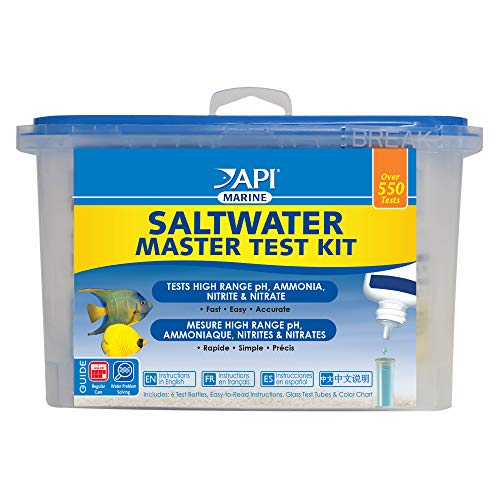
API’s saltwater master kit applies the same liquid approach to the readings a marine tank depends on: high range pH, ammonia, nitrite, and nitrate, with 550 tests in the box. The high range pH test is the headline here — it reads up into the band where marine water actually sits, which a standard freshwater pH test cannot do. Inside are six bottles of testing solution, four test tubes with caps, and a color card. Like its freshwater sibling, it asks for careful drop counting and a few minutes per parameter, and in exchange it gives the fine gradations that matter when you are cycling a marine tank or chasing down why a fish has stopped eating. Fish-only marine keepers are well served by this kit alone; reef keepers will want it for the nitrogen readings and then a reef-focused set, like the combo kit below, for the coral parameters it does not cover.
Specs
- Format: Liquid reagent kit
- Tests: High range pH, ammonia, nitrite, nitrate
- Test count: 550 tests across the four parameters
- Includes: 6 bottles of testing solution, 4 test tubes with caps, color card
- Water type: Saltwater
3. Tetra EasyStrips 6-in-1 — The One-Minute Weekly Check

EasyStrips are built for the keeper who knows they will test more often if testing takes a minute. One dip and a 60-second wait produce six readings: chlorine, nitrite, nitrate, alkalinity, hardness, and pH. The chlorine pad is the standout — it is the only strip in this guide that reads it, which makes these strips genuinely useful for checking treated tap water before a water change. They work in freshwater and saltwater, and the 25-count box suits a single tank tested weekly. Two honest limits: there is no ammonia pad, so new-tank keepers need a separate ammonia test, and strip pads give broader steps than liquid reagents, so treat a worrying result as a prompt to confirm with a liquid kit rather than as a final verdict. As a habit-forming weekly screen for an established tank, they are hard to beat.
Specs
- Format: Dip test strips
- Tests: Chlorine, nitrite, nitrate, alkalinity, hardness, pH
- Count: 25 strips
- Read time: 60 seconds
- Water type: Freshwater and saltwater
4. API 5-in-1 Test Strips — The Hardness-Aware Screen
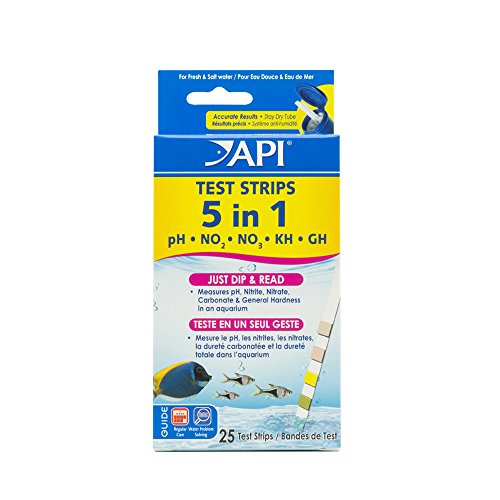
API’s strip entry covers a slightly different five: pH, nitrite, nitrate, carbonate hardness (KH), and general hardness (GH). The separate GH and KH readings are its reason to exist — most rival strips merge hardness into a single pad, while this one splits it, which planted-tank and shrimp keepers who track hardness closely will appreciate. The reading rhythm takes a little learning: the GH and KH pads are read right away, and the remaining pads at 30 seconds. The box holds 25 strips for freshwater and saltwater use. As with the Tetra strips, there is no ammonia test on board, so during a cycle these are a companion to a liquid ammonia test, not a replacement for one. Choose this tube if hardness detail matters to your setup and you want it in the same quick dip as your nitrogen screening.
Specs
- Format: Dip test strips
- Tests: pH, nitrite, nitrate, carbonate hardness (KH), general hardness (GH)
- Count: 25 strips
- Read time: GH and KH right away; remaining pads at 30 seconds
- Water type: Freshwater and saltwater
5. Salifert Master Reef Testing Combo Kit — The Reef Parameter Set

Once corals enter the picture, the core four readings stop being enough, and this combo kit is Salifert’s answer: six individual liquid test kits bundled in one box. It covers nitrate (50 tests), calcium (50 to 100 tests), magnesium (25 to 50 tests), KH/alkalinity (100 to 200 tests), phosphate (60 tests), and pH (50 tests). These are titration-style tests — you add reagent until the sample changes color — which reef keepers favor because alkalinity and calcium are numbers you dose against, and small differences change the dose. The kit deliberately leaves ammonia and nitrite to a cycle-stage kit like the saltwater master set above, since an established reef should not see either. For a keeper growing coral, this is the box that turns testing from a chore list into the data behind a dosing routine.
Specs
- Format: Liquid titration kits, six kits bundled
- Tests: Nitrate, calcium, magnesium, KH/alkalinity, phosphate, pH
- Test count: 50 nitrate; 50–100 calcium; 25–50 magnesium; 100–200 KH/alkalinity; 60 phosphate; 50 pH
- Includes: Six individual Salifert test kits in one box
- Water type: Saltwater and reef
Comparison Table
| Kit | Format | Parameters | Tests in box | Water type |
|---|---|---|---|---|
| API Freshwater Master Test Kit | Liquid reagents | pH, high range pH, ammonia, nitrite, nitrate | 800 | Freshwater |
| API Saltwater Master Test Kit | Liquid reagents | High range pH, ammonia, nitrite, nitrate | 550 | Saltwater |
| Tetra EasyStrips 6-in-1 | Dip strips | Chlorine, nitrite, nitrate, alkalinity, hardness, pH | 25 strips | Freshwater and saltwater |
| API 5-in-1 Test Strips | Dip strips | pH, nitrite, nitrate, KH, GH | 25 strips | Freshwater and saltwater |
| Salifert Master Reef Combo Kit | Liquid titration | Nitrate, calcium, magnesium, KH/alkalinity, phosphate, pH | 25–200 per kit | Saltwater and reef |
Frequently Asked Questions
How often should I test my aquarium water?
Daily while a new tank is cycling, since ammonia and nitrite can climb quickly. In an established tank, a weekly check of the core readings is a sensible rhythm, with extra tests after adding fish, changing filter media, or any time a fish looks unwell.
Are test strips accurate enough on their own?
For routine screening of an established tank, yes — they reliably show whether readings sit in the safe band. Their color steps are broader than liquid reagents, so confirm any strip result that looks wrong or borderline with a liquid test before acting on it.
Why do so many strip kits leave out ammonia?
Ammonia chemistry does not sit comfortably on the same fast dip-strip format as the other pads, so most makers sell ammonia as a separate strip or liquid test. If your panel lacks it, add a standalone ammonia test — it is the single most important reading in a young tank.
Do test kits go bad?
Yes. Liquid reagents carry expiry dates and drift as they age, and strips degrade with heat and humidity. Keep strips sealed in their tube with the cap on, store everything away from the tank’s warm, damp air, and replace a kit that starts giving results that make no sense.
What should I do when a reading comes back high?
Confirm it with a second test, ideally a liquid one, then act on the parameter: a partial water change with conditioned water is the standard first response for ammonia, nitrite, or nitrate. Retest afterward and log both numbers so you can see whether the level is falling.
Verdict
For most freshwater keepers, the API Freshwater Master Test Kit is the one to own first: it covers the five readings that matter, resolves them finely enough to cycle a tank safely, and holds enough tests for years of weekly use. Marine fish-only keepers should take the same path with the API Saltwater Master Test Kit and its high range pH coverage. If your tank is established and your real need is a fast weekly habit you will actually keep, the Tetra EasyStrips 6-in-1 earn their place by adding a chlorine check to a one-minute routine, while the API 5-in-1 strips suit keepers who want separate GH and KH numbers in the same dip. Reef keepers should pair a nitrogen-capable kit with the Salifert Master Reef Combo, which adds the calcium, alkalinity, magnesium, and phosphate readings that coral care runs on. Whichever you choose, the best kit is the one whose format fits your routine — because the test you run every week protects your fish far better than the precise one gathering dust.
More from Amazon
Programs that pair well with the guide above. Offers and eligibility are set by Amazon and may change.
A free business account with business pricing and bulk-buying tools for work, shop or home office.
Create a business accountFree shipping on eligible items, Prime Video and more. Eligible new members can start with a free trial.
Start a Prime free trialAudiobooks and podcasts to listen to on the go. Eligible new members can start with a free trial.
Try Audible freeAd-free music streaming. Eligible new subscribers can start with a free trial.
Try Music Unlimited freeAs an Amazon Associate we earn from qualifying purchases.







Write Your Review
No reviews yet. Be the first to share your experience!