
Key takeaways
- Compare baseball gloves for kids by pocket depth, web styles and break-in needs, with the oiled-leather care and two-hand catch habits coaches teach.
A child’s first real glove has one job: close around the ball, every time, without a fight. Everything else — leather grade, web pattern, pocket depth — matters only after that. The five gloves below are all youth models sized for kids, spanning the first league years through the step up to a pro-style pattern: a soft entry glove that squeezes shut on day one, an easy-close leather glove built for small hands, a big synthetic glove for older kids, a leather outfield pattern with a player’s name on it, and a narrower step-up glove for the child who has stopped growing out of equipment and started wearing it out. Two of the five are Rawlings patterns at different levels and two more come from the same maker family tree of youth lines, because Rawlings and Mizuno between them build most of the serious youth shelf; Franklin takes the big-kid synthetic slot. This guide is about fielder’s gloves only — catcher’s mitts and first-base mitts are different patterns with their own guides, and the soft gloves packed inside tee ball sets are toys for set balls, not league equipment.
Disclosure: As an Amazon Associate, I earn from qualifying purchases. Product details were verified at the time of writing.
How to Choose a Baseball Glove for a Kid
Size by hand and position, never by hope. Glove length is measured from the heel to the top of the index finger, and the working ranges are narrow: about 9 to 10.5 inches for the youngest league players, 10.5 to 11.5 inches through the grade-school years, and 11.5 to 12 inches for older kids, with outfield patterns running longer than infield ones. Buy the size your child’s hand fits now, with at most one size of growing room. A glove bought two sizes big flops open at the heel, slides on the hand, and teaches the child to trap the ball against the body instead of catching it — the habit then has to be untaught.
Match the hand before anything else. The glove is worn on the hand that does not throw. A listing marked right hand throw is worn on the left hand, for a child who throws right; left hand throw is the mirror. This is the single most common ordering mistake in youth gloves, and two of the picks below are series listings that carry both versions on one page — check the hand on the listing itself before ordering, not the color you like.
Pick the web for the position your child actually plays. Closed and basket-style webs hide the ball and forgive sloppy squeezes, which suits beginners and pitchers. Open webs — H webs, I webs, trapeze styles — let dirt fall through and make the ball easier to see and pull out fast, which suits infielders once the basics hold. At the youngest ages the web matters less than the close: a glove a small hand cannot squeeze shut catches nothing, whatever hangs between its fingers.
Break-in is gradual play, never a shortcut. A leather glove forms its pocket through hundreds of catches. Play catch a few times a week, work the hinges with your hands between sessions, and store the glove wrapped around a ball so the pocket sets in the shape of a catch. A light wipe of glove conditioner on leather once or twice a season keeps it supple. Never put a glove in an oven or microwave, never leave it baking on a car dashboard, and never soak it — heat and water cook the leather stiff, crack the laces, and shorten the glove’s life by seasons.
Two hands until the pocket is trusted. Young fielders should catch with the throwing hand covering the ball in the pocket until the glove closes reliably on its own. It stops pop-outs, it protects fingers from a ball that hits the heel, and it puts the throwing hand on the ball for a fast transfer. Coaches teach it because it works at every age in this guide.
Store it like equipment, not like a toy. Ball in the pocket, strap or band around it, kept out of the trunk and off the garage floor. Check the laces at the start of every season — a loose web lace or a worn heel lace is a small fix in March and a dropped fly ball in May.
The 5 Best Baseball Gloves for Kids
1. Rawlings Players Series Youth Glove

The entry point most families should start from. The Players Series shell is soft and pliable on purpose: it closes with the squeeze strength a six-year-old actually has, so the glove works in the first practice instead of the fifth. The 11.5-inch model carries a basket web, which hides the ball in a deep, forgiving pocket and asks nothing of the fielder’s technique while the technique is still forming. This listing is the series listing, running from 9 inches up to 11.5 inches in both throw hands — the smaller sizes suit tee ball graduates, and the 11.5-inch right hand throw version is the one to order for a grade-schooler moving into league play. There is almost no break-in to manage: a few games of catch seat the pocket, and the glove is done improving. It will not last a travel-ball childhood, and it is not meant to. It is the glove a child learns to catch in, sized honestly, that gets handed down to a sibling still working.
Specs
- Sizes on listing: 9 to 11.5 in
- Shell: Soft, pliable synthetic-and-leather blend shell for easy close
- Web: Basket web on the 11.5 in model
- Back: Conventional back
- Hand: Right hand throw and left hand throw versions on the listing
- Best for: First league glove, roughly ages 5 to 9
- Break-in: Minimal; a few sessions of catch
- ASIN: B07G8S9Z17
2. Mizuno Prospect PowerClose 10.5 Inch Glove
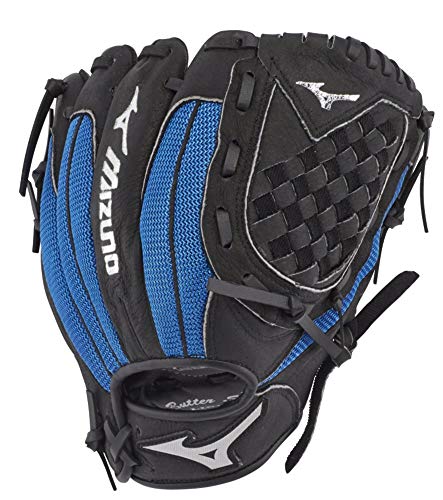
The easy-close leather glove, and the pick for the child who keeps getting a glove on the ball only to watch it pop back out. Mizuno builds the Prospect line around its PowerClose design: the pocket is pre-shaped and a V-flex notch in the heel lets the glove fold shut with far less hand strength than a plain leather glove demands. The shell is full-grain pigskin leather, which is softer out of the wrapper than steerhide and still a genuine leather that forms to the hand. A ParaShock palm pad takes the sting out of hard throws, the ButterSoft palm liner keeps the inside comfortable, and the AirMesh back panel lightens the glove and lets heat escape. This version is the 10.5-inch in black and royal with a Tartan Flex web — a closed, forgiving pattern that suits an all-positions grade-schooler. It is a right hand throw glove, worn on the left hand. Break-in is short: the pigskin and the pre-shaped pocket do most of the work in the first week of catch.
Specs
- Size: 10.5 in
- Shell: Full-grain pigskin leather
- Web: Tartan Flex web
- Hand: Right hand throw (worn on the left hand)
- Color: Black / Royal
- Features: PowerClose easy-close pocket, V-flex notch, ParaShock palm pad, ButterSoft palm liner, AirMesh back
- Best for: Ages roughly 6 to 9 learning to close a real leather glove
- Break-in: Short; mostly formed within the first week of play
- ASIN: B07DLV3S2R
3. Franklin Sports Field Master 12 Inch Glove

The big-kid synthetic, for the older child who needs outfield length without a leather break-in project. At 12 inches this is the longest glove in the guide, and its synthetic leather shell is formed with the pocket already shaped by hand at the factory, so it plays correctly the day it arrives and asks for nothing but games. An adjustable wrist strap snugs the fit on a growing hand. Franklin sells this glove across adult and youth play, and that is exactly its role here: it is the bridge glove for a nine-to-twelve-year-old who has outgrown 10.5-inch youth patterns, is shagging fly balls in the outfield, and has not yet settled into the position that would justify a dedicated leather glove. The trade is durability — synthetic shells scuff and soften faster than leather across heavy seasons — against zero break-in and a shape that holds from the first catch. It is a right hand throw glove, worn on the left hand.
Specs
- Size: 12 in
- Shell: Synthetic leather
- Pocket: Hand-formed pocket, shaped at the factory
- Hand: Right hand throw (worn on the left hand)
- Fit: Adjustable wrist strap
- Best for: Ages roughly 9 to 12, outfield-leaning and all-around play
- Break-in: None required
- ASIN: B013LPRKQ2
4. Rawlings Select Pro Lite 12 Inch Aaron Judge Glove

The leather step up for the older kid who has a position. The Select Pro Lite line takes pro-style patterns and rebuilds them lighter and narrower for a youth hand, so a ten-to-thirteen-year-old gets a real leather shell and a real outfield pattern without the weight and wide hand opening of an adult glove. This is the 12-inch Aaron Judge model: an outfield length with the pocket depth to match, in a right hand throw. The factory does most of the break-in work before the glove ships, and the rest finishes the honest way, through catch — expect the pocket to keep improving across the first month rather than arriving finished. Padded finger linings soften the inside, and the leather shell takes conditioner well, so the seasonal wipe-down in the guide above applies in full. For a child moving from all-positions play to a settled outfield spot, this is the glove in the guide that most resembles what the older players on the next field are wearing, scaled to the hand that has to close it.
Specs
- Size: 12 in
- Shell: Leather shell, pro-style pattern
- Model: SPL120AJBB, Aaron Judge model
- Hand: Right hand throw (worn on the left hand)
- Fit: Youth pro taper fit — narrower hand opening than adult patterns
- Best for: Ages roughly 10 to 13, settled outfielders
- Break-in: Largely done at the factory; finishes through the first month of catch
- ASIN: B07VHRFBHR
5. Rawlings R9 Youth Pro Taper Glove

The committed player’s glove, for the child who practices between games. The R9 youth line is built on a Pro Taper fit — a narrower hand opening and lower finger stalls that keep a smaller hand in control of a stiffer, more structured glove — with a soft full-grain leather shell that holds its shape across seasons instead of going floppy. A reinforced palm pad and a padded thumb loop protect the hand against hard-hit balls, and padded finger back liners keep the inside comfortable through long practices. This listing is the series listing, spanning the line’s youth sizes and patterns in both throw hands, so match the size to the position on the page: infield lengths for quick transfers, longer patterns for the outfield. The break-in is the longest in this guide and should be treated as part of the purchase — daily catch, ball stored in the pocket, conditioner on the leather — because a glove at this level is shaped by its owner, and a child who will not do that work is better served by the Mizuno or the Players Series above.
Specs
- Sizes on listing: Youth sizes across the R9 line, roughly 11.5 to 12.75 in
- Shell: Soft full-grain leather
- Hand: Right hand throw and left hand throw versions on the listing
- Fit: Pro Taper — narrower hand opening, lowered finger stalls
- Protection: Reinforced palm pad, padded thumb loop, padded finger back liners
- Best for: Committed players roughly ages 10 to 14
- Break-in: The longest here; weeks of regular catch, ball stored in the pocket
- ASIN: B0B4KSZG3L
Verdict
Start where your child’s hand is, not where the season ends. For a first league glove that closes on day one, the Rawlings Players Series is the honest buy, in the size that fits now. For a young fielder whose catches keep popping out, the Mizuno Prospect PowerClose solves the actual problem — hand strength — in real leather. The Franklin Field Master covers the older child who needs 12-inch reach without a break-in. The Select Pro Lite Aaron Judge is the leather outfield glove for a player with a settled position, and the R9 Youth Pro Taper is the step up for the committed player willing to break a glove in properly. Whichever one comes home: ball in the pocket at night, two hands on every catch, laces checked each spring.
FAQ
What size glove does a 7-year-old need? Usually 10.5 to 11 inches for all-positions play. Measure the hand, not the birthday: the glove should close fully around a ball with the child’s own squeeze, and the heel should not slide off the wrist.
What does right hand throw mean? The glove is worn on the left hand and the child throws with the right. Left hand throw is the mirror image. The glove always goes on the non-throwing hand.
How long does break-in take? Soft synthetic gloves need none. Easy-close leather like the Mizuno forms within about a week of catch. Stiffer leather like the R9 takes weeks of regular play — that time is the glove learning the shape of your child’s hand, and shortcuts with heat do damage that cannot be undone.
Can a fielder’s glove be used for softball too? For youth play, yes in practice — several listings here are sold for both. Softballs are larger, so a deeper pocket helps; a child playing both should use the longer of the two sizes in their range.
When is it time to move up a glove? When the current one is fully broken in and the ball starts stinging through the pocket, when the hand opening pinches, or when a settled position calls for a different length or web. Move one step at a time, the same rule as sizing.
More from Amazon
Programs that pair well with the guide above. Offers and eligibility are set by Amazon and may change.
A free business account with business pricing and bulk-buying tools for work, shop or home office.
Create a business accountFree shipping on eligible items, Prime Video and more. Eligible new members can start with a free trial.
Start a Prime free trialAudiobooks and podcasts to listen to on the go. Eligible new members can start with a free trial.
Try Audible freeAd-free music streaming. Eligible new subscribers can start with a free trial.
Try Music Unlimited freeAs an Amazon Associate we earn from qualifying purchases.





Write Your Review
No reviews yet. Be the first to share your experience!