
Key takeaways
- Compare slant boards by angle steps, board size and grip surface, with the start-at-the-lowest-angle rule and wall-support habit for stretches done right.
A slant board is an incline you stand on with your heels low and your toes high, so the calf and Achilles load at a controlled angle instead of whatever a curb or a stair edge happens to give you. Four habits decide whether the board helps or hurts. First: begin at the lowest angle the board offers — the gentlest setting that reaches the calf is the right one, and steeper settings are a progression earned over weeks, not a first session. Second: set the board against a wall, or keep a hand on a support, every time — balance should never be the thing that ends a stretch early. Third: a stretch is never pushed into pain — a firm pull in the calf is the working sensation; a sharp, pinching, or radiating feeling means step off and come back gentler. Fourth: rehab use follows the clinician’s plan — if a physical therapist set your angle and hold time after an injury, the board is how you carry that plan out, not a reason to rewrite it. One boundary before the picks: a slant board is not a squat wedge. The small metal heel wedges sold for heel-elevated squats are a different product, and so are calf raise blocks; this guide is only about full incline boards you stand on to stretch. The five picks below are judged on angle steps, board size, and the grip of the surface your feet stand on.
Disclosure: As an Amazon Associate, I earn from qualifying purchases. Product details were verified at the time of writing.
Our top picks
How to Choose a Slant Board
The lowest angle matters more than the highest. Boards in this guide begin anywhere from 15 to 30 degrees. A tight calf, a healing Achilles, or a first week of stretching belongs on a board that begins at 15 or 20 degrees. A board whose lowest setting is 30 degrees is a fine tool for someone already flexible, and the wrong first purchase for everyone else. Read the bottom of the angle ladder before you read the top.
Small steps beat wide jumps. Most adjustable boards climb in five-degree steps, which is about the size of progression a calf accepts happily from one week to the next. A ladder with a ten-degree gap near the bottom strands you between too gentle and too much. Count the settings and look at where the gaps sit, not just at how many settings there are.
Board size is a two-foot question. A deck around 16 by 12.5 inches holds both feet side by side with room to spare, which is how most calf stretching is done. Narrower decks near 11.8 inches wide still fit two average feet but leave less margin for wide stances or larger shoes. Measure against the shoes or bare feet you will actually stretch in.
Grip is a two-sided question. The top face has to hold your foot at an angle — full-coverage grip tape, textured wood, and sandpaper-style decks all do this differently — and the base has to hold the floor. A board that creeps forward as you lean in will eventually creep on the session that matters. Test both faces with body weight, against a wall, before the first real hold.
Material sets the feel underfoot. Hardwood plywood is the planted, clinic-style option and the heaviest to carry. Steel is firmer still and shrugs off garage floors. Lighter folding wooden boards trade some of that planted feel for storage — they slide under a desk or into a closet, which is why people keep using them daily.
Load figures are maker figures. The numbers in this guide are the figures the makers publish, given so you can compare builds. A higher figure points to denser material and stronger joints. It is not a target to test, and on the lighter boards it is the first number to check against your own weight before ordering.
1. StrongTek Professional Wooden Slant Board

The StrongTek is the board the rehab world reached for first, and its angle ladder is the reason: five settings from 15 to 35 degrees in five-degree steps, so the gentlest beginning in this guide and a sensible climb are in the same purchase. The deck is the joint largest here at 16 by 12.5 inches, cut from Lauan hardwood plywood, with grip coverage across the whole surface and anti-slip treatment underneath as well. Side handles are built into the frame, which matters more than it sounds — at just under nine pounds this is a board you move with one hand between rooms instead of hugging with two arms. The maker’s published load figure is 450 lb, headroom that reflects the plywood build rather than a number anyone needs to approach. This is the home-and-clinic default: begin at 15 degrees with a hand on the wall, hold, and step up a setting only when the current one feels easy. Choose it if you want one board that covers a cautious first stretch and years of progression after it.
Specs
- Format: Adjustable wooden slant board
- Angles: 15°, 20°, 25°, 30°, 35°
- Deck: 16 × 12.5 in
- Material: Lauan hardwood plywood
- Surface: Full-coverage anti-slip top, anti-slip base
- Maker load figure: 450 lb
2. ANVICTOX Reinforced Slant Board

The ANVICTOX is built around a narrower, gentler idea: four settings that run 15, 20, 25, and 30 degrees, and then stop. For a beginner, a post-injury ankle working through a clinician’s progression, or a calf that has been tight for years, that ceiling is a feature — every setting on the ladder is one a careful stretcher can actually use, and the five-degree steps are the smallest jumps in this guide. The frame is the other half of the design: the joints use longer reinforced fasteners than the short screws common on light boards, which is the detail that decides whether a board taking your full weight at an angle still feels solid in month six. At 5.6 pounds it moves between rooms easily and slides under a desk between sessions. The honest limit is the maker’s load figure of 250 lb, the lowest in this guide — check it against your weight before anything else. Choose it if your priority is a gentle ladder and a light board, and the 250 lb figure clears you comfortably.
Specs
- Format: Adjustable wooden slant board, reinforced frame
- Angles: 15°, 20°, 25°, 30°
- Deck: 15.7 × 11.8 in
- Weight: 5.6 lb
- Maker load figure: 250 lb
3. MUCITAGF Professional Slant Board
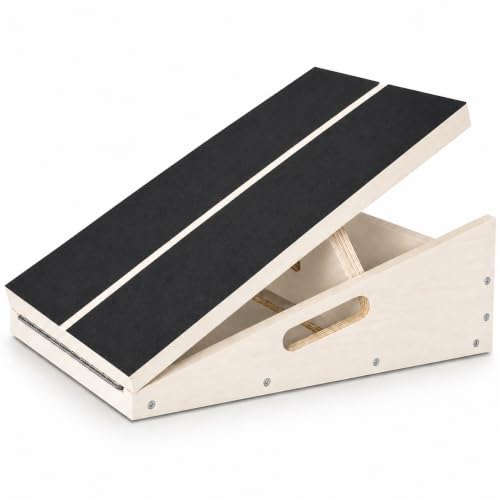
The MUCITAGF runs the same ladder as the StrongTek — 15 to 35 degrees in five-degree steps, on the same 16 by 12.5 inch deck size — with the highest maker load figure in this guide at 500 lb. The build is a solid wooden unit with side handles rather than a folding frame, so there is no hinge to work loose and the board stays where you put it. The deck texture deserves a mention of its own: it holds a sock foot at the gentlest setting, which means you can stretch in what you are already wearing instead of hunting for shoes first — a small thing that decides whether a daily habit survives busy mornings. The trades are the familiar ones for a full-size wooden board: no setting steeper than 35 degrees, and a footprint that wants a patch of floor rather than a slot in a cupboard. A three-year maker warranty backs the frame. Choose it if you want the full 15-to-35 range and the strongest published figure here, in a board that never folds because it never needs to.
Specs
- Format: Adjustable wooden slant board
- Angles: 15°, 20°, 25°, 30°, 35°
- Deck: 16 × 12.5 in
- Weight: 8.49 lb
- Maker load figure: 500 lb
- Extras: Side handles, three-year maker warranty
4. PROIRON Steel Slant Board

The PROIRON is the metal option: a steel incline board with five angle settings for stretchers who do not want wood or a folding frame anywhere near their routine. Steel is the zero-flex answer — the platform does not compress, does not absorb moisture, and shrugs off the concrete and damp corners of a garage gym that are hard on plywood over the years. That firmness cuts both ways: the surface feels colder and more industrial under bare feet than any wooden deck here, so most owners stretch in shoes or socks with grip. This is also the board for shared spaces and heavy daily use, where a wooden frame’s joints are the long-term question and a welded steel build simply removes it. Keep the same habits as with any board — lowest setting first, wall within reach, base checked on your floor before the first hold, because hard steel on smooth concrete deserves the body-weight test more than any pick here. Choose it if your stretching corner is a garage or a busy shared gym and you want the build that asks for nothing back.
Specs
- Format: Adjustable steel slant board
- Angle settings: 5 incline positions
- Material: Steel
- Surface: Non-slip deck
- Use: Calf and Achilles stretching, ankle mobility
5. NORBASE Portable Slant Board

The NORBASE is the specialist at the steep end, and it should be read that way from the first line: its four settings run 30, 35, 40, and 45 degrees, with no gentle setting anywhere on the ladder. For an established stretcher whose calves already take 30 degrees comfortably, or for deep Achilles work a clinician has prescribed at a steep angle, that range is exactly the useful one, and the deck stays solid at 45 degrees where thinner boards begin to flex. It is a light wooden board at 5 pounds, with a 15.74 by 11.81 inch deck, a cut-out carrying handle, and grip pads underneath. The cautions are part of the pick, not fine print: this is never a first board, never a post-injury board, and on a light frame the fasteners deserve a check every few weeks — stop using it if a bracket begins to move. Choose it only if you already know, from a gentler board, that the steep end is where your stretching actually lives.
Specs
- Format: Adjustable wooden slant board, portable
- Angles: 30°, 35°, 40°, 45°
- Deck: 15.74 × 11.81 in
- Weight: 5 lb
- Extras: Cut-out carry handle, grip pads underneath
Staying Safe on a Slant Board
Begin every new board, and every new angle, with a hand on a wall, a counter, or a sturdy chair — the support is part of the exercise, not a sign of weakness, and it stays within reach for as many weeks as balance needs it. Step up one setting at a time and give each angle several calm sessions before climbing; a stretch that feels like a firm pull is working, and anything sharp, pinching, or shooting means step off. Hold times belong to your plan: general stretching usually means relaxed holds of twenty to thirty seconds, while rehab progressions — after an Achilles injury, a calf strain, or ankle surgery — follow the angles and timings your clinician set, in the order they set them. Check the hardware habitually: props seated fully in their slots, hinge screws and bracket fasteners snug, grip surface clean and dry before you step on. Finally, keep the board on a flat floor with the base fully down — never on a rug edge, a mat corner, or a slope that adds its own angle to the one you chose.
FAQ
What angle should a beginner begin with?
The lowest the board offers — 15 degrees on three of the five picks here. Stay there until a full hold feels easy and your heel stays down without effort, then move up one five-degree step at a time.
Is a slant board the same as a squat wedge?
No. A squat wedge is a small heel block, often metal, made to lift the heels during squats. A slant board is a full incline platform you stand on with toes high and heels low, made for calf stretching and ankle work. They change the ankle angle in opposite directions for different jobs.
Can a slant board help after an ankle or Achilles injury?
It is a standard tool in rehab settings, but the plan comes first: your clinician sets the angle, the hold time, and when to progress. The board’s job is to make those settings repeatable at home, not to replace the plan.
Wood, steel, or folding — which build is right?
Wood is the planted, quiet default for a fixed home corner. Steel suits garages and shared spaces where the board gets heavy daily use. Folding boards give up some planted feel for storage, and for many people that trade is why the habit survives.
How do I know a board is big enough?
Both feet should stand on the deck with margin at the edges in the footwear you stretch in. Decks near 16 by 12.5 inches suit almost everyone; narrower decks near 11.8 inches wide fit average feet but leave less room for wide stances.
Verdict
Most stretchers should buy the StrongTek: the 15-degree beginning, the five even steps, and the big plywood deck cover everything from a first cautious stretch to years of progression. The ANVICTOX is the gentler, lighter route for beginners and clinician-guided rehab, as long as its 250 lb maker figure clears you. The MUCITAGF matches the leader’s ladder and deck with the strongest published figure here. The PROIRON is the steel answer for garages and shared gyms. The NORBASE belongs only to established stretchers who already live at the steep end. Whichever board lands in your home, the rules travel with it: lowest angle first, wall within reach, never into pain.
More from Amazon
Programs that pair well with the guide above. Offers and eligibility are set by Amazon and may change.
A free business account with business pricing and bulk-buying tools for work, shop or home office.
Create a business accountFree shipping on eligible items, Prime Video and more. Eligible new members can start with a free trial.
Start a Prime free trialAudiobooks and podcasts to listen to on the go. Eligible new members can start with a free trial.
Try Audible freeAd-free music streaming. Eligible new subscribers can start with a free trial.
Try Music Unlimited freeAs an Amazon Associate we earn from qualifying purchases.

Write Your Review
No reviews yet. Be the first to share your experience!