
Key takeaways
- Compare the best baby carriers with padded straps, lumbar support, and multiple carry positions for comfortable, hands-free days at home daily.
A good baby carrier does two jobs at once: it keeps your child settled close against your body, and it spreads the load across your shoulders, back, and hips so your arms stay free for everything else the day asks of you. The five carriers in this guide cover the main shapes of everyday babywearing — a breathable mesh structured carrier built for warm weather and long walks, a six-position structured carrier with a zip-down panel for changing seasons, an adjustable structured carrier whose seat grows in steps from newborn to toddler, a convertible four-position carrier with a seat that changes width as your baby grows, and a classic long cotton wrap that molds to any body. Every pick below is an everyday carrier for home, errands, and walks — framed hiking backpack carriers are a separate class with their own fit rules, and none of them appear here. Each pick states its weight range in plain pounds, exactly as its maker publishes it, so you can compare the figures directly.
Disclosure: As an Amazon Associate, I earn from qualifying purchases. Product details were verified at the time of writing.
One honest note before the picks: the headline weight range on any carrier covers the carrier as a whole, not every position. Front outward, hip, and back positions each carry their own minimums tied to your baby’s size and development — head and trunk control, chin clearance above the panel, and the ability to sit with support. Read the manual for the position you plan to use, and treat the smallest figure on the box as the entry point for front inward carrying only.
How to Choose the Best Baby Carriers
Start with the carrier type. A soft structured carrier uses buckles, padded straps, and a waist belt; it goes on quickly, shares well between caregivers, and carries most of the load on your hips. A wrap is one long piece of fabric you tie around your body; it gives the closest, most molded fit for the newborn months and folds down small, but it takes practice to tie well and most wraps top out at a lower weight. A hybrid sits between the two. For most families who want one carrier from the newborn stage into toddlerhood, a structured model with an adjustable seat is the simplest path.
Read the weight range in plain pounds. Newborn-ready structured carriers begin at 7 pounds; the wrap in this guide begins at 8 pounds. The top end matters just as much: a carrier that ends at 32 or 33 pounds may be outgrown before the toddler stage ends, while the 45-pound models here can carry a preschooler on a back carry for short stretches. Match the range to how long you realistically plan to carry, not just to the first six months.
Check whether an infant insert is needed. Older structured designs needed a separate padded insert to lift a small newborn into a safe position. All three structured carriers in the first picks below are built to carry from their minimum weight with no separate insert — the seat itself narrows or the panel adjusts down. If a carrier you are considering does need an insert, that is one more piece to buy, fit, and remove later.
Count positions, then check the minimums for each. Four to six positions sounds generous, but what matters is when each one opens up. Front inward works from the minimum weight. Front outward waits until your baby holds their head and trunk steadily and their chin clears the panel. Hip and back carries wait until your baby sits with support, which makers generally place around the six-month stage. A carrier with fewer positions that you can use correctly beats a six-position model used before its time.
Look at how the load reaches your hips. A wide, padded waist belt with a lumbar support pad moves the weight off your shoulders and onto your pelvis, which is where long carries are won or lost. Crossable shoulder straps help smaller-framed caregivers pull the load in close, and dual-adjustment buckles let you tighten a strap by pulling in whichever direction your hand naturally reaches. If two caregivers of very different sizes will share one carrier, check the waist belt range as well as the baby figures.
Match the fabric to your climate. Mesh panels and full mesh bodies move air across your baby’s back and your chest, which makes a real difference on summer walks. A zip-down panel, like the one on the LILLEbaby below, lets one carrier cover both mesh and covered modes. Cotton panels feel softer against newborn skin and hold up well in cooler months, but they hold more heat in August. Every pick here is machine washable, which matters more than it sounds — carriers collect milk, drool, and sunscreen faster than almost any other baby gear.
Confirm the seat supports a wide, knee-to-knee base. A healthy carry seats your baby with knees level with or higher than their bottom, in a spread position often described as an M shape. Adjustable seat widths — snaps, hook-and-loop tabs, or a convertible seat that folds narrow and opens wide — are what let one carrier keep that shape from a curled newborn to a long-legged toddler.
1. Ergobaby Omni Breeze — Best for Warm Days and Long Walks

The Omni Breeze is Ergobaby’s mesh structured carrier, built around a SoftFlex mesh body that runs across the panel, straps, and waistband so air moves through the whole carry instead of a single window. It covers the full span most families need: the maker lists it from 7 to 45 pounds, with four carry positions — front inward, front outward, hip, and back — and no separate insert at any stage. The padded waistband carries a lumbar support section that keeps the belt from folding under load, the shoulder straps are padded and can be worn crossed, and a removable hood gives shade and a little privacy for naps. A small pouch on the waistband holds the essentials you reach for most. If you carry through a hot summer, walk daily, or share the carrier between two caregivers, this is the most complete single purchase in the guide.
Specs
- Type: Soft structured carrier, full mesh body
- Weight range: 7–45 lb
- Carry positions: 4 (front inward, front outward, hip, back)
- Fabric: SoftFlex mesh, polyester
- Waistband: Padded, with lumbar support
- Shoulder straps: Padded, crossable
- Extras: Removable UPF 50+ hood, waistband pouch
- Infant insert: Not needed
- Care: Machine washable
2. LILLEbaby Complete All Seasons — Best for Changing Seasons
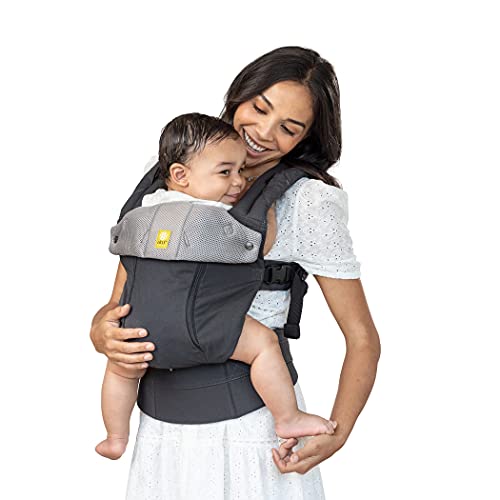
The Complete All Seasons earns its name with a front panel that zips down to reveal a mesh layer underneath: panel up for cool mornings, panel down when the day warms. It is the position leader here, with six carry styles covering front inward in two seat widths, front outward, hip, and back, across the same 7 to 45 pound span as the Ergobaby. A separate lumbar support pad sits behind the waist belt and can be removed if you prefer a simpler belt line. The straps adjust from two directions and can be worn crossed, and the seat switches between a narrow setting for small babies and a wide setting as legs grow. Choose this one if your weather swings between seasons — or within a single day — and you want one carrier that adapts instead of a mesh carrier and a cotton carrier taking turns.
Specs
- Type: Soft structured carrier, zip-down panel over mesh
- Weight range: 7–45 lb
- Carry positions: 6 (front inward narrow, front inward wide, front outward, hip, back, and fetal-style inward for the smallest babies per maker guidance)
- Fabric: Cotton body with mesh layer under the zip panel
- Waistband: Padded, with removable lumbar support pad
- Shoulder straps: Padded, dual-adjustment, crossable
- Model: LB-CSA-COAL (Charcoal & Silver)
- Infant insert: Not needed
- Care: Machine washable
3. Baby Tula Free-to-Grow Coast — Best Adjustable Seat

The Free-to-Grow takes a different approach to growth: instead of a seat that folds, its panel adjusts in steps — three seat width settings and two panel height settings — so the carrier’s shape tracks your baby’s size from 7 to 45 pounds with no insert. The Coast version adds a breathable mesh panel in the center of the cotton body, which keeps the soft feel of cotton against your baby while opening an airflow path down the middle of the back. It keeps the position list simple at two — front inward and back — which suits families who never plan to carry facing outward. The padded straps and waist belt are shaped for longer wears, and the printed and solid fabric range is the widest in this guide if looks matter to you. Pick it if you want the longest single-carrier span with the fewest parts to learn.
Specs
- Type: Soft structured carrier, adjustable panel
- Weight range: 7–45 lb
- Carry positions: 2 (front inward, back)
- Fabric: 100% cotton with breathable mesh panel
- Seat: 3 width settings; panel: 2 height settings
- Waistband: Padded
- Shoulder straps: Padded, adjustable
- Model: TBCP7S3 (Overcast)
- Carrier weight: 2 lb
- Infant insert: Not needed
4. Infantino Flip 4-in-1 Convertible — Best Simple Convertible Seat
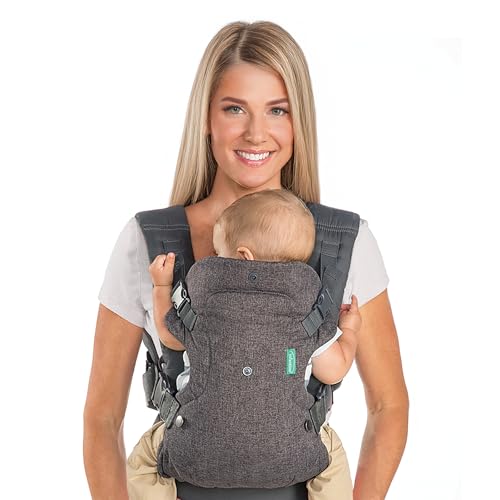
The Flip 4-in-1 is the lightest structured carrier here, and its whole design turns on one idea: a seat that converts. Folded narrow, the seat suits a small baby carried facing in; opened wide, it supports bigger legs facing in; the same carrier then turns front outward and later moves to a back carry — four positions across an 8 to 32 pound range. The trade-off for the compact build is the lower top end, so this is a carrier for the first two years rather than the full toddler span. The fabric is a polyester and cotton blend that washes easily, the straps and waist belt adjust with standard buckles, and the folded size is small enough to live in a diaper bag or car door pocket. It suits grandparents, travel, and second-carrier duty especially well — and plenty of families find it is the only carrier they ever need.
Specs
- Type: Soft structured carrier, convertible seat
- Weight range: 8–32 lb
- Carry positions: 4 (facing-in folded seat, facing-in expanded seat, facing-out, back)
- Fabric: 80% polyester, 20% cotton
- Model: 200-183 (Gray)
- Seat: Converts between narrow and wide settings
- Waist belt: Adjustable
- Item weight: About 1 lb
- Care: Machine washable
5. Moby Wrap Classic — Best Wrap for the Newborn Months
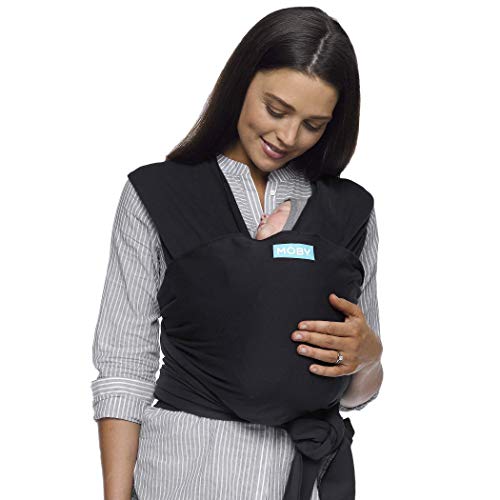
The Moby Classic is the original long cotton wrap: one generous piece of 100% cotton fabric that you wrap and tie around your torso, then settle your baby into against your chest. There are no buckles to adjust and nothing to size — the wrap molds to whoever ties it, which makes it the easiest carrier here to share between caregivers of very different builds, and the close, even hold is why wraps are so often the first carrier a newborn settles in. The maker lists it for 8 to 33 pounds, in front inward and hip carries. The honest trade-offs: tying takes a few practice rounds before it feels quick, the long fabric can trail on the ground while you tie it outdoors, and most families move to a structured carrier as their baby passes the mid-teens in pounds and wants to look around. As a first carrier for the early months at home, it remains the one to beat.
Specs
- Type: Stretchy wrap carrier
- Weight range: 8–33 lb
- Carry positions: Front inward, hip
- Fabric: 100% cotton
- Model: MCL-BLACK (Black)
- Size: One size fits all
- Closure: Tie-on, no buckles
- Care: Machine washable
Comparison Table
| Product | Type | Weight range | Positions | Panel / fabric |
|---|---|---|---|---|
| Ergobaby Omni Breeze | Soft structured | 7–45 lb | 4 | Full SoftFlex mesh |
| LILLEbaby Complete All Seasons | Soft structured | 7–45 lb | 6 | Zip-down panel over mesh |
| Baby Tula Free-to-Grow Coast | Soft structured | 7–45 lb | 2 | Cotton with mesh panel |
| Infantino Flip 4-in-1 | Soft structured | 8–32 lb | 4 | Polyester-cotton blend |
| Moby Wrap Classic | Wrap | 8–33 lb | 2 | 100% cotton |
Frequently Asked Questions
When can my baby face outward?
Only when your baby holds their head and trunk steadily and their chin clears the top of the panel, and only in a carrier whose maker lists an outward position with its own minimum figure. The Ergobaby, LILLEbaby, and Infantino above list outward positions; the Tula and the Moby do not, and they should not be used that way. Keep outward sessions short at first and turn your baby back inward for sleep.
Do any of these carriers need an infant insert?
No. All three structured carriers with a 7-pound minimum — the Ergobaby, the LILLEbaby, and the Tula — carry from that weight with their built-in seat adjustments and no separate insert. The Infantino begins at 8 pounds with its seat folded narrow, and the Moby wrap, at 8 pounds, shapes itself to a newborn by how it is tied.
How long can I carry my baby each day?
There is no single hour figure that fits every baby. Young newborns should come out regularly for feeding, changing, and flat time on a safe surface, and you should always be able to see your baby’s face, with their chin off their chest and their back supported in its natural curve. As babies grow and hold themselves upright, longer stretches become reasonable — your own back, helped by a good waist belt, usually sets the practical limit first.
Can two caregivers share one carrier?
Yes, and the structured picks here are built for it: waist belts and straps readjust in seconds. The LILLEbaby and Ergobaby straps can also be worn crossed, which helps smaller-framed caregivers. The Moby wrap shares the most easily of all, since the tie itself creates the fit each time it is put on.
When is a back carry appropriate?
When your baby sits steadily with support and the maker lists a back position for their size — generally around the six-month stage. The Ergobaby, LILLEbaby, Tula, and Infantino all list back carries; the Moby wrap does not. Practice over a bed or sofa with another adult nearby until getting your baby onto your back feels routine.
Verdict
For one carrier to cover the whole journey, the Ergobaby Omni Breeze and the LILLEbaby Complete All Seasons are the two strongest shapes of the idea: both span 7 to 45 pounds with no insert, both put a real lumbar waist belt under the load, and they split on climate — full mesh for steady heat, or a zip-down panel for weather that changes its mind. The Tula Free-to-Grow is the pick for families who want the longest adjustable span in soft cotton and never plan to face outward. The Infantino Flip 4-in-1 covers the first two years in the lightest, simplest package here, and the Moby Wrap Classic remains the closest, softest hold for the newborn months at home. Match the type to your days first, then check the weight range against how long you plan to carry — the right carrier is the one still comfortable in month ten, not just week one.
More from Amazon
Programs that pair well with the guide above. Offers and eligibility are set by Amazon and may change.
A free business account with business pricing and bulk-buying tools for work, shop or home office.
Create a business accountFree shipping on eligible items, Prime Video and more. Eligible new members can start with a free trial.
Start a Prime free trialAudiobooks and podcasts to listen to on the go. Eligible new members can start with a free trial.
Try Audible freeAd-free music streaming. Eligible new subscribers can start with a free trial.
Try Music Unlimited freeAs an Amazon Associate we earn from qualifying purchases.

Write Your Review
No reviews yet. Be the first to share your experience!