
Key takeaways
- Feed hydroponic vegetables and herbs with balanced liquid nutrients — NPK ratios, pH behavior, and dosing schedules compared for DWC and NFT systems.
Plants grown in water have no soil to fall back on, so everything they eat has to arrive dissolved in the reservoir: nitrogen, phosphorus, and potassium, plus calcium, magnesium, and the full spread of trace elements. A proper hydroponic feed supplies all of it in mineral form that roots can absorb immediately, and it stays stable in a tank for days instead of breaking down or clouding the water. The five products below cover the main ways home growers feed lettuce, basil, peppers, and tomatoes in DWC buckets, NFT channels, and countertop gardens.
Disclosure: As an Amazon Associate, I earn from qualifying purchases. Product details were verified at the time of writing.
The lineup runs from a three-bottle system that lets you steer the mix week by week, through one-bottle formulas for growers who want feeding to take thirty seconds, to a two-part set that splits the difference. Every entry is a complete base feed, not a supplement or booster.
How to Choose Hydroponic Nutrients
One-part, two-part, or three-part. One-part liquids put everything in a single bottle, which makes feeding fast and hard to get wrong, but the blend is fixed. Two-part and three-part systems split the minerals across bottles so calcium and phosphates stay stable in storage, and they let you shift the mix: more nitrogen while plants are leafy, more phosphorus and potassium once fruit sets. More bottles means more control and more measuring.
Read the NPK numbers. The three numbers on a label give the percentage of nitrogen, phosphorus, and potassium by weight. Leafy greens and herbs live their whole lives in the vegetative stage, so a nitrogen-forward mix such as 7-4-10 or 4-3-6 suits them from start to finish. Fruiting vegetables want a two-stage plan: a grow formula first, then a bloom formula with a bigger middle number when flowers appear.
Watch the pH behavior. Roots absorb minerals best when the solution sits between pH 5.5 and 6.5. Some feeds are buffered to land near that window and hold it; others drift and need checking with a meter and adjusting every few days. Chelated minerals stay available across a wider pH band, which forgives small swings. Whatever you choose, plan on owning a pH meter — no feed removes that job entirely.
Match the feed to the system. Recirculating systems such as DWC and NFT keep the same solution in contact with roots for a week or more, so the feed must stay clean and fully soluble; anything with heavy organic matter can foul pumps and feed lines. Small countertop gardens use tiny reservoirs and gentle, pre-balanced formulas dosed by the capful. Dry two-part and three-part blends suit growers with big tanks who mix fresh solution often.
Measure strength, not just volume. A TDS or EC meter tells you how strong the mixed solution actually is. Seedlings and young greens thrive on a mild mix, often half the chart strength, while mature fruiting plants take the full amount. Adding a measured dose and then confirming with a meter beats guessing from the cap alone.
The 5 Best Hydroponic Nutrient Products
1. General Hydroponics Flora Series Trio — Best for Full Control

The Flora Series is the three-bottle system that taught a generation of growers how hydroponic feeding works. FloraMicro lays down the micronutrient and calcium base, FloraGro pushes leafy growth, and FloraBloom takes over when fruiting plants start to flower. Because the three parts are blended fresh at every reservoir change, you can build a mild mix for seedlings, a nitrogen-rich mix for lettuce and basil, and a bloom-heavy mix for tomatoes from the same three bottles. It runs cleanly in DWC, NFT, drip, and ebb-and-flow systems, and the published feed chart gives a clear starting point for every stage.
Specs:
– Components: FloraMicro 5-0-1, FloraGro 2-1-6, FloraBloom 0-5-4
– Form: Liquid, three-part system
– Size: Three 1-quart bottles, bundled with a 1 oz bottle of RapidStart
– Dosing: Blend the three parts per the Flora Series feed chart for each growth stage; new growers often start at half chart strength and step up
– Systems: DWC, NFT, drip, ebb and flow
2. FoxFarm Liquid Nutrient Trio, Hydro Formula — Best Week-by-Week Schedule

FoxFarm built this trio specifically for hydroponic reservoirs, and it comes with the most hand-holding of any set here: a published week-by-week feeding schedule that tells you which bottle to pour and when. Grow Big Hydro carries the vegetative weeks with a nitrogen-forward blend plus earthworm castings and micronutrients. Big Bloom, a gentle organic-based liquid built on bat guano and castings, runs through the whole cycle to support roots and flowering. When plants show their first sign of flowering, usually around week five, Tiger Bloom joins in with the phosphorus push that fruit set needs.
Specs:
– Components: Grow Big Hydro 3-2-6, Big Bloom 0-0.5-0.7, Tiger Bloom 2-8-4
– Form: Liquid, three-part system
– Size: Three 32 fl oz bottles
– Dosing: Follow the FoxFarm hydroponic feeding schedule week by week; Grow Big Hydro during vegetative growth, then Tiger Bloom alongside Big Bloom from the first flowers
– Systems: Recirculating and drain-to-waste hydroponics
3. General Hydroponics FloraNova Grow — Best One-Bottle Vegetative Feed

FloraNova Grow squeezes the strength of a dry formula into a thick, one-part liquid, so a single bottle handles the entire vegetative stage for greens, herbs, and young fruiting plants. The 7-4-10 analysis is squarely aimed at leaf and stem growth, and the formula is pH stabilized to land close to the range roots prefer. It is famously thick, so the bottle needs a hard shake before measuring. Growers who run tomatoes or peppers past the vegetative stage pair it with its Bloom partner; for lettuce, basil, and other greens that never flower, this bottle is the whole program.
Specs:
– NPK: 7-4-10
– Form: Liquid, one-part
– Size: 1 quart
– Dosing: Shake well, then add in teaspoons per gallon following the FloraNova feed chart — lighter mixes for seedlings, stronger mixes for fast vegetative growth
– Systems: Hydroponics, soilless mixes, and containers
4. AeroGarden Liquid Nutrients — Best for Countertop Gardens
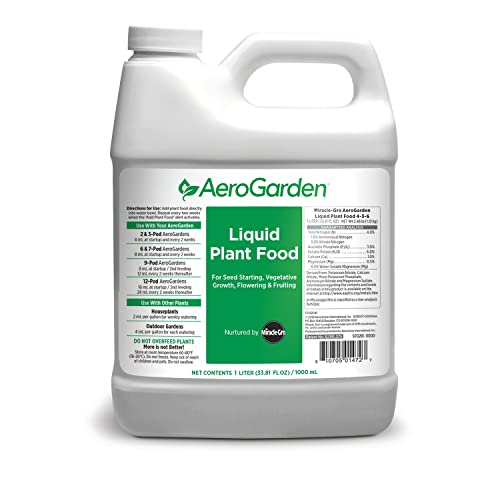
This is the feed AeroGarden ships with its countertop gardens, sold here in the large one-liter bottle that holds roughly a hundred feedings. The 4-3-6 blend is balanced for exactly the crops those gardens grow — lettuce, herbs, and compact vegetables — and it is pH-buffered, so the small reservoir stays in range between feedings without daily attention. Dosing is by capful rather than syringe, which suits a kitchen-counter setup where the whole feeding routine takes a minute every two weeks. It also works in any small hydroponic system where gentle, simple feeding matters more than fine-tuning.
Specs:
– NPK: 4-3-6
– Form: Liquid, one-part, pH-buffered
– Size: 1 liter bottle, about 100 feedings
– Dosing: Add the measured capfuls for your reservoir size when you fill or top up, and repeat every two weeks
– Systems: Countertop gardens and small reservoirs
5. General Hydroponics FloraDuo A — Best Two-Bottle Simplicity

FloraDuo trims the multi-bottle idea down to two parts: this bottle, FloraDuo A, carries the nitrogen and potassium side of the system at 5-0-6, while FloraDuo B, sold on its own, carries the phosphorus side. By changing the blend of the two from week to week, one pair of bottles covers seedlings, leafy growth, and bloom — a middle path between a fixed one-part feed and the full three-part trio above. This listing is the 16 fl oz bottle of Part A, the half you reach for most during the vegetative weeks; add Part B and the pair feeds a small DWC or NFT setup through a full crop cycle.
Specs:
– NPK: 5-0-6 (Part A of a two-part system; Part B sold on its own)
– Form: Liquid, two-part system
– Size: 16 fl oz bottle
– Dosing: Combine A and B in teaspoons per gallon following the FloraDuo feed chart, leaning on A during vegetative growth and shifting the balance toward B for bloom
– Systems: Hydroponics, coco, and soilless mixes
Comparison Table
| Product | NPK | Form | Size | Best Fit |
|---|---|---|---|---|
| Flora Series Trio | 5-0-1 / 2-1-6 / 0-5-4 | Liquid, three-part | 1 qt × 3 + 1 oz RapidStart | DWC and NFT, all stages |
| FoxFarm Trio Hydro | 3-2-6 / 0-0.5-0.7 / 2-8-4 | Liquid, three-part | 32 fl oz × 3 | Scheduled week-by-week feeding |
| FloraNova Grow | 7-4-10 | Liquid, one-part | 1 quart | Vegetative growth, greens |
| AeroGarden Liquid Nutrients | 4-3-6 | Liquid, one-part | 1 liter | Countertop gardens |
| FloraDuo A | 5-0-6 | Liquid, two-part | 16 fl oz | Small systems, simple mixing |
Frequently Asked Questions
Can I use regular soil fertilizer in a hydroponic system?
It is a poor fit. Soil fertilizers often leave out some micronutrients because soil supplies them, and many contain organic matter that clouds the reservoir and feeds slime in pumps and lines. Hydroponic feeds supply the complete mineral set in fully soluble form.
What pH should my nutrient solution be?
Keep it between 5.5 and 6.5 for vegetables, herbs, and greens. Outside that band, minerals such as iron and phosphorus become harder for roots to absorb even when they are present in the tank, so check with a meter after mixing and again every few days in a recirculating system.
How often should I replace the reservoir solution?
A full change every one to two weeks is the usual rhythm for small home systems, with plain water or a mild mix used for top-ups in between. Large shifts in EC or pH, cloudy water, or a sour smell are all signs to change it sooner.
Do lettuce and herbs need a bloom formula?
No. Leafy greens and culinary herbs are harvested before or instead of flowering, so they stay on a nitrogen-forward grow mix for their whole lives. Save the bloom formulas for tomatoes, peppers, cucumbers, and other fruiting crops.
How strong should the solution be for seedlings?
Start mild — half the chart strength is a sensible opening point — and raise it as the plants put on true leaves and roots fill out. An EC or TDS meter confirms the actual strength in the tank, which matters more than the exact number of capfuls.
Verdict
For most home growers running DWC or NFT, the Flora Series Trio remains the safest first buy: it covers every crop and stage, and its feed chart doubles as a short course in how hydroponic nutrition works. If you would rather follow a printed weekly schedule than blend your own, the FoxFarm Hydro Trio makes that trade happily. Greens and herb growers who never leave the vegetative stage can skip multi-bottle systems entirely — FloraNova Grow does the job with one thick, potent bottle — while countertop garden owners should simply keep the AeroGarden liter on the shelf and feed by the capful. FloraDuo A, paired with its B bottle, is the pick for small systems where two bottles feel right and shelf space is tight.
More from Amazon
Programs that pair well with the guide above. Offers and eligibility are set by Amazon and may change.
A free business account with business pricing and bulk-buying tools for work, shop or home office.
Create a business accountFree shipping on eligible items, Prime Video and more. Eligible new members can start with a free trial.
Start a Prime free trialAudiobooks and podcasts to listen to on the go. Eligible new members can start with a free trial.
Try Audible freeAd-free music streaming. Eligible new subscribers can start with a free trial.
Try Music Unlimited freeAs an Amazon Associate we earn from qualifying purchases.









Write Your Review
No reviews yet. Be the first to share your experience!