
Key takeaways
- Acidify soil safely with elemental soil sulfur for gardens and lawns, in pellets and granules that feed sulfur-loving plants like blueberries.
Blueberries that stay yellow-green, hydrangeas that refuse to turn blue, and azaleas that stall in neutral ground all point to the same fix: the soil needs to be more acidic. Elemental sulfur is the standard way to get there. Soil bacteria oxidize the sulfur into sulfuric acid over a period of weeks to months, easing the pH down gradually instead of shocking roots the way fast chemical acidifiers can. The same application also supplies sulfur as a plant nutrient, which supports protein formation and deep green foliage. It suits blueberries, hydrangeas, azaleas, rhododendrons, camellias, gardenias, evergreens, and lawns growing on alkaline or hard-water ground.
Disclosure: As an Amazon Associate, I earn from qualifying purchases. Product details were verified at the time of writing.
The five picks below cover the main buying shapes: two gypsum-blended granules at different bag sizes for beds and lawns, two high-analysis 90 percent products in granule and pellet form, and a prilled organic option with wide coverage. Every pick works through the same microbial process, so the real differences are sulfur percentage, form, bag weight, and how the label splits free sulfur from combined sulfur.
How to Choose Soil Sulfur
Read the sulfur percentage first. High-analysis products carry 90 percent elemental sulfur, so a small bag moves pH a long way. Blended acidifiers sit near 30 percent total sulfur because gypsum makes up much of the bag; the label splits that figure into free sulfur, which acidifies, and combined sulfur from the gypsum, which feeds plants without changing pH. A higher percentage means less material to haul and spread for the same pH shift.
Match the form to the job. Pellets and prills pour cleanly through a broadcast spreader and suit lawns and large beds. Granules scratch easily into the soil around shrubs and in raised beds. Fine powders react fastest because bacteria reach more surface area, but they drift in wind and are messier to handle, so most home products stay granular.
Size the bag to the area. Label directions cluster around 1 to 2 pounds per 100 square feet for beds, or 10 to 15 pounds per 1,000 square feet on lawns, adjusted by how far the pH has to move and how heavy the soil is. Clay soils resist change and need the upper end of the range; sandy soils shift with less. A 4 or 5 lb bag handles a blueberry row or a few shrubs, while a 30 lb bag covers a full lawn correction.
Test before and after. Sulfur works blind without a soil test. Measure the starting pH, apply for the target your plants want — blueberries thrive near 4.5 to 5.5, hydrangeas blue up below about 5.5 — then retest after two to three months before adding more. Warm, moist soil speeds the bacteria up; cold or dry ground slows the change to a crawl, so fall and early spring applications give the process a head start.
The 5 Best Soil Sulfurs
1. Espoma Organic Soil Acidifier, 6 lb — Best for Acid-Loving Shrubs
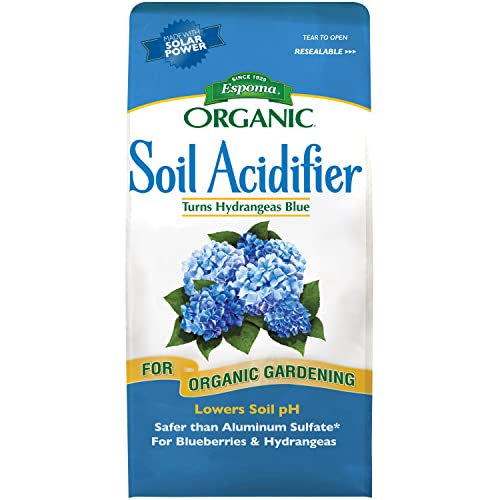
Espoma builds this acidifier from elemental sulfur and gypsum, and the guaranteed analysis tells the story plainly: 30 percent total sulfur, split into 18 percent free sulfur that lowers pH and 12 percent combined sulfur that arrives as gypsum. The granules pour from the bag without dust and scratch into mulch or bare soil around blueberries, hydrangeas, azaleas, rhododendrons, and evergreens. The 6 lb bag is the right scale for a foundation planting or a short row of berry bushes, and the formula is approved for organic gardening programs.
Specs:
– Sulfur: 30% (18% free sulfur, 12% combined sulfur)
– Bag size: 6 lb
– Form: Granules
– Model: GSUL6
– Source: Elemental sulfur and gypsum
– Use on: Blueberries, hydrangeas, azaleas, rhododendrons, evergreens, strawberries, camellias
2. Hi-Yield Soil Sulfur, 4 lb — Best High-Analysis Granules

Hi-Yield keeps this one simple: 90 percent sulfur derived from elemental sulfur, in a granular form made to mix into soil at 1 to 2 pounds per 100 square feet. That high analysis means the compact 4 lb bag carries as much acidifying power as a far larger blended bag, which matters when storage space is tight or the job is a single raised bed of blueberries. The label positions it for lawns, acid-loving ornamentals, and vegetables, and the granules water in without leaving a dusty film on foliage.
Specs:
– Sulfur: 90%
– Bag size: 4 lb
– Form: Granules
– Model: 32185
– Application: 1 to 2 lb per 100 sq ft, mixed into soil
– Source: Elemental sulfur
3. Southern Ag Pelletized Soil Acidifier, 5 lb — Best Pellets for Spreaders

Southern Ag presses its sulfur into hard, uniform pellets with a bentonite binder, so the product flows evenly through a broadcast spreader with almost no dust. The analysis matches the other high-strength picks at 90 percent free sulfur, and the label directs 10 to 15 pounds per 1,000 square feet for lawn correction, or 1 to 1.5 pounds per 100 square feet in beds. Once soil moisture reaches the pellets, the bentonite swells and breaks them apart, exposing fine sulfur particles to the bacteria that do the acidifying work.
Specs:
– Sulfur: 90% free sulfur
– Bag size: 5 lb
– Form: Pellets with bentonite binder
– Application: 10 to 15 lb per 1,000 sq ft on lawns
– Use on: Lawns, shrubs, trees, vegetable and flower beds
– Source: Elemental sulfur
4. True Organic Prilled Sulfur, 5 lb — Best Organic Prills

True Organic forms elemental sulfur into round prills that measure out cleanly and spread by hand or spreader without the dust of powdered sulfur. The 5 lb bag covers up to 1,333 square feet at label strength, the widest stated coverage in this lineup, and the product carries OMRI and CDFA listings for organic gardening. Directions ask for a soil pH test first, then application one to two weeks before planting and feeding, which fits spring bed preparation for vegetables, flowers, and herbs as well as established berry plantings.
Specs:
– Sulfur: Elemental sulfur prills, single ingredient
– Bag size: 5 lb
– Form: Prilled granules
– Coverage: Up to 1,333 sq ft
– Model: R0016
– Listing: OMRI Listed and CDFA registered for organic gardening
5. Espoma Organic Soil Acidifier, 30 lb — Best for Whole Lawns

This is the same sulfur and gypsum formula as the 6 lb bag above, scaled into a 30 lb bag for gardeners correcting pH across a lawn or a long hedge row rather than a single bed. The 30 percent total sulfur analysis — 18 percent free, 12 percent combined — stays gentle enough for repeat seasonal applications around established turf and evergreens, and the granule size runs through standard broadcast spreaders. For a big property where several smaller bags would be opened in one afternoon, the bulk bag is the practical shape of the same trusted formula.
Specs:
– Sulfur: 30% (18% free sulfur, 12% combined sulfur)
– Bag size: 30 lb
– Form: Granules
– Model: UL30
– Source: Elemental sulfur and gypsum
– Use on: Lawns, blueberries, hydrangeas, azaleas, rhododendrons, evergreens
Specs Comparison
| Product | Sulfur | Bag size | Form | Standout figure |
|---|---|---|---|---|
| Espoma Organic Soil Acidifier | 30% (18% free, 12% combined) | 6 lb | Granules | Gypsum-blended, organic program approved |
| Hi-Yield Soil Sulfur | 90% | 4 lb | Granules | 1 to 2 lb per 100 sq ft |
| Southern Ag Pelletized Soil Acidifier | 90% free sulfur | 5 lb | Pellets | 10 to 15 lb per 1,000 sq ft |
| True Organic Prilled Sulfur | Elemental sulfur | 5 lb | Prilled granules | Covers up to 1,333 sq ft |
| Espoma Organic Soil Acidifier, bulk | 30% (18% free, 12% combined) | 30 lb | Granules | Lawn-scale bag of the same formula |
FAQ
How long does soil sulfur take to lower pH?
Expect weeks to months, not days. Soil bacteria must oxidize the elemental sulfur into sulfuric acid, and they work fastest in warm, moist soil. Most gardeners see a measurable shift in four to eight weeks during the growing season, with the full effect arriving over a season.
How much sulfur does my soil need?
It depends on the starting pH, the target pH, and soil texture. Sandy soils change with less sulfur; clay soils need more for the same shift. Follow the label range for your product — roughly 1 to 2 pounds per 100 square feet in beds — and confirm with a soil test before applying a second round.
When is the best time to apply soil sulfur?
Fall and early spring are ideal because the bacteria get a long, moist runway before peak growth. Apply at least a few weeks before planting new beds, and water the granules in so they settle against the soil where microbes can reach them.
Can I use soil sulfur on my lawn?
Yes. Pellet and granule forms spread evenly with a broadcast spreader at label amounts, commonly 10 to 15 pounds per 1,000 square feet for the 90 percent products. Lawns on alkaline soil or irrigated with hard water are the usual candidates.
Will sulfur really turn my hydrangeas blue?
For mophead and lacecap hydrangeas, yes, indirectly. Blue pigment forms when roots can absorb aluminum, and aluminum stays available only in acidic soil. Bringing pH down toward 5.2 to 5.5 with sulfur lets the plant take up aluminum and shift blooms from pink toward blue over a season or two.
Verdict
For most home gardeners, the Espoma 6 lb bag is the balanced starting point: a published 30 percent sulfur analysis, an easy granule, and a size matched to shrub and berry beds. Gardeners who want maximum acidifying strength in a small bag should pick the Hi-Yield granules or the Southern Ag pellets, both at 90 percent sulfur, with the pellets winning for spreader work on lawns. True Organic earns its place for certified organic programs and wide coverage per bag, and the Espoma 30 lb bag serves anyone correcting a whole lawn. Whichever bag you choose, test first, apply at label strength, and give the soil bacteria time to finish the job.
More from Amazon
Programs that pair well with the guide above. Offers and eligibility are set by Amazon and may change.
A free business account with business pricing and bulk-buying tools for work, shop or home office.
Create a business accountFree shipping on eligible items, Prime Video and more. Eligible new members can start with a free trial.
Start a Prime free trialAudiobooks and podcasts to listen to on the go. Eligible new members can start with a free trial.
Try Audible freeAd-free music streaming. Eligible new subscribers can start with a free trial.
Try Music Unlimited freeAs an Amazon Associate we earn from qualifying purchases.


Write Your Review
No reviews yet. Be the first to share your experience!