
Key takeaways
- Compare five hard-shell lens cases built for travel and studio use, and find the right size, foam layout, and seal for your camera lenses today.
A camera body can be replaced, but a favorite lens is harder to replace, and it breaks first when a bag tips off a table or a suitcase gets dropped. A hard lens case solves that with a rigid shell, a watertight seal, and foam you shape around the glass itself. The five cases below are hard-shell designs sized for lenses rather than full kits, so they fit in a backpack, a carry-on, or a car trunk. Each uses customizable foam, a pressure valve, and latches built to stay shut.
As an Amazon Associate, we earn from qualifying purchases.
Quick Answer
Choose the Pelican 1200 Case With Foam for most kits: its interior holds a mirrorless body and a lens or two, its pick-and-pluck foam shapes around odd sizes, and its watertight seal holds up in rain and dust. The Nanuk 910 suits a wider kit with three or more lenses, and the MEIJIA case is the lightest pick for a compact body and a single lens.
How to Choose
Begin with interior dimensions, not exterior ones: measure your longest lens with its hood reversed, add room for a wall of foam on every side, and compare the result with the interior dimensions in the specs below. Foam needs thickness to absorb a knock, so a tight fit on paper means a frustrating fit in practice. Depth matters as much as length: a tall lens standing on end needs a deep case, while a flat case suits lenses laid side by side.
Foam type decides how well the case adapts to your kit. Pick-and-pluck foam comes pre-scored into small cubes that you pull out to form pockets, which suits lenses with unusual shapes or a kit you rearrange often. Leave at least a finger-width of foam between each item and the shell, and keep the solid base layer intact.
The seal is the next thing to check. Cases rated IP67 are dust-tight and protected against brief immersion, which covers rain, splashes, and a case left on wet ground. A pressure equalization valve matters if you fly, because cabin pressure changes can lock a sealed case shut; the valve lets air move while keeping water out. Latches should open with one hand but never pop open on their own. Weight rounds out the decision: a hard case is heavier than a soft pouch, so ounces matter in a backpack all day.
Best Lens Cases
Pelican 1200 Case With Foam — Best Overall Hard Lens Case
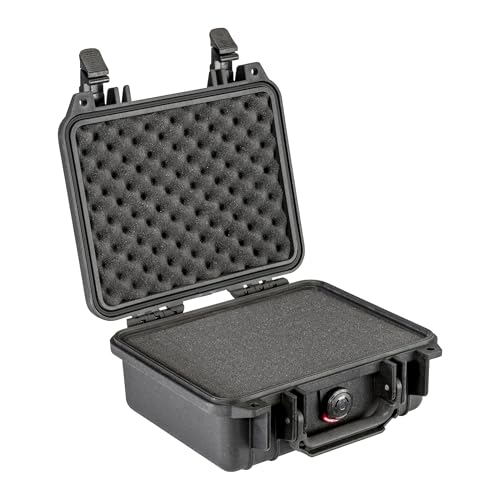
The Pelican 1200 is the benchmark other hard cases get measured against, with a shell that has survived decades of rough handling. Its copolymer-polypropylene body resists crushing and impact, stainless steel hardware holds the latches and hinges, and a tongue-and-groove fit with a polymer O-ring keeps the interior dry in rain. The pressure equalization valve releases built-up air pressure while keeping water out, so the lid opens easily after a flight.
Three foam layers do the fitting work: a convoluted pad in the lid, a pick-and-pluck layer scored into small squares in the base, and a solid layer underneath for support. That layout suits a mirrorless body with a lens attached plus a spare lens, or two or three primes arranged side by side. The interior measures 9.25 by 7.12 by 4.12 inches, compact enough for a backpack yet deep enough for a standard zoom. A folding front handle lies flat, and reinforced padlock protectors guard the lock points.
Specs
- Interior: 9.25 x 7.12 x 4.12 inches
- Exterior: 10.62 x 9.68 x 4.87 inches
- Weight: 2.86 pounds
- Shell: Crushproof copolymer-polypropylene
- Foam: Pick-and-pluck base with convoluted lid layer and solid base layer
- Seal: Tongue-and-groove fit with polymer O-ring, watertight
- Valve: Pressure equalization valve
- Handle: Single folding front handle
- Hardware: Stainless steel with reinforced padlock protectors
Nanuk 905 Waterproof Hard Case — Best Compact Lens Case

The Nanuk 905 is the deep compact case in this set, and depth is what a single large lens needs. Its interior runs 9.4 by 7.4 by 5.5 inches, taller than the other compact cases here, so a lens standing on end or a body with a grip fits without forcing the lid. The exterior stays small at 12.5 by 10.1 by 6.0 inches, so the case still drops into a day pack.
Nanuk builds the 905 from NK-7 resin, made to resist impact, deformation, and fatigue. The case carries an IP67 rating, which means it is dust-tight and protected against brief immersion, and an automatic pressure release valve equalizes the interior when altitude changes. The PowerClaw latching system clamps the lid tight with compressive force, and the latches fold all the way back while you load the case. The cubed foam insert comes with a base pad and lid foam, and the pre-scored cubes pull out at different depths so you can build a pocket that cradles a lens from below.
Specs
- Interior: 9.4 x 7.4 x 5.5 inches
- Exterior: 12.5 x 10.1 x 6.0 inches
- Weight: 3.3 pounds
- Shell: NK-7 resin, impact resistant
- Rating: IP67 waterproof, dustproof, shockproof
- Foam: Cubed foam insert with base pad and lid foam
- Latches: PowerClaw latching system
- Valve: Automatic pressure release valve
- Hardware: Stainless steel, stackable design
Nanuk 910 Waterproof Hard Case — Best Multi-Lens Kit Case

When the kit grows past two lenses, reach for the Nanuk 910. Its interior stretches 13.2 by 9.2 by 4.1 inches, wide enough to lay a body and three lenses side by side in separate foam pockets, with room for batteries and filters. The flat profile keeps the case slim at 4.7 inches deep on the outside, so it slides under an airplane seat or into a rolling bag.
The 910 shares the 905 family traits: an NK-7 resin shell, an IP67 rating against dust and brief immersion, an automatic purge valve, and the PowerClaw latching system that clamps the lid shut with compressive force. The shell is crushproof, impact resistant, and buoyant, and the closure is pad-lockable. The cubed foam insert ships with a base pad and lid foam, and because the case is wide rather than deep, the shallow foam pockets let every lens lift out with one hand. At 3 pounds the 910 is lighter than the smaller 905.
Specs
- Interior: 13.2 x 9.2 x 4.1 inches
- Exterior: 14.3 x 11.1 x 4.7 inches
- Weight: 3 pounds
- Shell: NK-7 resin, crushproof and impact resistant
- Rating: IP67 waterproof, dustproof, shockproof
- Foam: Cubed foam insert with base pad and lid foam
- Latches: PowerClaw latching system
- Valve: Automatic purge valve
- Closure: Pad-lockable, buoyant design
Amazon Basics Hard Camera Case, Small — Best Budget Hard Lens Case

The Amazon Basics small hard case proves a hard shell does not need a premium badge to protect a lens. Its ABS shell stands up to knocks and drops, and the listing describes the case as airtight and watertight, with a pressure equalization valve that keeps the seal working through altitude changes. The product dimensions run 12.1 by 10.6 by 5.9 inches, which puts it between the compact cases and the wide Nanuk 910, and the interior holds a small body with a lens plus accessories in foam pockets you shape yourself.
The foam is the pick-and-pluck style, with a convoluted pad glued to the lid and layers of scored foam below that you pull apart to match your gear. That works well for a first hard case, because you can reshape the layout as your kit changes. Front latches close the lid firmly, and the case is light enough to ride inside a larger bag. For a modest kit, it is the practical entry point to hard-shell protection.
Specs
- Dimensions: 12.1 x 10.6 x 5.9 inches
- Weight: 3.63 pounds
- Material: ABS shell
- Foam: Pick-and-pluck foam with convoluted lid pad
- Valve: Pressure equalization valve
- Seal: Airtight and watertight
- Closure: Front latches
MEIJIA Portable All Weather Waterproof Camera Case — Best Value Waterproof Lens Case

The MEIJIA case is the lightest pick in this set and the most compact weatherproof option for a small kit. Its exterior measures 11.65 by 8.35 by 3.78 inches, and the interior runs 10.54 by 6.04 by 3.16 inches, with a lid depth of 1.08 inches and a bottom depth of 2.08 inches. That shallow profile suits a compact camera or a small mirrorless body with one lens, plus a couple of accessories. At 2.66 pounds, it adds little to a travel bag.
MEIJIA rates the case IP67, which means it is dust-tight and protected against brief immersion, and the shell is injection-molded polypropylene built to take knocks. A pressure valve releases built-up air pressure while keeping water out, and reinforced steel latches clamp the lid tight. The customizable foam inside pulls apart into cubes so you can shape pockets around a lens.
Specs
- Exterior: 11.65 x 8.35 x 3.78 inches
- Interior: 10.54 x 6.04 x 3.16 inches
- Weight: 2.66 pounds
- Shell: Injection-molded polypropylene
- Rating: IP67 waterproof
- Foam: Customizable pick-and-pluck foam
- Valve: Pressure valve for air equalization
- Latches: Reinforced stainless steel latches
Who Should Skip It
A hard lens case is the wrong tool when weight matters more than armor. If you carry a single small prime in a jacket pocket or a padded bag insert, a soft pouch is lighter, quieter, and faster to open, and it protects the glass well enough for everyday use. Hard cases also make little sense for a studio kit that never leaves a shelf.
Size limits matter too. None of these five cases holds a long telephoto lens with its hood attached, and none of them is a rolling case for a full professional kit, so photographers with large glass should look at larger cases instead. If your lenses live mounted on bodies in a bag with dividers, the dividers already do the job.
FAQ
Can I take a hard lens case on a plane as a carry-on?
Yes, all five cases fit in a carry-on bag or under a seat, and their pressure valves keep the lids from locking shut when cabin pressure changes. Keep the latches closed and leave foam around each lens so flight vibration does not shift anything.
How do I shape pick-and-pluck foam around a lens?
Trace the lens outline on the foam, then pull out the scored cubes inside it until the lens sits snug with foam on every side. Leave a wall of foam at least a finger thick between items and around the edges, keep the solid base layer intact, and do not cut deeper than the lens needs, because foam removed from the bottom cannot be put back.
Will a hard case keep my lenses safe in rain?
A case rated IP67 is dust-tight and protected against brief immersion, so rain, splashes, and a wet surface will not reach the glass. Check that the seal is clean before you close the lid, because a grain of sand can break it. Dry the outside of the case before you open it, so water on the shell does not drip onto the lens.
What size case do I need for two lenses and a body?
Measure your longest lens with its hood reversed, then add room for a foam wall on every side and compare the result with the interior dimensions in the specs above. A compact case like the Nanuk 905 or the Pelican 1200 suits a body and one or two lenses, while the wider Nanuk 910 gives a body and three lenses room to sit side by side.
Final Verdict
The Pelican 1200 Case With Foam is the best lens case for most photographers, because it fits a body and a lens or two, its three-layer foam adapts to odd shapes, and its seal has a long record behind it. The Nanuk 910 takes over when the kit widens to three or more lenses, and its flat profile carries a full set. The Amazon Basics small case is the sensible budget pick, the MEIJIA case is the lightest weatherproof choice for travel, and the Nanuk 905 is the deep compact case for a single large lens. Measure your longest lens and choose the smallest case that still leaves a wall of foam on every side.
Product and ASIN Reference
| Product | ASIN |
|---|---|
| Pelican 1200 Case With Foam | B0002INQT2 |
| Nanuk 905 Waterproof Hard Case | B003JH7ZJK |
| Nanuk 910 Waterproof Hard Case | B00BP8URVS |
| Amazon Basics Hard Camera Case, Small | B01L0LVDJO |
| MEIJIA Portable All Weather Waterproof Camera Case | B07RZGFV59 |
FAQ
Can I take a hard lens case on a plane as a carry-on?
How do I shape pick-and-pluck foam around a lens?
Will a hard case keep my lenses safe in rain?
What size case do I need for two lenses and a body?
More from Amazon
Programs that pair well with the guide above. Offers and eligibility are set by Amazon and may change.
A free business account with business pricing and bulk-buying tools for work, shop or home office.
Create a business accountFree shipping on eligible items, Prime Video and more. Eligible new members can start with a free trial.
Start a Prime free trialAudiobooks and podcasts to listen to on the go. Eligible new members can start with a free trial.
Try Audible freeAd-free music streaming. Eligible new subscribers can start with a free trial.
Try Music Unlimited freeAs an Amazon Associate we earn from qualifying purchases.
Write Your Review
No reviews yet. Be the first to share your experience!