
Key takeaways
- Find the best board games for toddlers with chunky piece picks, short round designs, and gentle rules that teach taking turns without tears daily.
A toddler’s first board game has one real job: teach the shape of a game — wait for a turn, do one small thing, cheer for the next player — before attention runs out. The five games in this guide are built for exactly that window. Four of them are cooperative, so the whole table wins or loses together and nobody sits out or melts down over a lost race. The fifth is a gentle head-to-head game with soft setbacks, included as the step up for a child who is ready for turns that do not always go their way. A note on scope: this guide covers board games played around a shared board or play surface with pieces, spinners, and dice. Card games and memory matching games are different formats with their own guides, and the wooden peg puzzles covered elsewhere on this site are solo puzzles, not turn-taking games. None of those appear here.
Disclosure: As an Amazon Associate, I earn from qualifying purchases. Product details were verified at the time of writing.
The safety framing starts with piece size, because it decides which games belong on a toddler table at all. Every moving piece should be too big to pass the choke test — as a plain rule of thumb, a piece that could fit inside a toilet paper tube is too small for a child who still mouths objects, and it stays off the table. The picks below lead with chunky wooden fruit, a plush cube, and oversized tokens for that reason. Dice and spinners get the same treatment: a first game should use one large die or one spinner with a wide arrow, rolled or spun on the table — never tossed across the room — and an adult stays within arm’s reach for the whole session, because even big pieces wander toward mouths. Finally, the honest word on cooperative design: a no-loser game does not remove feelings, it removes the single loser. A team can still lose to the raven or the sunrise, and that shared, softened version of losing is exactly the practice a two- or three-year-old can handle.
Our top picks
How to Choose a First Board Game for a Toddler
Match the game to the youngest player, not the oldest. The age band on the box is the maker’s floor for the rules and the pieces, and a game that works for the youngest child at the table works for everyone. A two-year-old needs one action per turn — roll, pick, place. Counting spaces, reading cards, and holding a hand of cards all belong to the next stage up.
Count the minutes before you count the pieces. A toddler round should finish in about ten minutes. Short games get replayed, and replay is where turn-taking actually gets learned. If a game regularly runs long, shorten it openly — harvest fewer pieces, start the sun token partway along its track — rather than pushing a tired child to the final space.
Prefer one shared goal. Cooperative games let an adult narrate every turn out loud (“your roll, my roll, now we help the chicks”), which is how a toddler absorbs the rhythm of play. They also end the “you won, I lost” problem before it starts. Save head-to-head games for when a child can already lose a footrace across the living room without tears.
Check the moving parts, not just the theme. One chunky die or one spinner is plenty. Games that run on color matching ask nothing of reading or counting, which keeps the youngest players independent. Pieces should be wood, thick board, or plush — materials that survive being dropped, chewed on once, and wiped clean.
Plan the adult role. In every game below, the grown-up is referee, narrator, and keeper of the pieces. Sit where you can reach the board, keep spare pieces in the box lid, and end the session while it is still fun. A game put away happily comes back out tomorrow; a game pushed past the fussy point may not.
1. HABA First Orchard — The First Cooperative Game

This is the game most often handed to a two-year-old first, and the design shows why. Sixteen large wooden fruit pieces — green apples, red apples, yellow pears, and blue plums — hang on four trees, and the whole table works together to pick them before the wooden raven walks down its five-step path to the orchard. A turn is a single roll of the chunky color die: roll a color, pick that fruit; roll the basket, pick any fruit; roll the raven, and he hops one step closer. There is no reading, no counting beyond one piece at a time, and the shared goal means a younger sibling and an older one play the same game at the same table.
The pieces are solid wood and sized for small fists, well above the size that fits a choke tube, and the die is a single oversized cube rather than a pair of small dice. A full round takes about ten minutes. If your child is under two, play it as free fruit-picking with the die and skip the raven entirely — the box works as a sorting toy long before the rules land. Choose this one when you want the truest first game: cooperative, wooden, and finished before anyone gets restless.
Specs
- Maker: HABA, My Very First Games line, model 3177
- ASIN: B004BW8TYC
- Players: 1 to 4
- Maker age band: 2 years and up
- Play time: About 10 minutes
- Format: Cooperative; everyone wins or loses together
- Pieces: 16 wooden fruit pieces, 1 wooden raven, 1 chunky color die, 5 path cards, 4 trees
- Material: Wood
2. ThinkFun Roll and Play — The Game for the Youngest Players
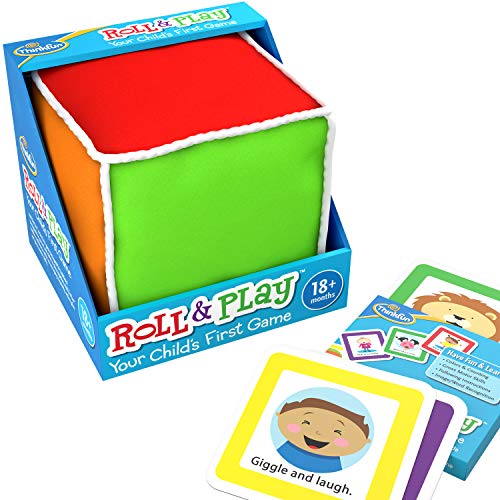
Roll and Play starts earlier than any board game on this list, at 18 months, because it replaces the board with a single soft object: a large plush cube. A child rolls the cube, an adult reads the card that matches the color on top, and the card names a simple action — make a happy face, roar like a lion, find something green, clap your hands. The 48 cards fall into six groups covering emotions, body parts, animals, counting, colors, and actions, so a session quietly practices naming and moving as much as turn-taking.
There is no winner and no way to lose; the game ends when the cards or the giggles run out, which makes it the gentlest possible introduction to “your turn, my turn.” The cube is plush, so a wild roll bumps nothing and hurts no one, and there are no small pieces in the box at all — the cards are the only loose parts, and an adult holds and reads them. Choose this one for a child under two, or for a first game night where the goal is simply taking turns doing something silly together.
Specs
- Maker: ThinkFun
- ASIN: B0070A9OUA
- Players: 2 or more, with an adult reader
- Maker age band: 18 months and up
- Play time: Open-ended; most families play 10 to 15 minutes
- Format: Cooperative activity play; no winner and no loser
- Pieces: 1 large plush cube, 48 action cards in 6 groups
- Material: Plush cube with printed card stock cards
3. Peaceable Kingdom Count Your Chickens — The First Counting Game

Count Your Chickens adds one new skill to the cooperative formula: counting spaces out loud. Players spin the spinner and move Mother Hen along the path, and every space she lands on lets the table place that many baby chicks into the coop. If all 40 chicks are home before Mother Hen reaches the end of the path, everyone wins together. A fox space sends one chick back out of the coop, which is the game’s only setback — shared by the whole table, so it stings far less than losing a personal pile.
The spinner replaces dice, which suits small hands that are still learning to roll rather than throw, and the chick tokens are chunky enough for a three-year-old grip. Counting to four or five per spin is the whole math load, and adults can count along until a child takes over. Choose this one when your toddler already knows the Orchard-style routine and is starting to count real objects — it turns that new skill into the engine of the game.
Specs
- Maker: Peaceable Kingdom, model GM108
- ASIN: B004HVKAAS
- Players: 2 to 4
- Maker age band: 3 years and up
- Play time: About 15 minutes
- Format: Cooperative; the table wins or loses together
- Pieces: Game board with spinner, 1 Mother Hen mover, 40 chick tokens, coop game board insert
- Material: Sturdy printed board and card stock
4. Peaceable Kingdom Snug as a Bug in a Rug — The Matching Game With Levels
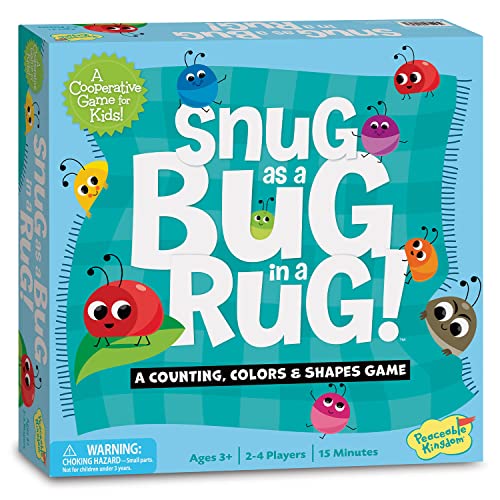
Snug as a Bug in a Rug is a matching game that grows in steps. Players spin the spinner, find a bug that matches, and slip it under the rug; tuck every bug in before three stink bugs land on top of the rug and the whole table wins. Before play starts, a die roll sets what counts as a match — color, number, or shape — and the game offers three levels of play, so the same box starts as simple color matching for a young three-year-old and adds counting and shape matching as the child grows.
That leveling is the honest strength here: most first games are outgrown in a season, while this one has a built-in next step. The bug pieces are large printed tokens, the spinner is a single wide-arrow design, and there are no dice to chase under the sofa during play — the one die is rolled once at setup by an adult. Choose this one when you want one game to carry a child from first matching through early counting, with the whole family on the same side.
Specs
- Maker: Peaceable Kingdom
- ASIN: B006S9L0OC
- Players: 2 to 4
- Maker age band: 3 years and up
- Play time: About 15 minutes
- Format: Cooperative; the table wins or loses together
- Pieces: Rug game board, spinner, 24 bug tokens, 3 stink bug pieces, 1 die used at setup
- Material: Sturdy printed board and card stock
5. Educational Insights The Sneaky, Snacky Squirrel Game — The Gentle Step Up
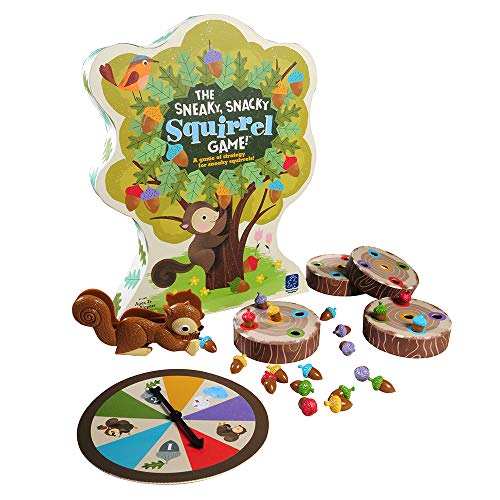
This is the one head-to-head game in the guide, placed here on purpose as the step up. Each player spins the spinner and uses the squirrel squeezer — a chunky pair of tongs shaped like a squirrel — to pick up acorns that match the colors on their own log. The first player to fill their log wins. Two spinner spaces add the mild drama: one lets a player take an acorn from another log, and one sends a player’s acorns back. Those setbacks are the point of including it — they are small, they reverse quickly, and an adult who sees frustration building can simply play those two spaces as “spin again” until a child is ready for them.
The fine motor practice is real: squeezing the tongs, aiming at one acorn, and placing it in a log hole is genuine work for three-year-old hands, and the acorns are chunky, bright, and easy to grip even without the squirrel. Play runs about fifteen minutes with two to four players. Choose this one when cooperative games have gone smoothly for a while and you want a first taste of winning and losing that stays kind.
Specs
- Maker: Educational Insights
- ASIN: B00486ZVC4
- Players: 2 to 4
- Maker age band: 3 years and up
- Play time: About 15 minutes
- Format: Head-to-head with mild setback spaces; adult can soften or skip them
- Pieces: Tree-shaped game board, spinner, 1 squirrel squeezer, 20 colored acorns, 4 player logs
- Material: Molded plastic pieces with printed board
Verdict
Start where your child actually is. Under two, or brand new to taking turns: Roll and Play, with its plush cube and no way to lose. A two-year-old ready for a real board: First Orchard, the cooperative wooden classic that finishes in ten minutes. A three-year-old who is beginning to count: Count Your Chickens. A three-year-old who matches confidently and needs a game that lasts more than one season: Snug as a Bug in a Rug. And when the shared-goal games feel easy and a child can shrug off a small setback, Sneaky, Snacky Squirrel is the gentle first step into playing against each other. Whichever box you open first, keep the sessions short, keep the pieces big, and end while everyone is still smiling — that is how a first game turns into a family habit.
More from Amazon
Programs that pair well with the guide above. Offers and eligibility are set by Amazon and may change.
A free business account with business pricing and bulk-buying tools for work, shop or home office.
Create a business accountFree shipping on eligible items, Prime Video and more. Eligible new members can start with a free trial.
Start a Prime free trialAudiobooks and podcasts to listen to on the go. Eligible new members can start with a free trial.
Try Audible freeAd-free music streaming. Eligible new subscribers can start with a free trial.
Try Music Unlimited freeAs an Amazon Associate we earn from qualifying purchases.







Write Your Review
No reviews yet. Be the first to share your experience!